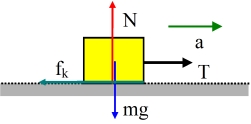
![[Return to Physics Homepage]](./../../physics.gif)
![[Return to Mike Coombes' Homepage]](./../../coombes.gif)
![[Return to List of Handouts]](./../../handouts.gif)
![[Return to Problem Sets]](./../../problems.gif)
![[Return to List of Solutions]](./../../solutions.gif)
| Questions: 1 | 2 | 3 | 4 | 5 | 6 | 7 | 8 | 9 | 10 | 11 | 12 | 13 | 14 | 15 | 16 | 17 | 18 | 19 | 20 | 21 | 22 | 23 | 24 | 25 | 26 | 27 |
(a) F = 15.0 N, θ = 15°, and Δx = 2.50 m,
(b) F = 25.0 N, θ = 75°, and Δx = 12.0 m,
(c) F = 10.0 N, θ = 135°, and Δx = 5.50 m,
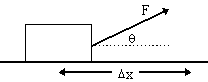
For constant forces, work is defined by W = FΔxcos(θ).
(a) W = 36.2 J
(b) W = 77.6 J
(c) W = -38.9 J
![[Return to Top of Page]](./../../top.gif)
To find the work done by a force, we need to know the magnitude of the force and the angle it makes with the displacement. To find forces, we draw a FBD and use Newton's Second Law.
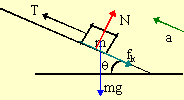
|
|
|
| Fx = max | Fy = may |
| T - fk - mgsin(θ) = ma | N - mgcos(θ) = 0 |
The second equation informs us that N = mgcos(θ). We know fk = μkN = μkmgcos(θ).
| Force | Force (N) | θ | W = FΔxcos(θ)(J) |
| Tension | 150 | 0 | 450 |
| Weight | 147.15 | θ + π/2 | -187 |
| Normal | 133.36 | π/2 | 0 |
| Friction | 26.67 | π | -80 |
To find the work done by a force, we need to know the magnitude of the force and the angle it makes with the displacement. To find forces, we draw a FBD and use Newton's Second Law.
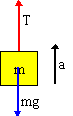
|
|
| Fy = may |
| T - mg = ma |
The work done by the winch is the work done by tension. The work done by gravity is the work done by the object's weight. Since we know m and g, we find T = mg + ma = 1546.5 N. The work done by tension is Wtension = TΔycos(0) = 4.64 × 10³ J. The work done by gravity is Wgravity = mgΔycos(π) = -4.41 × 10³ J.
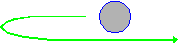
Since we are asked for the work done and have a change in speed, we make use of the generalized Work-Energy Theorem. Since the height of the ball does not change, there is only a change in kinetic energy.
This is the work done on the ball by the bat. It's not a good hit as the ball slowed down. The batter decreased the energy of the ball. Perhaps he was trying for a bunt!
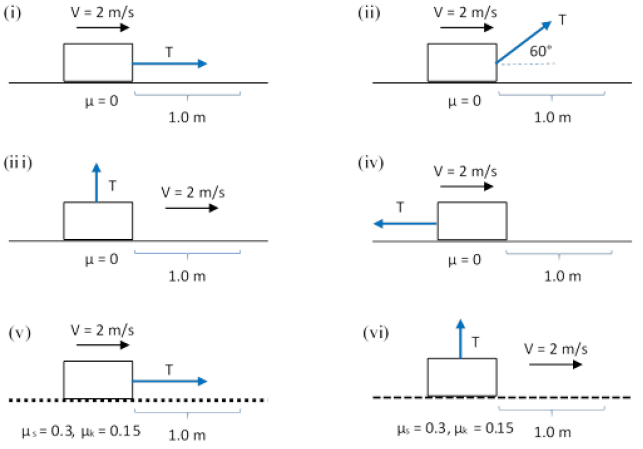
| (i) | ||
| (a) | The block is the system | |
| (b) | The tension in string will do work. The normal and the weight do no work since they are at 90° to the motion. The system is not isolated. | |
| (c) | With one block, there are no internal forces. | |
| (d) | For systems we know the following equation is true, WExternal = ΔEsystem. By inspection, we see WExternal = +TL. There is no change in height only a change in speed, so only the kinetic energy changes. Our equation for this case is
+TL = ½mvf2 − ½mvi2 Rearranging yields vf2 = vi2 + 2TL/m Solving, we find vf = [(2 m/s)2 + 2(1.0 N)(1.0 m)/(0.5 kg)]½ = 2.83 m/s.
|
|
| (ii) | ||
| (a) | The block is the system | |
| (b) | The tension in string will do work. The normal and the weight do no work since they are at 90° to the motion. The system is not isolated. | |
| (c) | With one block, there are no internal forces. | |
| (d) | For systems we know the following equation is true, WExternal = ΔEsystem. By inspection, we see WExternal = +TLcos(60°). There is no change in height only a change in speed, so only the kinetic energy changes. Our equation for this case is
+TLcos(60°) = ½mvf2 − ½mvi2 Rearranging yields vf2 = vi2 + 2TLcos(60°)/m Solving, we find vf = [(2 m/s)2 + 2(1.0 N)(1.0 m)(0.5)/(0.5 kg)]½ = 2.45 m/s.
|
|
| (iii) | ||
| (a) | The block is the system | |
| (b) | The tension, the normal and the weight do no work since they are at 90° to the motion. The system is isolated. | |
| (c) | With one block, there are no internal forces. | |
| (d) | For systems we know the following equation is true, WExternal = ΔEsystem. By inspection, we see WExternal = 0. There is no change in height only a change in speed, so only the kinetic energy changes. But with no external work being done, the block maintins a constant 2.0 m/s speed. | |
| (iv) | ||
| (a) | The block is the system | |
| (b) | The tension in string will do work. The normal and the weight do no work since they are at 90° to the motion. The system is not isolated. | |
| (c) | With one block, there are no internal forces. | |
| (d) | For systems we know the following equation is true, WExternal = ΔEsystem. By inspection, we see WExternal = −TL. There is no change in height only a change in speed, so only the kinetic energy changes. Our equation for this case is
−TL = ½mvf2 − ½mvi2 Rearranging yields vf2 = vi2 − 2TL/m Solving, we find vf = [(2 m/s)2 − 2(1.0 N)(1.0 m)/(0.5 kg)]½ = 0 m/s.
|
|
| (v) | ||
| (a) | The block is the system | |
| (b) | The tension in string and kinetic friction will do work though in opposite directions. The normal and the weight do no work since they are at 90° to the motion. The system is not isolated. | |
| (c) | With one block, there are no internal forces. | |
| (d) | For systems we know the following equation is true, WExternal = ΔEsystem. By inspection, we see WExternal = +TL - fkL. Using Newton's Laws, we note fk = μkN = μk mg. There is no change in height only a change in speed, so only the kinetic energy changes. Our equation for this case is
TL − μkmgL = ½mvf2 − ½mvi2 Rearranging yields vf2 = vi2 + 2[T − μkmg]L/m Solving, we find vf = [(2 m/s)2 + 2[1.0 N − (0.15)(0.5 kg)(9.81 m/s2)](1.0 m)/(0.5 kg)]½ = 2.56 m/s.
|
|
| (vi) | ||
| (a) | The block is the system | |
| (b) | The kinetic friction will do work. The tension, the normal, and the weight do no work since they are at 90° to the motion. The system is not isolated. | |
| (c) | With one block, there are no internal forces. | |
| (d) | For systems we know the following equation is true, WExternal = ΔEsystem. By inspection, we see WExternal = -fkL. Using Newton's Laws, we note fk = μkN = μk mg. There is no change in height only a change in speed, so only the kinetic energy changes. Our equation for this case is
−μkmgL = ½mvf2 − ½mvi2 Eliminating, the common factor m and rearranging yields vf2 = vi2 − 2μkgL Solving, we find vf = [(2 m/s)2 − 2(0.15)(9.81 m/s2)(1.0 m)]½ = 2.63 m/s.
|
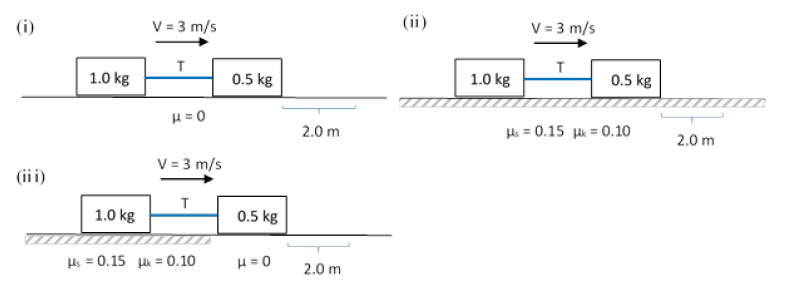
| (i) | ||
| (a) | The two blocks and connecting string are the system | |
| (b) | No one is pulling on the block and there is no friction acting. Since there are no external forces acting other than weight and the normal force, the system is isolated. | |
| (c) | The tension in the connecting string is an internal force. | |
| (d) | For systems we know the following equation is true, WExternal = Efinal − Efinal. However by inspection, we found WExternal = 0 which means Efinal = Efinal. Now the only energy involved is kinetic energy as there is no change in height. This means that the kinetic energy and thus the speed cannot change, vfinal = 3 m/s. | |
| (ii) | ||
| (a) | The two blocks and connecting string are the system | |
| (b) | No one is pulling on the block but there is kinetic friction acting on each block. The system is not isolated. | |
| (c) | The tension in the connecting string is an internal force. | |
| (d) | For systems we know the following equation is true, WExternal = Efinal − Efinal. Here we find WExternal = −f1kL + −f2kL. For each block, using Newton's Laws, we see f1k = μkN1 = μkm1g and f2k = μkN2 = μkm2g. which means Efinal = Efinal. Now the only energy involved is kinetic energy as there is no change in height. This means we can rewrite our starting equation as −μkm1gL + −μkm2gL = [½m1v1f2 + ½m2v2f2] − [½m1v1i2 + ½m2v2i2] Now m1 + m2 is a common factor. Dividing through by the common factor leaves −μkgL = [½v1f2 + ½v2f2] − [½v1i2 + ½v2i2] Also the blocked are connected by a string and must have the same speed. That is v2f = v1f = vf and v2i = v1i = vi. So we have the further simplification −μkgL = vf2 − vi2 Solving, we find vf = [(3 m/s2 − (0.15)(9.81 m/s2)(2.0 m)]½ = 2.46 m/s. | |
| (iii) | ||
| (a) | The two blocks and connecting string are the system. | |
| (b) | There is kinetic friction acting but only on the 1.0-kg block. The system is not isolated. | |
| (c) | The tension in the connecting string is an internal force. | |
| (d) | For systems we know the following equation is true, WExternal = Efinal − Efinal. Here we find WExternal = −f1kL. For the back block, using Newton's Laws, we see f1k = μkN1 = μkm1g. Now the only energy involved is kinetic energy as there is no change in height. This means we can rewrite our starting equation as −μkm1gL = [½m1v1f2 + ½m2v2f2] − [½m1v1i2 + ½m2v2i2] Also the blocks are connected by a string and must have the same speed. That is v2f = v1f = vf and v2i = v1i = vi. So we have the further simplification −μkm1gL = ½(m1 + m2)(vf2 − vi2) Rearranging to isolate vf2 yields vf2 = vi2 − 2μkm1gL /(m1 + m2) Solving, we find vf = [(3 m/s)2 − (2)(0.15)(1.0 kg)(9.81 m/s2)(2.0 m)/(1.5 kg)]½ = 2.25 m/s. |
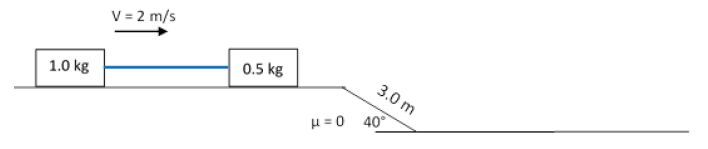
(a) The two blocks and connecting string are the system.
(b) No one is pulling on the block and there is no friction acting. Since there are no external forces acting other than weight and the normal force, the system is isolated.
(c) The tension in the connecting string is an internal force.
(d) For systems we know the following equation is true, WExternal = ΔEsystem. However by inspection, we found WExternal = 0 which means ΔEsystem = 0.
The back 1.0-kg block only has a change in speed and therefore only a change in kinetic energy. The front 0.5-kg block has a change in speed and height, so its KE and PE both change. Our equation for this problem is
{½m1v1f2 - ½m1v1i2} + {½m2v2f2 - ½m2v2i2} + {m2ghfinal − m2ghinitial} = 0
The blocks are connected by a string and must have the same speed. That is v2f = v1f = vf and v2i = v1i = vi. So we have the further simplification
{½[m1 + m2]vf2 - ½[m1 + m2]vi2} + m2g[hfinal − hinitial] = 0
For convenience take hfinal so that hinitial = (3.0 m)sin(50°) = 1.9284 m. We can rearrange the above equation as
vf2 = vi2 + 2m2g[hfinal − hinitial] / [m1 + m2] = 0
Solving, we find vf = [(2 m/s)2 + (2)(0.5 kg)(9.81 m/s2)(1.9284 m)/(1.5 kg)]½ = 4.08 m/s.
(e) Here both block have a change in KE and PE, so the equation is
{½[m1 + m2]vf2 - ½[m1 + m2]vi2} + [m1 + m2]g[hfinal − hinitial] = 0
The term [m1 + m2] is a common factor that cancels out leaving
½vf2 - ½vi2 + g[hfinal − hinitial] = 0
We rearrange to get
vf2 = vi2 + 2g[hfinal − hinitial] = 0
Solving, we find vf = [(2 m/s)2 + (2)(9.81 m/s2)(1.9284 m)]½ = 6.46 m/s.
Since we are asked for the work done and have a change in speed, we make use of the generalized Work-Energy Theorem. Since the height of the car does not change, there is only a change in kinetic energy. First converting the initial velocity into SI
Therefore,
Now the force doing this work, fbrake, is related to the work by Wbrake = fbrakexcos(θ). Since the force is slowing the car down, θ = 180°, cos(180°) = -1, and
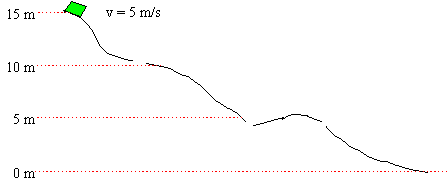
Since the problem involves a change in height and speed, we make use of the generalized Work-Energy Theorem,
Since there is no mention of friction, WNC = 0. Our equation therefore simplifies to
or more simply
We can divide through by m, and since we know hf, hi, and vi, we can rearrange the above to find vf
For the given values, we find
| hf (m) | vi (m/s) | |
| 1 | 15 | 5 |
| 2 | 10 | 11.1 |
| 3 | 5 | 14.9 |
| 4 | 0 | 17.9 |
Since the problem involves a change in height and speed, we make use of the generalized Work-Energy Theorem,
Since we are told that there is no air resistance, WNC = 0. Our equation therefore simplifies to
or more simply
We can divide through by mg, and since we know hi, vi, and vf, we can rearrange the above to find hf
The rock reaches 4.67 m up into the air.
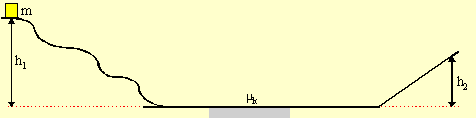
Since the problem involves a change of height and speed, we make use of the Generalized Work-Energy Theorem. Since the block's initial and final speeds are zero, we have
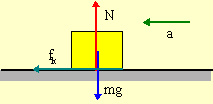
The nonconservative force in this problem is friction. To find the work done by friction, we need to know the friction. To find friction, a force, we draw a FBD at the rough surface and use Newton's Second Law.
|
|
|
| Fx = max | Fy = may |
| - fk = -ma | N - mg = 0 |
The second equation gives N = mg and we know fk = μkN, so fk = μkmg. Therefore, the work done by friction is Wfriction = -fkΔx = -μkmgΔx. Putting this into equation (1) yields
Solving for h2, we find
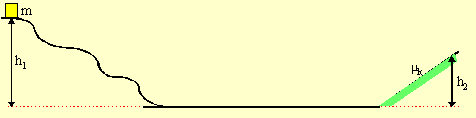
Since the problem involves a change of height and speed, we make use of the Generalized Work-Energy Theorem. Since the block's initial and final speeds are zero, we have
The nonconservative force in this problem is friction. To find the work done by friction, we need to know the friction. To find friction, a force, we draw a FBD at the rough surface and use Newton's Second Law.
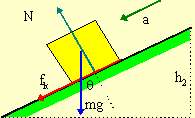
|
|
|
| Fx = max | Fy = may |
| -fk - mgsin(θ) = -ma | N - mgcos(θ) = 0 |
The second equation gives N = mgcos(θ) and we know fk = μkN, so fk = μkmgcos(θ). Therefore, the work done by friction is Wfriction = -fkΔx = -μkmgcos(θ)Δx. Putting this into equation (1) yields
A little trigonometry shows that Δx is related to h2 by Δx = h2 / sin(θ). Putting this into the above equation yields
Solving for h2, we find
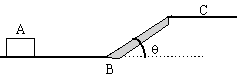
The problem involves a change in height and speed, so we apply the generalized Work-Energy Theorem.
Here the nonconservative force is friction, so WNC = Wf. To find friction, a force, we draw a FBD and use Newton's Second Law.
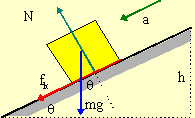
|
|
|
| Fx = max | Fy = may |
| -fk - mgsin(θ) = -ma | N - mgcos(θ) = 0 |
The second equation gives N = mgcos(θ) and we know fk = μkN, so fk = μkmgcos(θ). Therefore, the work done by friction is
Note from the diagram, that the height h is related to the length of the incline by h = Δxsin(θ). Putting both results into equation (1) yields
Solving for vC yields
Two blocks are connected by a string hung over a frictionless massless pulley. Block A has mass MA and block B has mass MB. Initially the blocks are held at rest before being allowed to move. How fast will block B be moving when it has risen a distance h?
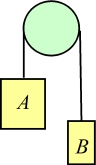
Again we have a change in height and speed, so we apply the Work-Energy Theorem
WNC = (Kf - Ki) + (Uf - Ui).
We are told that there is no friction so WNC = 0.
The difference between this and earlier problems is that we are dealing with two objects. For each object there is an external force the tension T in the string. However the work done by the tension in each case is equal, since the distance each block moves is the same, but opposite. (Check this!) So for the system, energy is transferred from one block to the other. We solve the problem by applying the right hand side of the Work-Energy Theorem to each block in turn.
0 = [½MBvf2 + MBgh] + [½MAvf2 − MAgh]
Note that the two blocks are connected by a string so the final speed of each is the same. Also if block B moves up h block A drops h. Thus our equation becomes
0 = ½ (MA + MB)vf2 − (MA − MB)gh.
When we solve this, we find
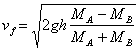
![[Return to Top of Page]](../../top.gif)
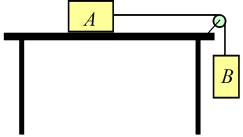
Two blocks are connected by a string hung over a frictionless
massless pulley. Block A has mass MA
and is on a table top. Block B has mass MB
and is hanging in the air. Initially the blocks are held at rest. The
coefficients of friction between block A and the
tabletop are μS and μK.
(a) B is allowed to fall. How fast will block B
be moving when it has fallen distance h?
(b) Block A is pulled to the left by a horizontal
force F for a distance L. How fast
will block B be moving?
(a) Again we have a change in height and speed, so we apply the Work-Energy Theorem
WNC = (Kf - Ki) + (Uf - Ui).
We are told that there is friction so we need to determine WNC = Wfriction. Friction does negative work, takes energy out of the system, since it is opposite to the movement of block A. To find friction, a force, we draw a FBD of block A and use Newton's Second Law.
|
|
i |
j |
||
|
ΣFx = max |
ΣFy = may |
|||
|
T - fk = MAa |
N - MAg = 0 |
The second equation gives N = MAg and we know fk = μkN, so fk = μkMAg. Therefore, the work done by friction is Wfriction = -fkΔx = -μkMAgh since block A will move as far as block B will drop.
For the pair of blocks, the tension T in the string, is internal and does not net work. So for the system, energy is transferred from one block to the other. We solve the problem by applying the right hand side of the Work-Energy Theorem to each block in turn.
-μkMAgh = ½MAvf2 + [½MBvf2 − MAgh]
Note that the two blocks are connected by a string so the final speed of each is the same. Thus our equation becomes
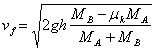
MBgh − μkMAgh = ½(MA + MB)vf2.
When we solve this, we find
(b) Again we have a change in height and speed, so we apply the Work-Energy Theorem
WNC = (Kf - Ki) + (Uf - Ui).
We are told that there is friction, and the work done by friction is still Wfriction = -fkΔx = -μkMAgL since block A moves L not h. Because of the string block B rises L and both blocks will have the same speed. However there is an extra external force F which in the same direction as the motion of block A. It does positive work adding to the energy of the system.
We solve the problem by applying the right hand side of the Work-Energy Theorem to each block in turn.
FL − μkMAgh = ½MAvf2 + [½MBvf2 + MAgL]
Thus our equation becomes
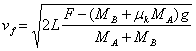
FL − MBgh − μkMAgh = ½(MA + MB)vf2 .
When we solve this, we find
Two blocks are connected by a sting slung over a pulley as shown in the diagram below. The hanging block is allowed to drop. How fast will it be moving when it hits the ground? The block on the incline has mass MA = 2.50 kg. The hanging block has mass MB = 1.50 kg. The incline makes and angle θ = 30° with horizontal. Ignore friction.
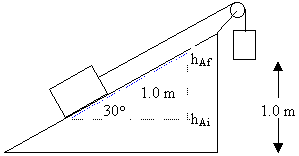
Again we have a change in height and speed, so we apply the Work-Energy Theorem
We are told to ignore friction so WNC = 0.
The difference between this and earlier problems is that we are dealing with two objects. For each object there is an external force the tension T in the string. However the work done by the tension in each case is equal, since the distance each block moves is the same, but opposite. (Check this!) So for the system, energy is transferred from one block to the other. We solve the problem by applying the right hand side of the Work-Energy Theorem to each block in turn.
| 0 = | (½MBVBf2 - 0) + (MBg(0) - MBg(1.0m)) |
| + (½MAVAf2 - 0) + (MAg(hAf - hAi)) |
Now the two blocks are connected by a string so the final speed of each is the same, VBf = VAf = Vf. Next the block moves 1.0 m up the 30° degree incline, so hAf - hAi = (1.0 m)sin(30°). Thus our equation becomes
When we solve this we find
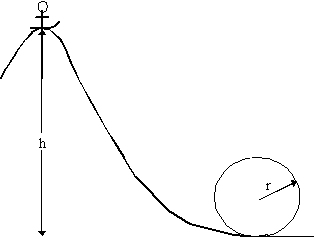
The problem involves a change of height and speed, so that suggests that we use the generalized Work-Energy Equation. However, the skier also travels in a circle, which suggests a centripetal acceleration problem. Centripetal acceleration problems are solved by drawing a free-body diagram (FBD) and applying Newton's Second Law. Let's do this first.
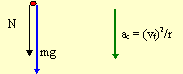
At the top of the inside of the loop, the centripetal acceleration acts straight down as does the normal force and the weight.
|
|
| Fy = may |
| -N - mg = -m(vf)2/r |
The skier will lose contact with the inside of the loop when N goes to zero. This fact and our equation, let's us find a minimum value of vf,
Now we consider the work energy portion of the problem.
The Work-Energy formula may be rewritten as
We know vi = 0, we see from the diagram that hf = 2r, and vf = [gr]½ from our earlier work, so we rearrange the above equation to find hi
If the trip is frictionless, the hill needs to be at least 12.5-m tall if the skier is to make it around the loop safely.
Since there are non-conservative forces, the generalized Work-Energy equation for this case is
We are told WNC = -3000 J, so we rearrange the equation to find that hi is,
Using the given data,
With this much friction, the hill needs to be at least 17.2-m tall if the skier is to make it around the loop safely.
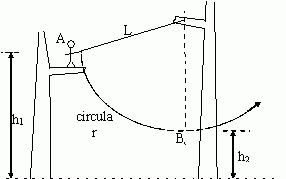
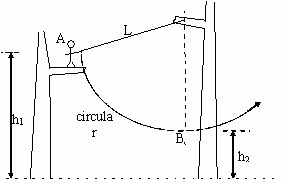
The problem involves a change in height and speed, so we apply the generalized Work-Energy Theorem.
(b) To find the speed at point B, we need to know h, the distance Tarzan dropped. Examining the question, we see that h = h1 - h2 = 22.0 m - 13.0 m = 9.0 m. Rearranging our equation, we find
(c) Tension is a force. To find a force we need to draw a FBD and apply Newton's Second Law. Since Tarzan is swinging in a circle, we are dealing with centripetal acceleration.
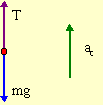
 j j |
| Fy = may |
| T - mg = mv2/L |
Solving for T,
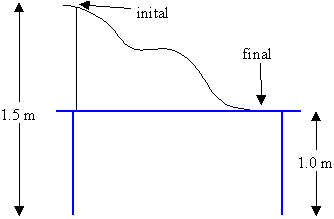
The first part of the problem involves a change in height and speed, so we can use the Work-Energy Theorem there. When the block leaves the surface it becomes a projectile.
(a) Applying the Work-Energy Theorem and assuming that the initial velocity of the block is zero.
The mass m cancels out and we find
Now this velocity is the initial velocity for the projectile.
| i | j |
| v0x = 3.3121 m/s | v0y = 0 m/s (horizontal flight) |
| ax = 0 m/s2 | ay = -9.81 m/s2 |
| Δx = ? | Δy = -1.0 m |
| ----- t (common) ----- | |
From the j information we can find the time that the block is in the air using Δy = v0yt + ½ayt2. This becomes -1.0 m = ½(-9.81 m/s2)t2 or t = ±0.4515 s. We need the positive, forward in time, solution. We then find Δx using
The block lands 1.50 m from the edge of the table.
(b) If the block only lands 1.20 m away, then is velocity must have been v0x = (1.20 m)/(0.4515 s) = 2.6578 m/s .
This is also the velocity at the bottom of the slide. To find WNC we again use the Work-Energy Theorem.
So the work done by non-conservative forces is
In the diagram below, the spring has a force constant of 5000 N/m, the block has a mass of 6.20 kg, and the height h of the hill is 5.25 m. Determine the compression of the spring such that the block just makes it to the top of the hill. Assume that there are no non-conservative forces involved.
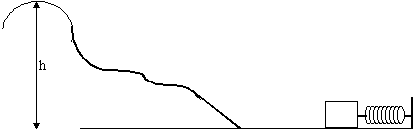
Since the problem involves a change is height and has a spring, we make use of the Generalized Work-Energy Theorem. Since the initial and final speeds are zero,
There are no external forces so Wext = 0.
Getting x by itself yields
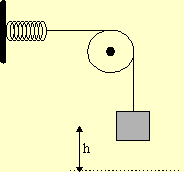
(a) The problem involves a change in height and speed and has a spring, so we would apply the generalized Work-Energy Theorem even if not directed to do,
where K is the sum of all the linear kinetic
energies of each object, and U is the sum of the spring and
gravitational potential energies. Since there is no kinetic friction
acting on the system, Wext = 0.
Examining the problem object by object we see that
the spring
stretches, so there is an increase in spring potential energy. The
pulley is massless and can be ignored as it can have no kinetic energy if it has
no mass. The block drops, so there is a decrease in its
gravitational potential energy. As well, as the block drop, it
increases its kinetic energy. Equation (1) for this problem is thus
Since the spring is connected to the block, the
spring stretches
as much as the block drops, so x = h. Substituting this relation
back into our equation yields,
Collecting the terms with v, and solving for v yields
(b) Recall from our discussions on kinematics that an object turns around when its velocity is zero. Setting equation (2) to zero
we see that the numerator is zero when
Solving this for h reveals that the object turns
around when h = 2mg/k or when h = 0 which means that the block oscillates between these two heights.
At point A in the
figure shown below, a spring (spring
constant k
= 1000 N/m) is compressed 50.0 cm by a 2.00 kg block. When released the
block travels over the frictionless track until it is launched into the
air at point B. It lands at point C. The inclined part of the track
makes an angle of θ = 55.0°
with the horizontal and point B is a height h = 4.50 m above the
ground.
How far horizontally is point C from point B?
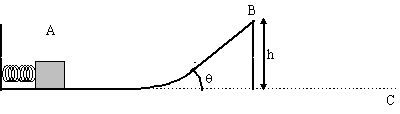
The problem involves a change in height and speed and has a spring, so we apply the generalized Work-Energy Theorem., Wext = ΔE.
There is no friction or air resistance, so Wext
= 0. The spring is compressed initially, so it loses spring potential
energy. The block increases kinetic energy and gains gravitational
potential energy. Our equation is thus
We can use this to find the speed of the block at launch
Now the block is a projectile. To solve a projectile
problem we
break the motion into its x and y components and apply our kinematics
equations.
|
|
|
| v0x = vcos(55°) = 3.47523 m/s | v0y = vsin(55°) = 4.96314 m/s |
| Δx = ? | Δy = −4.50 m |
| ax = 0 | ay = −9.81 m/s2 |
| t = ? | t = ? |
We have enough information in the y column to find t using Δy = v0yt + ½at2 ,
Using the quadratic equation, the solutions are t =
−0.5773 s
and t = 1.5892 s. We want the positive, or forward in time, solution.
Hence the horizontal distance traveled by the block is
Point C is therefore 5.52 m from B.
A block of mass M on a flat table is connected by a string of negligible mass to a vertical spring with spring constant K which is fixed to the floor. The string goes over a massless pulley. As shown in the diagram below, the spring is initially in its equilibrium position and the system is not moving. A person pulls the block with force F through a distance L. Determine the speed v of the block after it has moved distance L.The tabletop is frictionless.
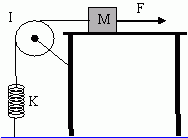
The problem involves changes in height, speed, and rotation, so we would apply the generalized Work-Energy Theorem even if not directed to do so,
where E is the sum of all the mechanical energies of each object. If the system consists of the spring, string, pulley, block and the earth, then F is an external force acting on the system and Wext = FL.
Next consider the change in energy of each object. The spring stretches as so increases its potential energy. The pulley can be ignored as it is massless. The block moves from rest so it increases its linear kinetic energy. Thus equation (1) becomes
Since the block and spring are connected by the same string, the spring has stretched x = L. Substituting this back yields
Taking the term with v to one side yields
½Mv2 = FL − ½KL2 .
Solving for v yields,
v = [(2FL − KL2) / M]½ .
We are given the power of the engine
Power is defined as work done per given time, P = W/t. The time t is what we are asked for. Work done is force times distance, here W = 2000 N × 35 m = 70,000 J.
So the time needed is
Note however that rated power is seldom the same as the actual power that does useful work.
We are given the power (50,000,000 W) and power is defined as work done per given time, P = W/t. The time t we are given is one day. We are told that the work done equals the loss in potential energy of the water falling from the top of the dam, so W = mgh where h = 22.0 m. Thus the amount of water, i.e. its mass, is found from P = mgh / t or
The power required to move the block at constant speed is P = Fv. We are given v, the speed of the block. To get F, a force, we draw a FBD and apply Newton's Second Law,
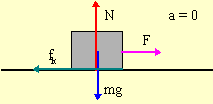
|
|
|
| Fx = max | Fy = may |
| F - fk = 0 | N - mg = 0 |
The second equation gives N = mg and we know fk = μkN, so fk = μkmg. Therefore, the applied force is F = μkmg. Thus the power is
First we convert the velocity to SI units,
We know P = Fv, so
By Newton's Third Law, the water is exerting 840 N in the reverse direction. It is also removing 7000 W of power which is going into increasing the kinetic energy of the water.
Questions? mike.coombes@kpu.ca
![[Return to Kwantlen Homepage]](http://www.kpu.ca/images/return_button.gif)