![[Return to Physics Homepage]](./../../physics.gif)
![[Return to Mike Coombes' Homepage]](./../../coombes.gif)
![[Return to List of Handouts]](./../../handouts.gif)
![[Return to Problem Sets]](./../../problems.gif)
![[Return to List of Solutions]](./../../solutions.gif)
|
|
|
|
|
| Questions: | 1 | 2 | 3 | 4 | 5 | 6 | 7 | 8 | 9 | 10 | 11 | 12 | 13 | 14 | 15 | 16 | 17 | 18 | 19 | 20 | 21 | 22 | 23 | 24 | 25 | 26 | 27 | 28 |
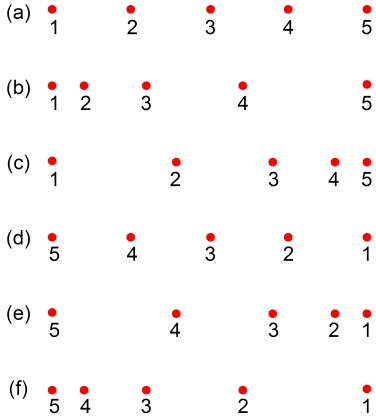
Neatly sketch the following dot-motion diagrams:
(a) A particle moving right at constant speed.
(b) A particle moving right and speeding up.
(c) A particle moving right and slowing down.
(d) A particle moving left at constant speed.
(e) A particle moving left and speeding up.
(f) A particle moving left and slowing down.
![[Return to Top of Page]](../../top.gif)
Use the definition of acceleration  to draw
the direction of the acceleration at a midpoint of the sketch from
Question 1.
to draw
the direction of the acceleration at a midpoint of the sketch from
Question 1.
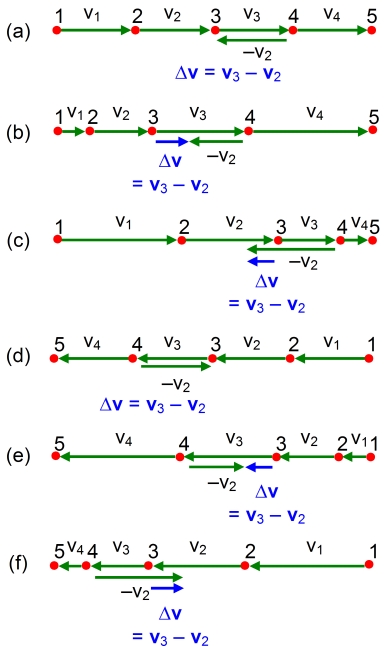
Note that the direction of the acceleration, as indicated by Δv, and the direction of motion at a point are both needed to determine if an object is speeding up or slowing down. If a and v are in the same direction, the object is speeding up. If a and v are in the opposite direction, the object is slowing down.
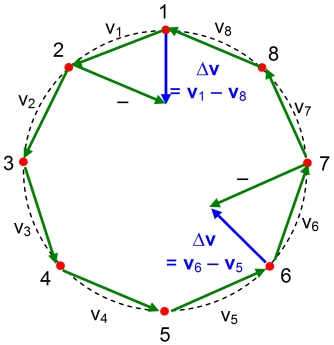
Note that the change in velocity, and thus the acceleration, is the same magnitude at points 1 and 6 and at all other points around the circle. Moreover, the direction of the acceleration is towards the centre. This acceleration is usually called the centripetal acceleration.
Describe in simple terms the motion of the particles in the dot-motion diagrams below.
(a)

The particle is moving to the left. For points 1 to 5 the speed is constant as the gaps between the points are constant. For points 5 to 8, the gaps are increasing so the particle is speeding up. Finally, between points 8 and 11 the gaps are decreasing and thus the particle is slowing down.
The particle is moving to the right. For points 1 to 4 the speed is increasing as the gaps between the points are increasing. For points 4 to 7, the gaps are constant so the particle is travelling at constant speed. Finally, between points 7 and 11 the gaps are constant again indicating constant albeit slower speed. Note the abrupt change at point 7.
The biggest change in velocity in (a) is at point 8. The particle is moving left but slowing down, so the acceleration must be opposite the velocity or to the right. The biggest change in velocity in (b) is at point 7. The particle is moving right but slows down between points 6 and 8, so the acceleration must be opposite the velocity or to the left.
(a) Sketch x-t graphs for Question 1.
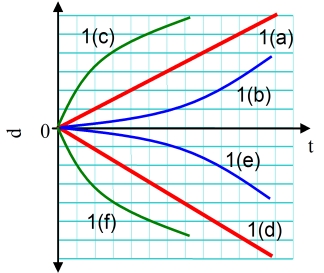
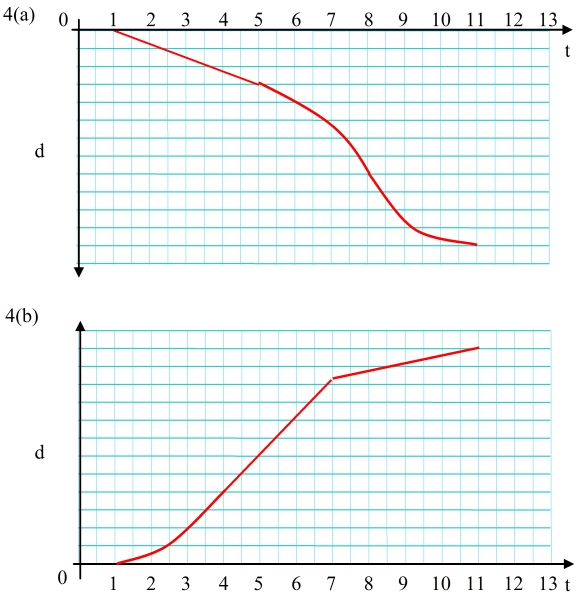
(b) Sketch x-t graphs for Question 4(a) and 4(b).
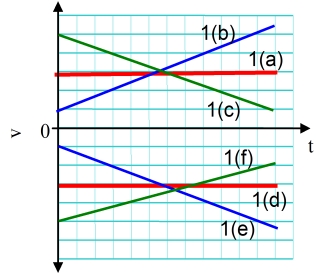
(a) Sketch v-t graphs for Question 1 </li>
. 
(b) Sketch v-t graphs for Question 4(a) and 4(b).
</li> </li>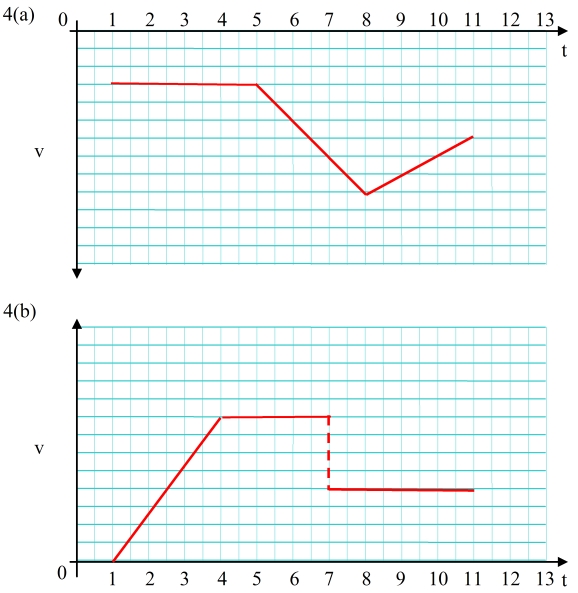
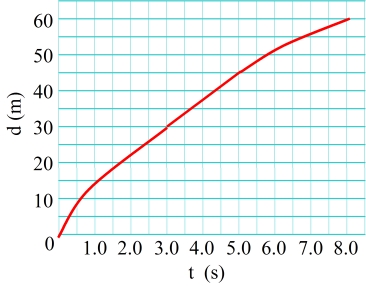
Draw a dot-motion diagram and an x-t graph from the following v-t graph.
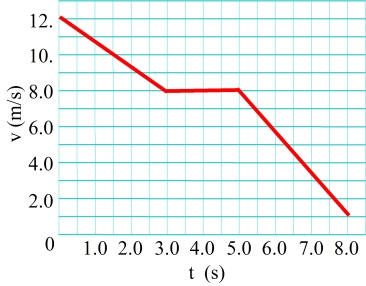
First note that all the velocities are positive so the object is always moving to the right. Next, note that there are three separate sections to the motion. First the object is moving right but slowing. Second it travels at constant speed. Third is slows again but faster than in the first segment. A possible dot-motion diagram would look like:

To accurately sketch the x-t graph note that the object travels 30 m in the first section, 16 m in the second, and 14.25 m in the third. We can either look at the area under the curve or use average velocity for each section.
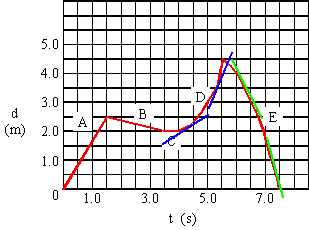
We calculate average velocity from vaverage
= (xf
– x0)/(tf
– t0), and read the
values of x and t off the graph.
Determining the sign of the acceleration is more
complicated.
Since the acceleration is defined a = Δv/t,
the sign of a is the same as the sign of v.
For segment A,
B, and C velocity is constant so v = 0 and thus a
=
0. For segment D, the slope of the tangent lines is
increasing,
thus v > 0 and a > 0.
For segment E, the
slope of the tangent lines is getting more negative, thus v
< 0 and a < 0.
|
|
|
|
|
|
|
= (2.5 – 0)/(1.5 – 0s) = 1.67 |
0 | Straight line d vs t, means constant velocity or zero acceleration |
|
|
= (2.0 –
2.5)/(3.5 – 1.5) = –0.25 |
0 | Straight line d vs t, means constant velocity or zero acceleration |
|
|
= (2.0 – 2.0)/(4.0 – 3.5) = 0 |
0 | Straight line d vs t, means constant velocity or zero acceleration |
|
|
= (4.5 – 2.0)/(5.5 – 4.0) = 1.67 |
> 0 | Curved upward d vs t line means increasing v |
|
|
= (0.0 – 4.5)/(7.5 – 5.5) = –2.25 |
< 0 | Curved downward d vs t line means v is becoming more negative. |
The displacement over the entire time interval is zero as the object returns to d = 0, so the average velocity is zero as well.
![[Return to Top of Page]](./../../top.gif)
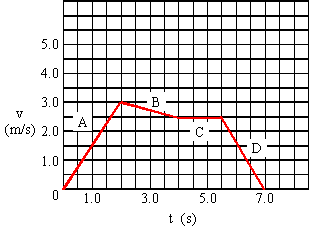
We may find the average velocity from vaverage = ½(vf + v0). The acceleration is defined by a = (vf – v0)/(tf – t0). We may find the displacement from the area under each segment or use Δx = vaveraget.
| Segment | vaverage (m/s) | a (m/s2) | Δx (m) |
| A | = (3 + 0 )/2 = 1.5 |
= (3 – 0) / (2 – 0) = 1.5 |
= 1.5 / 2 = 3.0 |
| B | = (2.5 + 3 )/2 = 2.75 |
= (2.5 – 3) / (4 – 2) = –0.25 |
= 2.75 × 2 = 5.5 |
| C | = 2.5 | = 0 | = 2.5 × 1.5 = 3.75 |
| D | = (0 + 2.5 )/2 = 1.25 |
= (0–2.5) / (7–5.5) = –1.67 |
= 1.25 × 1.5 = 1.88 |
Since the velocity is not a straight line for the entire time interval, we cannot use vaverage = ½(vf + v0) to find the average velocity. Instead we must use the definition vaverage = Δx/Δt. For the entire time interval, Δxtotal = ΔxA + ΔxB + ΔxC + ΔxD = 3.0 m + 5.5 + 3.75 m + 1.88 m = 14.13 m. Thus vaverage = (14.13 m)/(7.0 s) = 2.02 m/s.
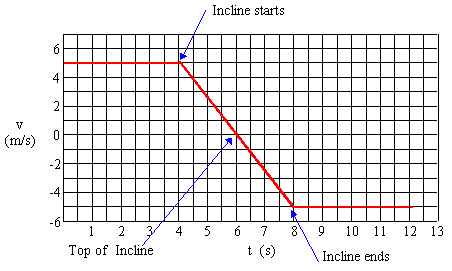
(a) At what time does the ball encounter the incline?
When the ball encounters the incline, it slows down. Examining the graph this occurs at t = 4.0 s.
(b) When is it at the top of the incline? How do you know
this?
At the top of the incline, the ball is turning around. A
turning
object has a velocity v = 0. Examining the graph, this occurs
at t = 6 s.
(c) When does it leave the incline?
When the ball leaves the incline, it will have a constant
velocity
again. This starts at t = 8 s on the graph.
(d) What was the acceleration of the ball up the incline?
Acceleration is given by a = (vf
– v0)/(tf
– t0) = (0 – 5)/(6
– 4) = –2.5 m/s2.
(e) What was the acceleration of the ball down the incline?
Acceleration is given by a = (vf
– v0)/(tf
– t0) = (–5 –
0)/(8 – 6) = –2.5 m/s2. Since
we a dealing with a straight line segment, the value is the same
as part (f)
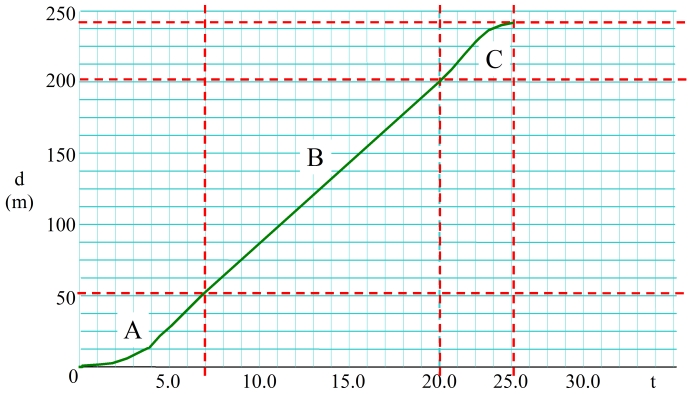
An accurate sketch requires that we know some distances
and
times.
| A | v0 = 0 m/s, a = 1.60 m/s2, t = 8.0 s |
| vf = v0 + at = 12.8 m/s | |
| vave = ½(v0 + vf) = 6.4 m/s | |
| ΔxA = vavet = 51.2 m | |
| B | v0 = 12.8 m/s, a = 0, t = 12.0 s |
| vf = v0 = 12.8 m/s | |
| vave = ½(v0 + vf) = 12.8 m/s | |
| ΔxA = vavet = 153.6 m | |
| C | v0 = 12.8 m/s, vf = 0, a = –2.50 m/s2 |
| t = (vf – v0)/a = 5.12 s | |
| vave = ½(v0 + vf) = 6.4 m/s | |
| xA = vavet = 32.8 m |
In segment A, there is an acceleration so the line curves upwards as velocity increases. In B the velocity is constant, so the line is straight. In C the train decelerates, so the line flattens out as velocity decreases.
Average speed is defined as distance travelled divided
by travel time,
Average speed is defined as distance travelled divided
by travel time,
Converting to km/h,
Average speed is defined by distance traveled over
time, s = d/t. For this problem
Average velocity is defined by displacement over
time, v = Δx/t. For
this
problem
The difference reflects the fact that displacement
ignores the details of the motion and is concerned only with where
the final position is relative ti the initial position.
Acceleration is defined as the change in velocity
with respect to time. Before we calculate this, we must convert
the final velocity to SI units,
| 60 km/h = 60 | km | × | 1000 m | × | 1 h | = 16.67 m/s. |
| h | 1 km | 3600 s |
Thus the acceleration is
Since we have the initial and final velocities,
we can calculate the average velocity from
Since the motion is in a straight line, the distance
travelled is the same as the displacement. For the given data
and examining our kinematic equations, the displacement can be
calculated several ways,
or, equivalently
To solve this problem, we list the list the given
information and what we are looking for:
| v0 = 0.0 m/s | (since the bullet is initially at rest) |
| vf = 500 m/s | (velocity of the bullet as it leaves the barrel) |
| a = 70,000 m/s2 |
|
| Δx = ? | (the length of the barrel) |
| t = ? | (the time it takes to travel the barrel) |
| vaverage = ? |
To find the length of the barrel, we find the kinematics
equation that contains x and the given quantities. Examining
our equations we see that we can use 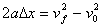 .
Rearranging this equation to find a yields
.
Rearranging this equation to find a yields
 .
.To find the time it takes for the bullet to travel
the length of barrel, we find the kinematics equation that contains
t and the given quantities. Examining our equations we see that
we can use  .
Rearranging this
equation
to find t yields
.
Rearranging this
equation
to find t yields
 .
.The average velocity is defined  .
.
A well–labeled sketch usually helps make the
problem clearer.
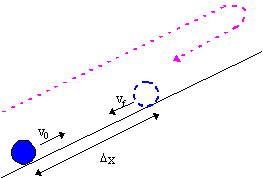
(a) Next, we list the list the given information and what we are looking for:
| v0 = +5.0 m/s |
| vf = –1.5 m/s |
| Δx = +5.5 m |
| a = ? |
| vaverage = ? |
| t = ? |
Note that I have taken the direction up the incline
as positive and that the signs are explicitly stated. It is a
very common source of error to leave out or to not consider the
signs of directions of all vector quantities.
To find the acceleration, we find the kinematics
equation that contains a and the given quantities. Examining
our equations we see that we can use 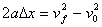 . Rearranging this equation to find a yields
 .
.Notice that the acceleration is negative. This means that
the
acceleration points down the incline. It means that an object
traveling up an incline will slow, turn around, and roll down
the incline.
The average velocity is defined 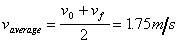 .
.
To find the time, we find the kinematics equation
that contains a and the given quantities. Examining our equations
we see that we can use  .
Rearranging
this equation to find t yields
.
Rearranging
this equation to find t yields 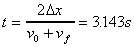 .
.
(b) When an object moving in 1D turns around we
know that the object is instantaneously at rest and that its velocity
at that point is v3 = 0. The information that we
know
is thus:
| v0 = +5.0 m/s | |
| v3 = 0 m/s | This is our new final velocity |
| a = –2.068 m/s2 | From part (a) |
| Δx = ? | |
| vaverage = ? | |
| t = ? |
Notice that the acceleration is a constant of the
motion; it has the same value in both parts of the problem.
To find the displacement from the initial position
where the ball turns around, we find the kinematics equation that
contains x and the given quantities. Examining our equations
we see that we can use 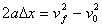 .
Rearranging
this equation to find x yields
.
Rearranging
this equation to find x yields
 .
.Notice that this value is bigger than the original 5.5 m
and is
consistent
with the sketch, i.e. the ball was farther up the incline when it
turned around.
To find the time it takes for the ball to reach
the point where it turns around, we find the kinematics equation
that contains t and the given quantities. Examining our equations
we see that we can use  .
Rearranging
this equation to find t yields
.
Rearranging
this equation to find t yields
 .
.Notice that this value is smaller than the time in part
(a) and is
consistent
with the sketch, i.e. the ball hasn't come back down the incline yet.
(Of course, in the modern telling of the story,
the hare would be proclaimed the winner after a random drug test
showed that the tortoise had been taking steroids!)
As with any kinematics problem, we list the list the given
information.
| tortoise | hare |
| Δx = 25.0 m | Δx = 25.0 m |
| v0T = 0.101 m/s | v0H = 0 |
| vfT = v0T (constant velocity) | vf = ? |
| aT = 0 (constant velocity) | aH = 0.5 m/s2 |
| tT = ? | tH = ? |
Examining each set of data, we can see that we have enough
data
to use our kinematics equations to calculate t. Whoever wins
the race will have the smaller time.
Calculating tT, we use the
kinematics equation Δx
= v0TtT + ½aT(tT)2.
Since aT = 0, rearranging
the equation yields
Similarly, we use the kinematics equation Δx
= v0HtH
+ ½aH(tH)2
to calculate tH. Since v0H
= 0, we have
We have to be careful, tH is the
time it takes
the hare to run the 25 m but he gave the tortoise a 4–minute,
or a 240–second, headstart. The hare's race time is thus 250
s,
and the tortoise wins the race.
Examining our results, we see that the tortoise won by 2.5 seconds, if the hare gave the tortoise of 3 minutes and 57 seconds or less, the hare should win.
A well–labeled sketch usually helps make the
problem clearer.
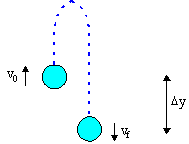
Next, we list the list the given information and the unknowns:
| v0 = +10.0 m/s |
| vf = –12.0 m/s |
| Δy = ? |
| a = –g = –9.81 m/s2 |
| t = ? |
Note that I have taken the direction up as positive and
that
the signs are explicitly stated. It is a very common source of
error to leave out or to not consider the signs of directions
of all vector quantities.
We can use the equation vf
= v0 + at
to find t. Rearranging yields
To find the displacement, we can use the formula 2aΔy
= (vf)2 – (v0)2.
Rearranging yields
So the ball is 2.24 m lower at the end of the 2.24 s.
We are asked to calculate the total distance travelled by the ball, however distance is not a kinematic quantity that we can calculate. Fortunately, we can calculate the displacement up to where the ball turned and then the displacement down. We recall that v = 0 at that point. So we have two calculation to do and we first list the information
| up | down |
| v0 = +10.0 m/s | v0 = 0 |
| vf = 0 | vf = –12.0 m/s |
| Δy1 = ? | Δy2 = ? |
| a = –g = –9.81 m/s2 | a = –g = –9.81 m/s2 |
| t1 = ? | t2 = ? |
To find the displacement for each part, we can use the
formula 2aΔy = (vf)2
– (v0)2.
Rearranging yields
We have to be careful about signs since distance is a
scalar
quantity while displacement is a vector,
The ball travelled a total distance of 12.4 m.
A well–labeled sketch usually helps make the
problem clearer.
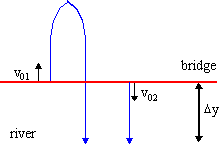
Next, we list the list the given information and the unknowns for each case:
| up | down |
| v01 = +325.0 m/s | v02 = –325 m/s |
| vf1 = ? | vf2 = ?<p><sup><sub><sub><sub |
| Δy1 = –120 m | Δy2 = –120 m |
| a = –g = –9.81 m/s2 | a = –g = –9.81 m/s2 |
| t1 = ? | t2 = ? |
Note that I have taken the direction up as positive and
that
the signs are explicitly stated. It is a very common source of
error to leave out or to not consider the signs of directions
of all vector quantities. Note that the displacement of each
bullet is exactly the same.
We can use the equation Δy = v0t
+ ½at2 to find t. We have a
quadratic in t. When
we substitute
in the numbers and rearrange into standard quadratic form, we have
| up: | –4.905t2 + 325t + 120 = 0 | (1) | ||
| down: | –4.905t2 – 325t + 120 = 0 | (2) |
The solutions to equation (1) are t1
= –0.367 s and
t1 = 66.6 s. We are looking for the forward in
time
solution so t1 = 66.6 s is the total time the
first
bullet is in the air – neglecting the effects of air
resistance.
The solutions to equation (2) are t2
= –66.6 s and
t1 = 0.367 s. We are looking for the forward in
time
solution so t2 = 0.367 s is the total time the
second
bullet is in the air.
To calculate the average velocity we need to know the
final
velocity
of each bullet. We can use the equation 2aΔy
= (vf)2 – (v0)2
for
this.
| up: | vf1 = [2aΔy1 + (v01)2]½ = [2(–9.81)(–120) + (+325)2]½ = <±328.6 m/s , |
| down: | vf2 = [2aΔy2 + (v02)2]½ = [2(–9.81)(–120) + (–325)2]½ = <±328.6 m/s . |
The proper choice of sign in both case is minus because the bullets are moving downwards just before impact, so vf1 = vf2 = –328.6 m/s .
The average velocity for the each bullet is thus
| up: | v1 average = ½(vf1 + v01) = ½(–328.6 + 325) = –1.80 m/s , |
| down: | v2 average = ½(vf2 + v02) = ½(–328.6 + –325) = 326.8 m/s . |
This results are different because the first bullet, which
is shot
upwards,
takes much longer to complete the same displacement than does the
second bullet.
We could have also calculated the average velocity from
| up: | v1 average = Δy/t1 = –120 m / 66.6 s = –1.80 m/s , |
| down: | v2 average = Δy/t2 = –120 m / 0.367 s = 326.8 m/s . |
Both methods give exactly the same results!
To find how far the first bullet rose, we know that at the
top
vtop = 0 as it is turning around. We can use the
formula 2aΔy = (vf)2
– (v0)2.
Rearranging yields
So the first bullet rose 5384 m
The bullet will have to return down this 5384 m, to the
total
distance travelled by the first bullet is
A well–labeled sketch usually helps make the
problem clearer.
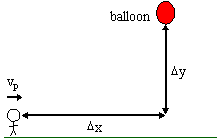
Next, we list the list the given information and the unknowns for the person and the water balloon:
| person | balloon |
| v0 = vp = 2.75 m/s | v0 = 0 (assuming it starts from rest) |
| vf = vp | vf = ? |
| Δx = ? | Δy = –12 m |
| ax = 0 | ay = –g = –9.81 m/s2 |
| t = ? |
|
Note that I have taken the directions up and to the right
as
positive and that the signs are explicitly stated. It is a very
common source of error to leave out or to not consider the signs
of directions of all vector quantities.
The common element to the balloon and the person is the
time,
t, each is in motion. Examining the balloon column we see we
can use the equation Δy = v0t
+ ½at2 to find t. When we
substitute in the
numbers and rearrange
to find t, we have
We choose the positive, forward in time, solution so the
balloon
take 1.564 s to fall. With this information, we use the equation
Δx = v0t + ½at2
to find out how far away the person has to be,
The person should be 4.30 m away when the ball is dropped.
A red car is stopped at a red light. As the light
turns green, it accelerates forward at 2.00 m/s2.
At the
exact
same instant, a blue car passes by traveling at 62.0 km/h. When
and how far down the road will the cars again meet? Sketch the
d versus t motion for each car on the same graph. What was the
average velocity of the red car for this time interval? For the
blue car? Compare the two and explain the result?
To solve this problem, we list the list the given
information
| Red Car | Blue Car |
|---|---|
| v0 red = 0.0 m/s | v0 blue = 62.0 km/h = 17.222 m/s |
| ared = 2.00 m/s2 | ablue = 0 m/s2 (constant velocity) |
| Δxred = ? | Δxblue = ? |
| tred = ? | tblue = ? |
This is an example of a two–body constrained
kinematics
problem. Even if a sketch was not explicitly required, we would
need one anyway to get the constraints. For the sketch, recall
that on a d versus t curve an object moving forward with a uniform
acceleration should be represented by a line curving upwards while
an object with constant forward velocity is represented by a straight
line with a positive slope.
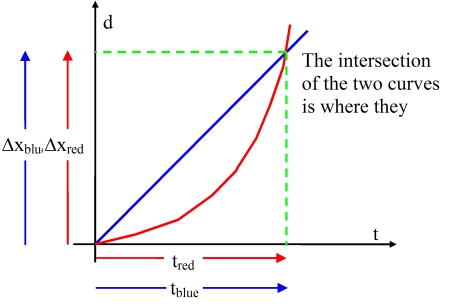 </li>
</li> Looking at the sketch, we see that our constraints
are:
To solve the problem, we must find the kinematics
equation that contains the known quantities, v0
and
a, and the unknown quantities, Δx and t.
Examining our equations
we see that we can use Δx= v0t +
½at2. We substitute this equation
into both sides of
equation (1). This yields,
We then use equation (2) to replace tred
and tblue by t,
Plugging in the values of the given quantities yields,
The solution of this equaΔtion is t =
17.222 seconds. This
is
the time that elapses before the two cars meet again.
With a value for t, we can find how far down the road the red car has traveled;
As a check, we can find how far down the road the blue car has traveled;
So the cars meet 297 m down the road.
According to our definition of average velocity,
vaverage red= Δxred/t
= (297
m)/(17.2 s) = 17.2 m/s. Since the blue car maintains a constant
velocity, vaverage blue= v0 blue
= 17.2 m/s. The two quantities are the same since the two cars
have traveled the same distance in the same amount of time.
A bicyclist travelling at 8.0 m/s passes a napping dog. Startled, the dog barks for three seconds and then gives chase accelerating at 2.2 m/s2. How far from her initial position does the dog catch up with the bicyclist? How long did this take? What is the dog's velocity when she catches the bicyclist? Her average velocity for the entire chase? Compare this to the bicyclist's average velocity.
To solve this problem, we list the given information
|
bicyclist |
dog |
|
|
Δxb = ? |
Δxd = ? |
|
|
v0b = 8.0 m/s |
v0d = 0 m/s |
|
|
vfb = 8.0 m/s |
(assuming constant velocity) |
vfd = ? m/s |
|
ab = 0 |
(assuming constant velocity) |
ad = 2.2 m/s2 |
|
tb = ? |
td = ? |
This is an example of a two–body constrained kinematics problem. Even if a sketch was not explicitly required, we would need one anyway to get the constraints. For the sketch, recall that on a d versus t curve an object moving forward with a uniform acceleration should be represented by a line curving upwards. An object with constant forward velocity is represented by a straight line with a positive slope.
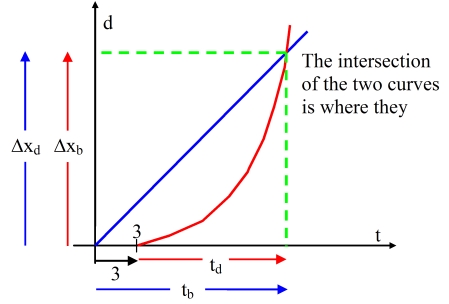
Looking at the sketch, we see that our constraints are:
Δxb = Δxd (1),
and
tb = td + 3 (2).
To solve the problem, we must find the kinematics equation that contains the known quantities, v0 and a, and the unknown quantities, Δ x and t. Examining our equations we see that we can use Δ x = v0t + ½at2. We substitute this equation into both sides of equation (1). This yields,
v0btb + ½ab(tb)2 = v0dtd + ½ad(td)2.
We then use equation (2) to replace td by t and tb by t + 3,
v0b( t+3) + ½ab(t+3)2 = v0dt + ½adt2.
Plugging in the values of the given quantities yields,
8(t+3) = ½(2.20)t2 .
This gives a quadratic equation
1.10t2 – 8t – 24 = 0 .
The solutions of this equation are t = 9.556 s and t = –2.283 seconds. The solution that we are looking for is the positive, future, value. So the boy has been travelling for
tb = 9.556 s + 3 s = 12.556 s
while the dog has run for
td = 9.556 s
With a value for t, we can find how far down the road they have gone;
Δxb = v0btb + ½ab(tb)2 = (8 m/s)(12.556) = 100.45 m.
As a check, we can find how far down the road the dog has traveled;
Δxd = v0dt + ½adt2 = ½(2.2 m/s2)(9.556)2 = 100.45 m.
So they meet 100.45 m down the road.
With the given and calculated information, we find the final velocity of the dog to be
vdf = v0d + adt = 0 + (2.20 m/s)(9.556 s) = 21.02 m/s .
According to our definition of average velocity, vaverage d = Δxd/t = (100.45 m)/(9.556 s) = 10.51 m/s. This is faster than the bicyclist’s constant speed since the dog has to overcome the bicyclist’s head start.
A speeding motorist traveling down a straight highway at 110 km/h passes a parked patrol car. It takes the police constable 1.0 s to take a radar reading and to start up his car. The police vehicle accelerates from rest at 2.1 m/s2. When the constable catches up with the speeder, how far down the road are they and how much time has elapsed since the two cars passed one another?
| v0 police = 0.0 m/s, | v0 speeder = 110 km/h = 30.556 m/s |
| apolice = 2.00 m/s2 | aspeeder = 0 m/s2 (constant velocity) |
| Δxpolice = ? | Δxspeeder = ? |
| tpolice = ? | tspeeder = ? |
This is an example of a two-body constrained kinematics problem. We need a sketch to get the constraints. For the sketch, recall that on a d versus t curve an object moving forward with a uniform acceleration should be represented by a line curving upwards while an object with constant forward velocity is represented by a straight line with a positive slope.
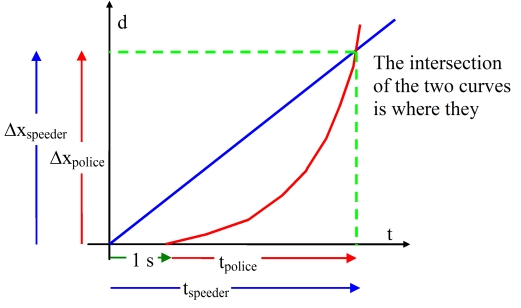
Looking at the sketch, we see that our constraints are:
Δxspeeder = Δxpolice (1), and
tspeeder = tpolice + 1 (2)..
To solve the problem, we must find the kinematics equation that contains the known quantities, v0 and a, and the unknown quantities, Δx and t. Examining our equations we see that we can use Δx = v0t + ½at2. We substitute this equation into both sides of equation (1). This yields,
v0 speedertspeeder + ½aspeeder(tspeeder)2 = v0 policetp<p><sup><sub><sub><subolice + ½apolice(tpolice)2.
We then use equation (2) to replace tspeeder by tpolice + 1,
v0 speeder (tpolice + 1) + ½aspeeder(tpolice + 1)2 = v0 policetpolice + ½apolice (tpolice)2.
Plugging in the values of the given quantities yields,
(30.556)( tpolice + 1) = ½(2.1)(tpolice)2.
This is a quadratic in tpolice. Solving the quadratic yields, tpolice = 30.07 seconds. It takes the police constable 30.1 s to catch up with the speeder. The speeder was traveling for 31.1 s.
With a value for tpolice, we can find how far down the road the police car has traveled;
Δxpolice = v0 policetpolice + ½apolice(tpolice)2 = ½(2.1)(30.07)2 = 949 m.
As a check, we can find how far down the road the speeder’s car has traveled;
Δxspeeder = v0 speeder (tpolice + 1) + ½aspeeder(tpolice + 1)2 =30.556 × 31.07 = 949 m.
So the cars meet 949 m down the road.
Two balls are thrown upwards from the same spot 1.15 seconds apart. The first ball had an initial velocity of 15.0 m/s and the second was 12.0 m/s. At what height do they collide?
To solve this problem, we list the list the given information
| v0 1 = 15.0 m/s | v0 2 = 12.0 m/s |
| a1 = -9.81 m/s2 | a2 = -9.81 m/s2 |
| Δy1 = ? | Δy2 = ? |
| t1 = ? | t2 = ? |
This is an example of a two-body constrained kinematics problem. We need a sketch to get the constraints. For the sketch, recall the shape of the d versus t curve for an object thrown up into the air - a parabola.
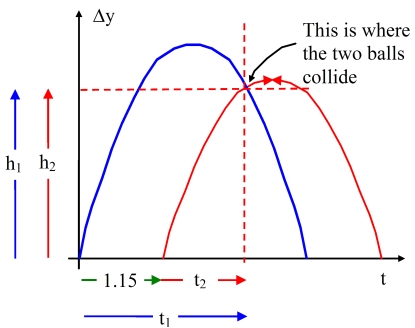
Looking at the sketch, we see that our constraints are:
Δy1 = Δy2 (1), and<p><sup><sub><sub><sub
t1 = t2 + 1.15 (2).
To solve the problem, we must find the kinematics equation that contains the known quantities, v0 and a = -g, and the unknown quantities, Δy and t. Examining our equations we see that we can use Δy = v0t - ½gt2. We substitute this equation into both sides of equation (1). This yields,
v01t1 - ½g(t1)2 = v02t2 - ½g(t2)2.
We then use equation (2) to replace t1 by t2 + 1.15,
v01(t2 + 1.15) - ½g(t2 + 1.15)2 = v02t2 - ½g(t2)2.
This reduces to
1.15v01 + v01t2 - ½g [t22 + 2.30t2 + 1.3225] = v02t2 - ½g t22.
Upon rearrangement this becomes
(v01 - v02 - 1.15g)t2 = -(1.15v01 -0.66125g).
Thus t2 = 1.2997 s, and t1 = 2.4497 s. Now that we have the time that each ball is in the air, we can now find h
h = v01t1 - ½g(t1)2 = (15.0 × 2.4497) - ½g(2.4497)2 = 7.31 m ,
and double-checking our result
h = v02t2 - ½g(t2)2 = (12.0 × 1.2297) - ½g(1.2297)2 = 7.31 m .
So the balls collide when they are 7.31 m in the air.
Two cars are separated by 75 km of straight highway. They both head toward each other at the same time. Car A travels at a constant 45 km/h and car B travels at a constant 65 km/h. How long after they start do they pass one another? How far from car A's starting point do they pass one another?
To solve this problem, we list the list the given information.
| v0A = –45 km/h (down highway) , | v0B = +65.0 km/h |
| aA = 0 (constant velocity) , | aB = 0 |
| ΔxA = ? , | ΔxB = ? |
| tA =? , | tB = ? |
This is an example of a two-body constrained kinematics problem. We need a sketch to get the constraints. For the sketch, recall the shape of the d versus t curve for an object moving at constant velocity - a tilted straight line.
To solve this problem, we list the list the given information
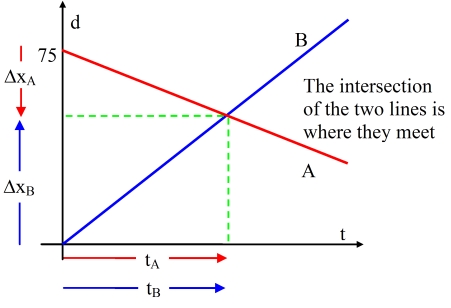
Looking at the sketch, we see that our constraints are:
ΔxB – ΔxA = 75 (1), and
tA = tB (2).
Note that ΔxA is pointing downwards meaning that the vector is negative.
To solve the problem, we must find the kinematics equation that contains the known quantities, v0 and a, and the unknown quantities, Δx and t. Examining our equations we see that we can use Δx = v0t. We substitute this equation into both sides of equation (1). This yields,
We then use equation (2) to replace tA by tB,
Plugging in the values of the given quantities yields,
This yields tB = (75 km)/(110 km/h) = 0.682 hours. Each vehicle has been travelling for about 41 minutes when they pass one another.
With a values for tB and tA, we can find how far down the road the vehicle A has travelled;
Car A is 30.7 km from where it started.
As a check, we can find how far down the road car B has travelled;
The cars have travelled 75 km as required.
In short
sprints, runners can be assumed to maintain
constant
speeds. In a practice run, runner 1 whose speed is 11.0 m/s,
starts the race 5.0 m behind runner 2 whose speed is 10.5 m/s.
Despite the headstart, runner 1 wins the race by a distance of
1.0 m.
(a) Provide a neat sketch of the position versus time graph for
the runners.
(b) How long did the race last?
(c) How far did each runner travel?
To solve this problem, we list the list the given information
| v01 = 11 m/s | v02 = 10.5 m/s |
| a1 = 0 (constant velocity) | a2 = 0 |
| Δx1 = ? | Δx2 = ? |
| t1 =? | |
This is an example of a two-body constrained kinematics problem. We would need a sketch to get the constraints even if it wasn’t asked for. For the sketch, recall the shape of the d versus t curve for an object moving at constant velocity - a tilted straight line.
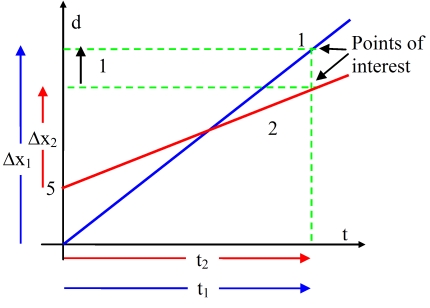
Looking at the sketch, we see that our constraints are:
Δx1 = Δx2 + 5 m + 1 m (1), and
t2 = t1 (2).
To solve the
problem, we must find the
kinematics equation that contains the known quantities, v0
and a, and
the unknown quantities, Δx and t. Examining our
equations we see that
we can use Δx= v0t.
We substitute this equation into both
sides of equation (1). This yields,
We then use equation (2) to replace t2 by t1,
Plugging in the values of the given quantities yields,
This yields t1 = (6 m)/(0.5 m/s) = 12.0 s. Each runner has been travelling for 12 seconds.
With a value for t1 and t2, we can find how far down the road the runner 1 has travelled;
Runner 1 covered 132 m.
Runner 2 has travelled;
Note runner 1 has travelled 6 m more than runner 2.
|
|
|
|
|
Questions?mike.coombes@kpu.ca
![[Return to Kwantlen Homepage]](http://www.kpu.ca/images/return_button.gif)