![[Return to Physics Homepage]](../physics.gif)
![[Return to Mike Coombes' Homepage]](../coombes.gif)
![[Return to List of Handouts]](../handouts.gif)
| Questions | Solutions | ||||
| A | Consider diagrams 1(a), 1(b), and 1(c) below, which way is the object moving? | mpg | A - 1 (a) | A - 1 (b) | A - 1 (c) |
| B | Consider diagrams 1(a), 1(b), and 1(c) below, what is the displacement of the object over the entire time interval? | mpg | B - 1 (a) | B - 1 (b) | B - 1 (c) |
| C |
Consider diagrams 1(a), 1(b), and 1(c) below, what is the distance travelled by the object over the entire time interval? | mpg | C - 1 (a) | C - 1 (b) | C - 1 (c) |
| D | Consider diagrams 1(a), 1(b), and 1(c) below, what is the average velocity of the object over the entire time interval? | mpg | D - 1 (a) | D - 1 (b) | D - 1 (c) |
| 1(a) |  |
1(b) | 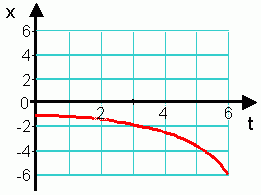 |
1(c) |  |
| Questions | Solutions | ||||
| E | Consider diagrams 2(a), 2(b), and 2(c) below, is the object speeding up, slowing down, or travelling at constant speed? | mpg | E - 2 (a) | E - 2 (b) | E - 2 (c) |
| F | Consider diagrams 2(a), 2(b), and 2(c) below, is the acceleration of the object positive, negative, or zero? | mpg | F - 2 (a) | F - 2 (b) | F - 2 (c) |
| 2(a) | 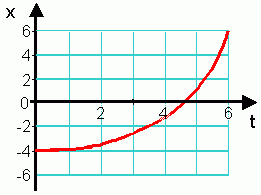 |
2(b) | 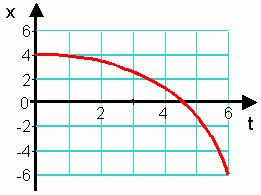 |
2(c) | 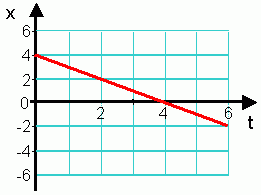 |
| Questions | Solutions | ||||
| G | Consider diagrams 3(a), 3(b), and 3(c) below, when, if ever, is the object turning around? | mpg | G - 3 (a) | G - 3 (b) | G - 3 (c) |
| H | Consider diagrams 3(a), 3(b), and 3(c) below, when, if ever, does the object have zero velocity? | mpg | H - 3 (a) | H - 3 (b) | H - 3 (c) |
| I | Consider diagrams 3(a), 3(b), and 3(c) below, when, if ever, does the object return to its starting position? | mpg | I - 3 (a) | I - 3 (b) | I - 3 (c) |
| 3(a) |  |
3(b) | 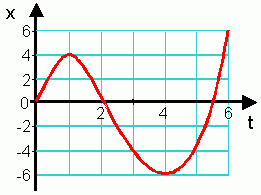 |
3(c) | 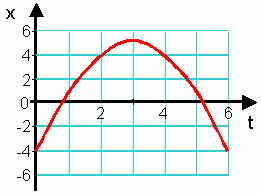 |
Questions? mike.coombes@kpu.ca
![[Return to Kwantlen Homepage]](http://www.kpu.ca/images/return_button.gif)