Physics 2424
Test
#1
February 2003
For Q1 and Q2 use attached graphs to solve the problems! Add appropriate comments to the graphs.
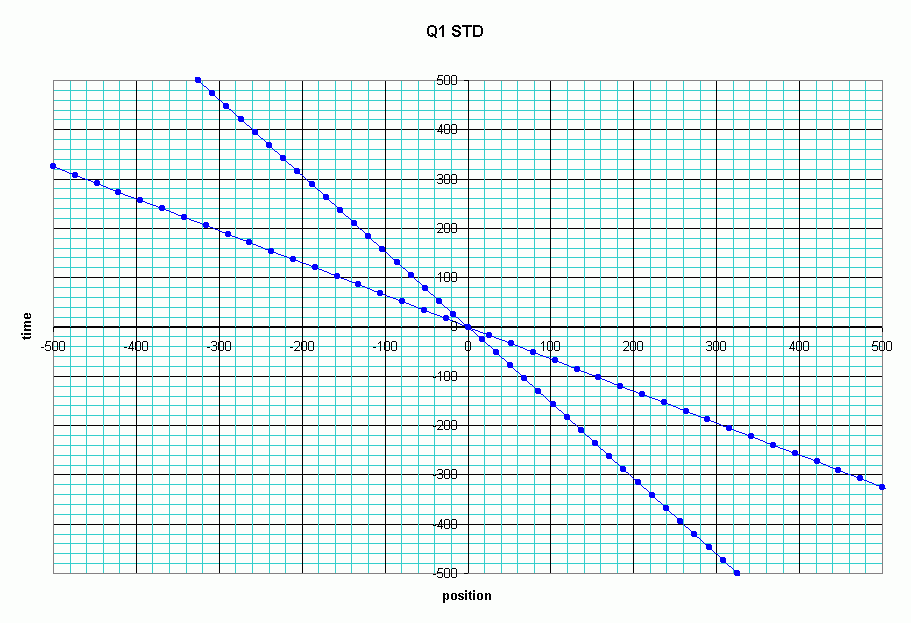
1. The attached spacetime diagram Q1 is for two spaceships that face one another. Spaceship A is taken to be stationary will B is the moving frame. The units are in metres. The divisions (dots) on the x¢ and ct¢ axes are both every 20 m. The stationary spaceship A is 100 m long while the moving spaceship B is 150 m long each measured in its own frame of reference. At ct = ct' = 0, the noses of A and B are at x = x' = 0.
(a) On the diagram, use arrows to show the length of each spaceship in its own frame.
(b) From the diagram, determine the velocity of spaceship B.
(c)
From the
diagram, determine the length of spaceship B in the frame of A. Show
how you would do this graphically not numerically!
(d) From the diagram, determine in the frame of spaceship A when the tails of both just meet.
(e) From the diagram, determine in the frame of spaceship B when the tails of both just meet.
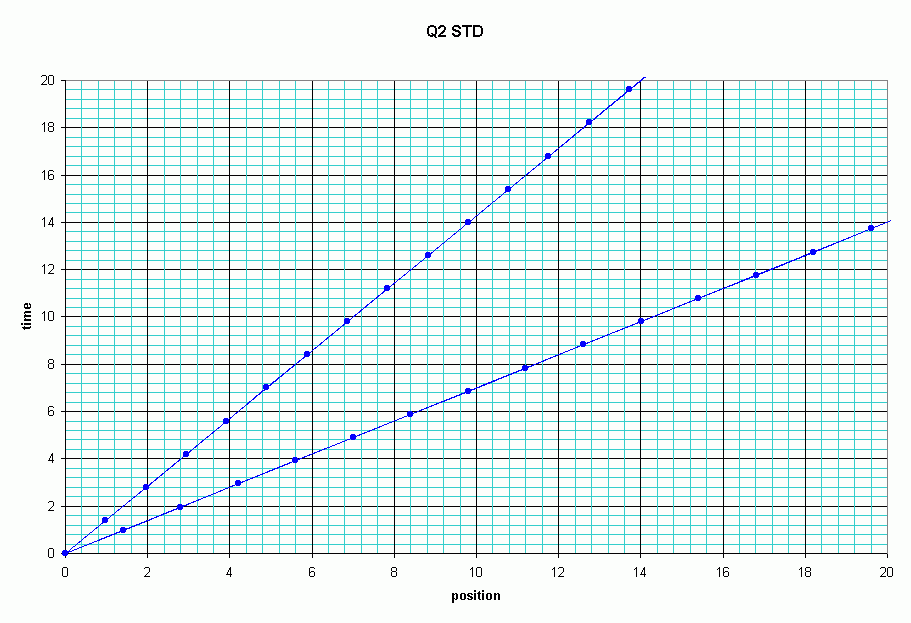
2. The attached spacetime diagram Q2 shows the reference frame of earth. You and your best friend are both Space Cadets. You each leave earth at the same time each travelling on a different spaceship headed in the same direction but at different speeds. The stationary frame shown is that of earth. The x' and ct' axes on the graph are your reference frame. In both frames the time units are c×months. The divisions (dots) on the x' and ct' axes are one for every c×month. The worldline of your friend is not shown.
(a) From the earth frame, how fast are you moving?
Before you both left, your friend agreed to send a radio message to both you and to earth at the same time in his frame. The message arrives on earth 14 months, earth frame, after he left. In your frame you receive the message 11 months after you left earth.
(b) Locate the position of your
friend when he sent the message. Hint draw worldlines for the radio
signals.
(c) From the earth frame, how fast is your friend moving?
Immediately on receiving your friend’s message you sent a reply back.
(d) Show the reply message worldline and indicate on the diagram where your friend receives it.
(e) If your friend sent the message to you at time T in his frame, estimate what time he receives your reply as a multiple of T.
3. The radius of our galaxy is approximately 3 × 10²⁰ m. A spaceship sets out to cross the galaxy in 25 years, as measured on board the ship. With what uniform speed does the spaceship need to travel? Give your answer in the form b = 1 – b, and tell me b. How long would the trip take, as measured by a timepiece stationed on earth? Hint use expansions: (1 + x )z = 1 + zx , where x is small!
4. Two spaceships leave earth. Spaceship A travels at vA = 0.5c directly away. The second spaceship B travels at vB = 0.8c at a 40° to the path A takes. What does A see as the magnitude and direction of the velocity of B?
5. A spaceship with a clock C ticking off seconds on its front is approaching you at a speed 0.8c.
(a) If you observe the clock through binoculars, how fast does it appear to be running? (That is, how frequently do you see the hands to be moving compared to an identical clock at rest in your frame?)
(b) This puzzles you since you have heard that moving clocks run slow. If that were true how often would you think the clock C should be ticking? Explain the apparent paradox.
(c) Luckily you get a chance to test your thinking. The approaching spaceship passes in succession two space stations with clocks C1, C2 fixed in your frame of reference and 10 light seconds apart. These two clocks are synchronized in your frame. As the spaceship passes C1, the ship clock C and C1 both read zero. What time will clock C2 read as clock C passes?
(d) What will clock C read as it passes C2?
(e) As you watch the spaceship through binoculars, what time interval elapses (according to your own watch) between the time you see C to pass C1 and the time you see C to pass C2? (Don’t forget the light reaching you from C1, C2 takes different times!)
6.
At
spaceship leaves earth at 0.5c.
A day later a second spaceship leaves at 0.7c. How long,
according to
someone on earth, will it take for the second ship to catch up with the
first?