![[Return to Physics Homepage]](../../physics.gif)
![[Return to Mike Coombes' Homepage]](../../coombes.gif)
![[Return to List of Handouts]](../../handouts.gif)
![[Return to Problem Sets]](../../problems.gif)
![[Return to List of Solutions]](../../solutions.gif)
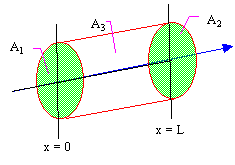
We are given that the polarization is P = (ax2 + b)i. The volume polarization density of charge is given by ρP = -Ñ ·P. Here we find
|
ρP
|
= -Ñ·P |
| = − ¶Px/¶x − ¶Py/¶y − ¶Pz/¶z | |
| = − d(ax2 + b)/dx − 0 − 0 | |
| = − 2ax |
The surface polarization charge is given by QP = P·nA, where A is area of the surface in question, n is the outward looking normal to the surface, and P is evaluated at the point in question. We have three surfaces here. For surface A1 n1 = − i, that is the surface normal points to the left. For surface A2 the surface normal points right, n2 = +i. For A3 n3 = r, where r is the cylindrical radial unit vector. Also A3 = 2πrL.
Q1 = (ax2 + b)i · −iA|x=0 = − bA ,
Q2 = (ax2 + b)i · +iA|x=L = (aL2 + b)A ,
and,
Q3 = (ax2 + b)i · r2πrL = 0 .
There is no surface charge on the side of the cylinder since the polarization is at right angles to the normal.
The charge in the interior of the cylinder is found by integrating the polarization density over the volume of the cylinder.
|
Qinterior
|
= ò ρP dV |
| = ò ò ρP dA dx | |
| = ò dA ò ρP dx | |
| = A ò 0L (− 2ax) dx | |
| = − aA x2 |0L | |
| = − aL2A |
The total of the interior and surface charges is thus
|
QTotal
|
= Q1 + Q2 + Q3 + Qinterior |
| = − bA + (aL2 + b) A + 0 − aL2A | |
| = 0 |
The total charge is zero as expected.
![[Return to Top of Page]](../../top.gif)
We are given that the polarization is P = Ar.
The volume polarization density of charge is given by ρP
= -Ñ·P. Here we find
|
ρP
|
= -Ñ·P |
| = -¶(Ax)/¶x − ¶(Ay)/¶y − ¶(Az)/¶z | |
| = − A − A − A | |
| = − 3A |
The surface polarization charge density is given by ΣP = QP/A = P·n, where n is the outward looking normal to the surface, and P is evaluated at the point in question. We have six surfaces here, one for each side of the cube. If we look at the xy plane of the cube as shown below, we find
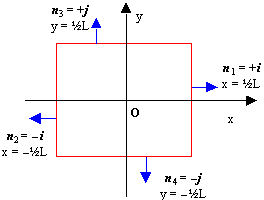
Similarly for the other faces, n5 = +k at z = ½L and n6 = − k at z = − ½L. We find
Σ1 = P · n1|x=½L = A(ix + jy + kz) · i|x=½L = ½AL ,
Σ2 = P · n2|x=-½L = A(ix + jy + kz) · − i|x=− ½L = ½AL ,
Σ3 = P · n3|y=½L = A(ix + jy + kz) · j|y=½L = ½AL ,
Σ4 = P · n4|y=− ½L = A(ix + jy + kz) · − j|y=− ½L = ½AL ,
Σ5 = P · n5|z=½L = A(ix + jy + kz) · k|z=½L = ½AL ,
and
Σ6 = P · n6|z=− ½L = A(ix + jy + kz) · − k|z=− ½L = ½AL .
The charge on each face is thus Qface = ΣAface = ΣL2 = ½AL3.
The charge in the interior of the cylinder is found by integrating the polarization density over the volume of the cylinder.
|
Qinterior
|
= ò ρP dV |
| = ò ò ò ρP dxdydz | |
| = −3A ò ò ò ρP dxdydz | |
| = −3AL3 |
The total of the interior and surface charges is thus
|
QTotal
|
= Q1 + Q2 + Q3 + Q4 + Q5 + Q6 + Qinterior |
| = 6(½AL3) − 3AL3 | |
| = 0 |
The total charge is zero as expected.
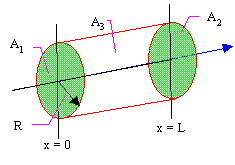
We are told that the polarization is P = Pi, where P is a constant. The electric field due to the polarization is the electric field due to the polarization charge on each surface an in the material. Thus these need to be calculated first.
The volume charge density is given by ρP = -Ñ·P. However we are told that the polarization P is uniform, hence its derivatives are zero. Thus ρP = 0.
The surface polarization charge density is given by ΣP = QP/A = P·n, where n is the outward looking normal to the surface, and P is evaluated at the point in question. We have three surfaces here. For surface A1 n1 = − i, that is the surface normal points to the left. For surface A2 the surface normal points right, n2 = +i. For A3 n3 = r, where r is the cylindrical radial unit vector. Thus the charge densities are
Σ1 = P · n1|x=0 = Pi · i|x=o = P ,
Σ2 = P · n2|x=-L = Pi · −i|x=L = -P ,
and
Σ3 = P · n3|r=R = Pi · r|r=R = 0 .
There is no surface charge on the side of the cylinder since the polarization is at right angles to the normal.
What we have are two oppositely charge plates separated by a distance L, a capacitor. Various texts tell us that the well-known result for the electric field due to a single plate located at x = 0,
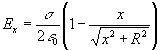 .
.
We have two plates, one at x = 0 and one at x = L, so we find the net electric field to be
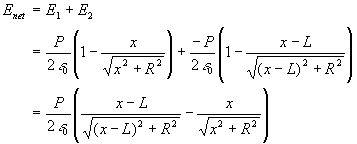
The situation described looks like
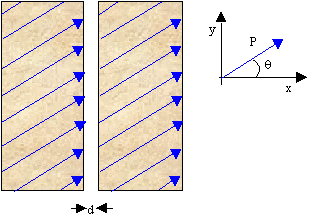
where I have included a coordinate system. In this coordinate system, the polarization is
P = iPcos(θ) + jPsin(θ)
where P is a constant. The electric field in the gap is due to the polarization and this electric field arises from the polarization charge on each surface an in the material. Thus these need to be calculated first.
The volume charge density is given by ρP = -Ñ·P. However we are told that the polarization P is uniform, hence its derivatives are zero. Thus ρP = 0.
The surface polarization charge density is given by ΣP = QP/A = P·n, where n is the outward looking normal to the surface, and P is evaluated at the point in question. We have two surfaces here. For the right surface nright = +i, that is the surface normal points to the right. For the left surface the surface normal points left, nleft = -i.
Σleft = P · nleft|x=0 = [iPcos(θ) + jPsin(θ)] · i|x=o = Pcos(θ) ,
and
Σright = P · nright|x=d = [iPcos(θ) + jPsin(θ)] · − i|x=L = −Pcos(θ) .
We do not need to worry about the other sides of the dielectric as they are an infinite distance away and will not contribute to the net electric field in the gap. We have two oppositely charged sides. Thus we have a capacitor situation and we know
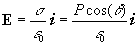
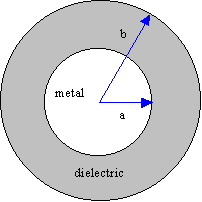
When dealing with dielectrics, we deal with the electric displacement, D. Since we have spherical symmetry, we can use the integral form of Gauss' Law
ò D•ndS = ò ρCdV ,
where ò ρCdV = Qenclosed, the enclosed free charge. Free charge is the charge not bound into matter, the charge that was added to the neutral bodies. Symmetry demands that the displacement be radial, D = D(r)r . The outward looking normal, n, is also radial here. Thus at r = R
ò D•ndS = ò D(r)r •rdS = D(R)4πR2 .
Thus Gauss' Law reduces to
D(R)4πR2 = Qenclosed .
We know that the charge Q must be uniformly distributed on the surface of metal sphere. Thus the problem is naturally broken into two regions, inside the shell and outside the shell.
Since there is no charge inside the shell, D = 0.
Since the enclosed charge is Q,
D = Q/4πR2 .
The electric field is related to the electric displacement by E = D/ε , where ε is the dielectric constant where you wish to determine the field. The electric field will have the same radial symmetry as D. However, there are three regions of different dielectric here, inside the metal, inside the dielectric, outside the dielectric.
The dielectric constant of a metal is infinite, but that doesn't matter since D = 0. Hence E = 0 inside the metal sphere. This is the usual expected result.
The dielectric constant is ε, so
E = D/ε = Q/4peR2 .
Presumably there is just air outside the dielectric and air has a dielectric constant very close to that of a vacuum, ε0. Thus
E = D/ε0 = Q/4pe0R2 .
The polarization P is related to D and E by the formula P = D – ε0E. Thus the polarization has the same radial symmetry as D and E. Since the electric field has three regions, so does the polarization.
Both D and E are zero, therefore so is P. This makes sense as there is no dielectric to polarize.
We have D and E so
P = D – ε0E = Q/4π R2 – ε 0(Q/4peR2) = (1 – ε0/ε) Q/4πR2 .
We have assumed that there is very nearly a vacuum outside the sphere, so there will be nothing to polarize. However we do know D and E, so checking to be sure we get
P = D – ε0E = Q/4πR2 – ε0(Q/4pe0R2) = (1 – ε0/ε0) Q/4πR2 = 0 .
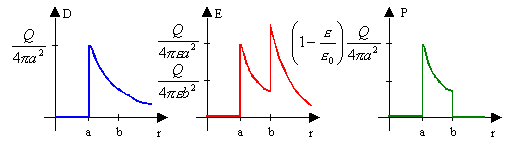
Summing our results for D, E, and P in a graph we have
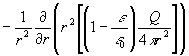
The polarization charge density in the dielectric is determined by ρP = -Ñ·P. We should use the particular form of the divergence in spherical coordinates as given in our text.
|
ρP
|
= -Ñ·P |
=  |
|
= |
|
=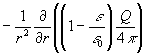 |
|
| = 0 |
Since is the expected result since the polarization is uniform.
The surface polarization charge density is given by ΣP = QP/A = P·n, where n is the outward looking normal to the surface, and P is evaluated at the point in question. We have two surfaces here. For the inner face of the dielectric ninner = -r. For the outer face the surface, nouter = +r.
Σinner = P · ninner|R=a = (1 – ε/ε0) Qr/4πR2 · –r|R=a = – (1 – ε/ε0) Q/4πa2,
and
Σouter = P · nouter|R=b = (1 – ε/ε0) Qr/4πR2 · r|R=b = (1 – ε/ε0) Q/4πb2 .
The electrostatic potential difference between two points when the electric field is known is given by
ΔV = VB – VA = –òAB E·dL .
When we are asked for the potential of a point B, we must remember that potential is always relative to some arbitrary reference position A. The most common reference point is at infinity. We will use that reference here. Therefore we define the potential as
V = –ò¥r=B E·dL .
We have determined given the form of the electric field. The electric field is radial, that is E(r) = E(r)r. The path element is dL = rdr + θrdθ + φsin(θ)dφ where r, θ, and φ are the spherical coordinate unit vectors. Therefore the potential reduces to
V = –ò¥r=B E(r) dr .
Since there are discontinuities in the electric field at r = a and b, we need to consider three cases.
V = –ò¥r=B
Q/4pe0r2 dr = Q/4pe0r
|¥r=B = Q/4pe0B
.
|
V
|
= –ò r=br=B E(r) dr – ò¥r=b E(r) dr |
| = –ò r=br=B Q/4per2 dr – ò¥r=b Q/4pe0r2 dr | |
| = Q/4per |r=br=B + Q/4pe0r |¥r=b | |
= 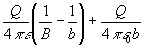 |
|
V
|
= –òr=ar=B E(r) dr – òr=ar=b E(r) dr – ò¥r=b E(r) dr |
| = 0 – ò r=br=a Q/4per2 dr – ò¥r=b Q/4pe0r2 dr | |
| = Q/4per |r=br=a + Q/4pe0r |¥r=b | |
= 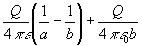 |
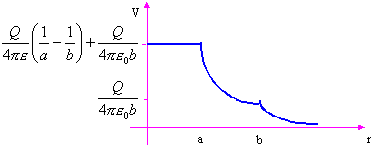
Note that the first integral was zero since E = 0 inside the sphere. As expected, the potential is constant everywhere inside the sphere.
The potential looks like
Questions?mike.coombes@kpu.ca
![[Return to Kwantlen Homepage]](http://www.kpu.ca/images/return_button.gif)