![[Return to Physics Homepage]](../physics.gif)
![[Return to Mike Coombes' Homepage]](../coombes.gif)
![[Return to List of Handouts]](../handouts.gif)
![[Return to Sample Tests]](../tests.gif)
Final Examination
PHYSICS 2420
April 1998
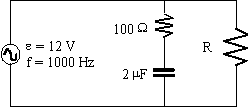
- For the circuit shown below, the current leads the sinusoidal emf by
14.0°.
(a) Use the phasor method to determine the unknown resistance R.
(b) Use complex methods to determine the Zequivalent
of the circuit.
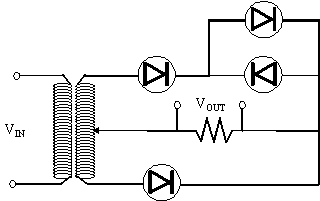
- A 60.0 Hz sinusoidal voltage is feed, via an ideal transformer, into
the odd centre-tapped rectifying circuit below. For the transformer, Nin::Nout
= 250::250. The diodes are silicon. The peak value of the input voltage
is 4.20 Volts.
(a) Give an accurate sketch of the output voltage. Be sure to indicate
maximum and minimum values on your sketch.
(b) Determine VDC. Determine the RMS value of the output.
Find the RMS value of the AC part of the wave.
(c) Give an accurate sketch of the AC part of output voltage. Be sure to
indicate maximum and minimum values, as well as the DC offset, on your
sketch.
(d) The output voltage is feed into another ideal transformer, Nin::Nout
= 150::300. For the new output voltage, determine VDC.
(e) Give an accurate sketch of the output voltage. Be sure to indicate
maximum and minimum values, as well as the DC offset, on your sketch.
(Hint - it doesn't just look like a bigger version of (b). Review how
transformers work.)
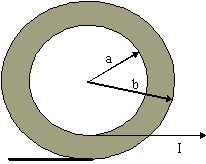
- A flat coil is wound so that it contains a very large uniform number
of turns per unit distance, n, along its radius from a to b as shown in
the diagram below. Determine the field at the centre of the coil, due to
the coil, by direct integration. The wire carries a current I. Hint -
consider a ring of thickness dr.
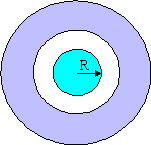
- Consider a thin spherical shell of radius R carrying a charge Q.
Around the shell, are two dielectric shells of thickness a and b
respectively. Finally there is a last spherical shell carrying a charge
-Q. The relative permittivity of the first dielectric shell is εa,
and εb for the second. Note εa > εb.
(Information on spherical cooordinates is in a math appendix at the back
of Duffin)
(a) Use Gauss' Law to find D, E, and P
everywhere.
(b) Sketch E as a function of radial distance.
(c) Determine Σp and ρp for the dielectrics.
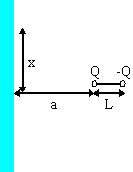
- A dipole is perpendicular to an infinite conducting plate. Use the Method
of Images to get the induced charge distribution Σ on the surface
of the plate as a function of x - assume a >> L and keep only
terms to first order in L.
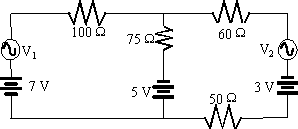
- For the circuit below, find the current through each resistor. The AC
sources are V1 = 4sin(200t) and V2 = 3.5sin(400t).
The AC and DC sources have no internal resistance.
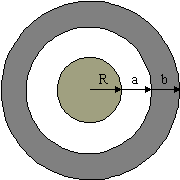
- A thick conducting cylindrical shell has an inner core and an outer
sheath made of a magnetic material which has a relative permeability μr.
The conducting shell carries a current density j(r) = Ae-Kr/r
and is directed out of the paper.
(a) Determine H, B, and M for all r, where r is
the radial distance from the centre of the cylinder. Be sure to indicate
the direction of these fields.
(b) Determine JSM and JM
for the magnetic materials. (Information on cylindrical coordinates is
in a math appendix at the back of Duffin.)
Questions? mike.coombes@kpu.ca
![[Return to Kwantlen Homepage]](http://www.kpu.ca/images/return_button.gif)