![[Return to Physics Homepage]](./../../physics.gif)
![[Return to Mike Coombes' Homepage]](./../../coombes.gif)
![[Return to List of Handouts]](./../../handouts.gif)
![[Return to Problem Sets]](./../../problems.gif)
Physics 2420 In-Class Problems: Transistors
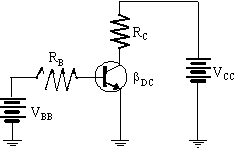
- For the silicon (VBE = 0.7 V) transistor
shown in the diagram below determine whether it is in saturation
if
(a) βDC = 50, VBB
= 6.5 V, RB = 2500 Ω, RC
= 500 Ω, VCC = 6.0 V, and
VCE(sat) = 0.0V;
(b) βDC = 75, VBB = 4.0 V,
RB = 10 kΩ, RC =
100 Ω, VCC = 4.0 V, and
VCE(sat) = 0.3V;
(c) βDC = 180, VBB = 3.0 V,
RB = 16 kΩ, RC =
400 Ω, VCC = 12.0, and
VCE(sat) = 0.5V;
(d) βDC = 125, VBB = 3.9 V,
RB = 40 kΩ, RC
= 2.0 kΩ, VCC = 9.5, and
VCE(sat) = 0.4V.
-
Under the following set of conditions determine
IC(sat). What is the minimum of IB
that produces saturation. What minimum value of VBB
produces saturation. Refer to the diagram above. Take VBE
= 0.7 V.
(a) βDC = 50 , RB =
2500 Ω, RC = 500
Ω, VCC = 6.0 V, and
VCE(sat) = 0.0 V;
(b) βDC = 75, RB =
10000 Ω, RC =
100 Ω, VCC = 4.0 V, and
VCE(sat) = 0.3 V;
(c) βDC = 180, RB =
16000 Ω, RC =
400 Ω, VCC = 12.0 V, and
VCE(sat) = 0.5 V;
(d) βDC = 125 , RB =
40 kΩ, RC = 2.0
kΩ, VCC = 9.5 V, and
VCE(sat) = 0.4 V.
-
For the following sets of conditions determine
the Q-point. Determine the maximum peak value of the base current
Ib . If the maximum value is exceeded, will the signal
be driven into cutoff, or saturation, or both? Take VBE
= 0.7 V and VCE(sat) = 0.0 V.
(a) βDC = 50, VBB = 1.0 V,
RB = 2500 Ω, RC = 500
Ω, VCC = 6.0 V;
(b) βDC = 25, VBB = 1.0 V,
RB = 2500 Ω, RC = 500
Ω, VCC = 6.0 V;
(c) βDC = 75, VBB = 1.0 V,
RB = 2500 Ω, RC = 500
Ω, VCC = 6.0 V.
-
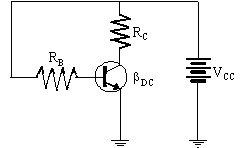
The diagram below shows a base-biased transistor.
For the following sets of conditions determine the Q-point. Determine
the maximum peak value of the base current. If the maximum value
is exceeded, will the signal be driven into cutoff, or saturation,
or both? Take VBE = 0.7 V and VCE(sat)
= 0.0 V.
(a) βDC = 200, RB = 75
kΩ, RC = 200
Ω, and VCC = 15.0 V;
(b) βDC = 100, RB = 75
kΩ, RC = 200
Ω, and VCC = 15.0 V;
(c) βDC = 300, RB = 75
kΩ, RC = 200
Ω, and VCC = 15.0 V.
-
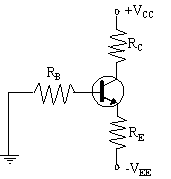
The diagram below shows an npn emitter-biased
transistor. For the following sets of conditions determine the
Q-point. Determine the maximum peak value of the base current.
If the maximum value is exceeded, will the signal be driven into
cutoff, or saturation, or both? Take VCE(sat)
= 0.0 V.
(a) βDC = 150, RB = 10
kΩ, RC = 1.0
kΩ, RE = 3.0
kΩ, VCC = 9.0 V, VEE
= 9.0 V, and VBE = 0.7 V;
(b) βDC = 300, RB = 10
kΩ, RC = 1.0
kΩ, RE = 3.0
kΩ, VCC = 9.0 V, VEE
= 9.0 V, and VBE = 0.6 V;
(c) βDC = 150, RB = 10
kΩ, RC = 1.0
kΩ, RE = 1.5
kΩ, VCC = 9.0 V, VEE
= 9.0 V, and VBE = 0.7 V;
(d) βDC = 150, RB = 10
kΩ, RC = 1.0
kΩ, RE = 4.5
kΩ, VCC = 9.0 V, VEE
= 9.0 V, and VBE = 0.7 V.
-
For the npn emitter-biased transistor shown above,
what would be the minimum value of RE that keeps the
transistor from going into saturation?
(a) βDC = 150, RB = 10
kΩ, RC = 1.0
kΩ, VCC = 9.0 V, VEE
= 9.0 V, VBE = 0.7 V, and VCE(sat) = 0.5 V,
(b) βDC = 300, RB = 10
kΩ, RC = 1.0
kΩ, VCC = 9.0 V, VEE =
9.0 V, VBE = 0.6 V, and VCE(sat) = 0.4 V,
(c) βDC = 220, RB = 1200
Ω, RC = 700 Ω,
VCC = 6.0 V, VEE = 6.0 V, VBE
= 0.7 V, and VCE(sat) = 0.7 V.
-
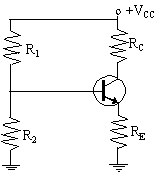
The diagram below shows a transistor with a voltage-divider
bias. For the following sets of conditions determine the Q-point.
Determine the maximum peak value of the base current. If the maximum
value is exceeded, will the signal be driven into cutoff, or saturation,
or both? Take VCE(sat) = 0.0 Volts.
(a) βDC = 100, VCC = 8.0 V,
VBE = 0.7 V, RC = 1.4 kΩ,
RE = 600 Ω, R1
= 25 kΩ, and R2 = 12
kΩ;
(b) βDC = 200, VCC = 8.0 V,
VBE = 0.6 V, RC = 1.4 kΩ,
RE = 600 Ω, R1
= 25 kΩ, and R2 = 12
kΩ;
(b) βDC = 300, VCC = 8.0 V,
VBE = 0.6 V, RC = 1.4 kΩ,
RE = 600 Ω, R1
= 25 kΩ, and R2 = 12
kΩ.
-
The diagram above shows a voltage-divider biased
transistor. What is the minimum value of R2 which causes
saturation?
(a) βDC = 100, VCC = 8.0 V,
VBE = 0.7 V, RC = 1.4 kΩ,
RE = 6.0 kΩ, R1
= 25 kΩ, and VCE(sat) = 0.0 V;
(b) βDC = 200, VCC = 8.0 V,
VBE = 0.7 V, RC = 1.4 kΩ,
RE = 6.0 kΩ, R1
= 25 kΩ, and VCE(sat) = 0.0 V;
(c) βDC = 300, VCC = 8.0 V,
VBE = 0.7 V, RC = 1.4 kΩ,
RE = 6.0 kΩ, R1
= 25 kΩ, and VCE(sat) = 0.5 V;
-
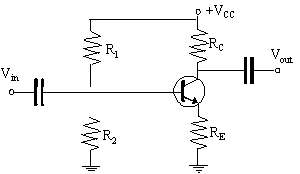
Determine re, Rin(base) , Rin,
Av, A'v for the following amplifier
if
(a) Rs = 850 Ω,
β = 92, RC = 140
kΩ, RE = 60
kΩ, R1 = 25
kΩ, and
R2 = 12 kΩ;
(b) Rs = 175 Ω,
β = 180, RC = 25
kΩ, RE = 5.0
kΩ, R1 = 2.5
kΩ, and R2 = 2.8
kΩ.
-
Determine Av, A'v,
for the amplifier in the problem above if RE is bypassed
by a capacitor.
Questions?
mike.coombes@kpu.ca
![[Return to Kwantlen Homepage]](http://www.kpu.ca/images/return_button.gif)