![[Return to Physics Homepage]](./../../physics.gif)
![[Return to Mike Coombes' Homepage]](./../../coombes.gif)
![[Return to List of Handouts]](./../../handouts.gif)
![[Return to Problem Sets]](./../../problems.gif)
![[Return to List of Solutions]](./../../solutions.gif)
We have light passing through media of different indices of refraction, so we need to apply the Law of Refraction at each interface. A sketch of a light ray's path is shown below.
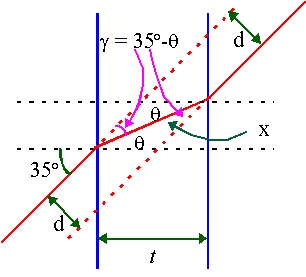
The angle is related to the 35.0° angle by the Law
of Refraction, nairsin(35.0°) =
nprismsin(θ).
Solving for θ, we find
θ = arcsin(1 × sin(35.0°)
/ 1.70) = 19.7184° .
We will need to do some geometry to relate θ
and t to d. First let x be the length of the ray in the glass. The
separation of the ray is related to x by d =
xsin(35°-θ).
Similarly, the thickness of the glass t is related to x
by t = xcos(θ). Eliminating
the common factor x,
The ray has shifted 1.40 mm to the side.
![[Return to Top of Page]](./../../top.gif)
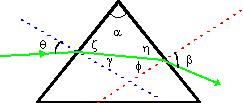
The angle γ is related to
θ by the Law of Refraction,
nairsin(θ) =
nprismsin(γ).
Solving for γ, we find
γ = arcsin(1 ×
sin(40.0°) / 1.50) = 25.3740° .
Next we need to do some geometry to find φ.
| α + ζ + η | = π | (1) |
| ζ + γ | = ½π | (2) |
| φ + η | = ½π | (3) |
Using equations (2) and (3) to eliminate ζ
and η from equation (1), we find
The angle φ is related to
β by the Law of Refraction,
nprismsin(φ) =
nairsin(β). Solving
for β, we find β
= arcsin(1.50 × sin(19.6260°) / 1) =
30.2530 ° .
The beam of light emerges at 30.3° to the normal.
The critical angle is the angle in the material for
which the ray emerging into air is refracted at 90°. Using the
Law of Refraction, nsin(θC)
= nairsin(90°). Solving for n, we find
The material has an index of refraction of 1.54 .
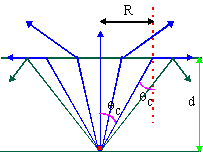
The circle is defined by the light that escapes.
Light at angles greater than the critical angle is reflected back
into the water. At the critical angle, the light emerging into
the air is refracted at 90°. Using the Law of Refraction,
nsin(θC)
= nairsin(90°), to find
θC, we get
Using geometry,
In the first case the eye is in air and the apparent
depth, d1, would be given by
In the second case the eye is in water and the apparent
depth, d2, would be given by
We have two equations in two unknowns. We eliminate
the common factor dactual to get
Under water, the medallion appears to be 2.1 cm under
the plastic surface.
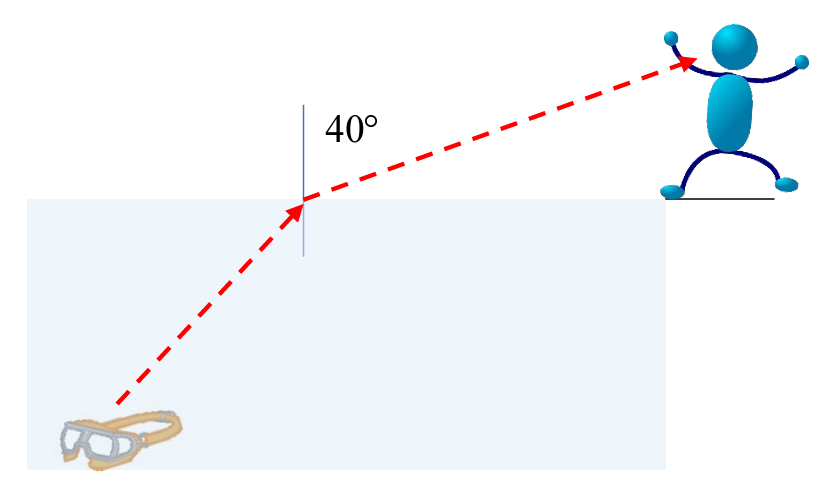
Recall that our brains work on the assumption that light always travels in straight lines. In the diagram below, you can see that the apparent depth of the googles is highter than the actual depth.
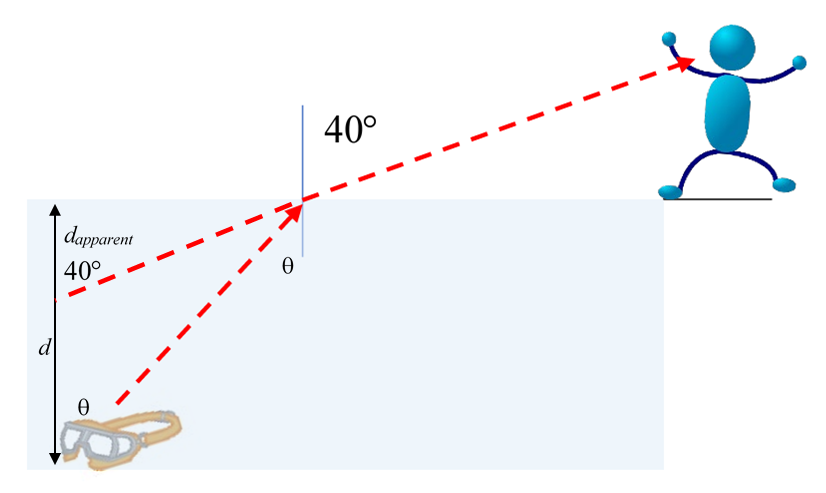
We have two right triangles that share a common side; so dapparenttan(40°) = dtanθ. We can determine the angle θ from the Law of Refraction, nwatersinθ = nairrsin(40°) which yields θ = 29.9°. So dapparent = (1.8 m) × tan(28.9°)/tan(40°) = 1.18 m.
The apparent depth formula, which only works for looking from above, yields dapparent = (nair/nwater)d = 1.35 m. This is a substantial difference.
The angle that the light is refracted or bent is
given by the Law of Refraction,
Assuming that n1 and θ1 refer
to the air, the refracted angle in the glass is
For the each colour of light we get,
The difference is Δθ = 0.35° .
This phenomenon where different colours of light
refract at different angles is called Dispersion and leads
to the rainbow of light formed by prisms.
Questions? mike.coombes@kpu.ca
![[Return to Kwantlen Homepage]](http://www.kpu.ca/images/return_button.gif)