![[Return to Physics Homepage]](./../../physics.gif)
![[Return to Mike Coombes' Homepage]](./../../coombes.gif)
![[Return to List of Handouts]](./../../handouts.gif)
![[Return to Problem Sets]](./../../problems.gif)
![[Return to List of Solutions]](./../../solutions.gif)
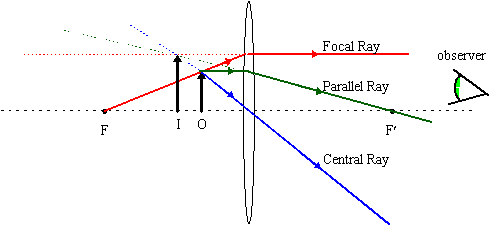
The image, I, is erect, larger, and virtual. It
is located between the left focal point and the object at O.
We assume that the observer in on the right side.
![[Return to Top of Page]](./../../top.gif)
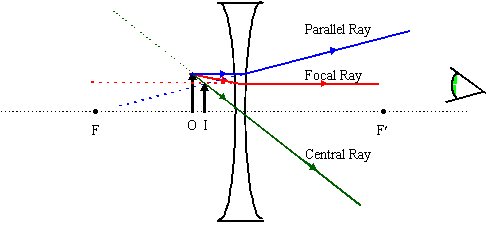
The image, I, is erect, smaller, and virtual.
It is located between the object, O, and the lens.
For a convex lens, f = +20 cm.
(a) Given that the image is inverted and twice as large, we have M = -2. Now our definition of magnification is M = -i/o, therefore i = 2o. Using the lens formula
Substituting i = 2o , this becomes
or
Thus i = 2(30 cm) = 60 cm.
(b) Since the image is erect and twice as large, then M = +2. Therefore i = -2o. Substituting this into the lens equation
yields
Thus i = -2(10 cm) = -20 cm.
(a) We given that o = 20.0 cm and that i = -5.00 cm. The minus sign for i indicates that the image is on the same side of the lens as the object. Using the lens equation
The focal length of the lens is thus -20/3 = -6.67
cm. The minus sign indicates that the lens is diverging or concave.
The magnification is given by
As well, the size of the image is given by
The magnification is positive so the image is erect. As well the image is on the same side as the object, so it is virtual and virtual images are erect.
We are dealing with two cases, so we need two diagrams
and one equation for each case.
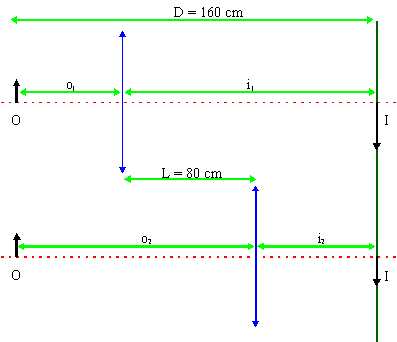
Our equations for both cases are
and
The other information that we are given, and shown
in the diagram, is
and
The absolute signs on the object and image distances
are there to cancel the sign convention. They are not absolutely
necessary here since the images are on the transmission side and
thus must be positive. The objects are real objects and are also
already positive.
We next write i1, i2, and o2
in terms of D, L, and o1,
and
We substitute these into equations (1) and (2),
and
Equating (1a) and (1b) yields,
Rationalizing each side yields
Cross-multiplying gives
Rearranging yields
This quadratic simplifies further since we are given
that L = ½D. We find
Our other values are i1 = +120 cm, o2 = +120 cm, and i2 = +40 cm.
The magnification of the image in the first case is
The first image is 3 times larger, inverted, and real.
The magnification of the image in the second case is
The image is one-third of the original size, inverted, and real.
Notice that the image and object distances in the
second case are the reverse of the first. This make sense because
of the symmetry of light rays. We find an image by following
rays from the object to where they intercept at the image. We
could imagine that the image was an object and follow the rays
back to the object. The second case is equivalent to swapping
the image and object.
We start with the first lens. We are given that
o1 = 50 cm and f1 = 30 cm. We find i1
from
We find
The image formed by the first lens is the object
for the second lens. Since the lenses are 60 cm apart, the "object"
is 15 cm away from lens #2 on the transmission side. The "object"
is thus virtual and
We are given that f2 = 20 cm. We find
i2 from
We find
The final image is on the transmission side of the
second lens and is thus real.
The overall magnification is given by
The final image is inverted and 86% of the original size.
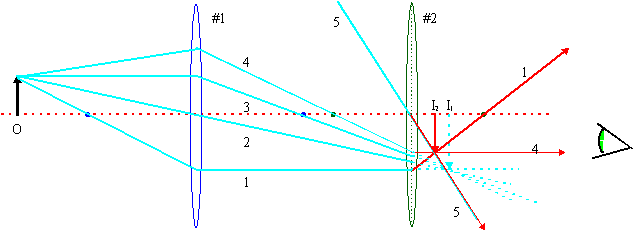
Drawing the path of the rays is a tricky business
as shown below. First we draw the Principle Ray, 1, 2, and, 3
in cyan to find the image formed by the first lens. Note that
the lines are dashed as they pass through the second lens; they
never reach there but are refracted by the second lens. Ray 1
is parallel to the axis, so it will be refracted through the second
lens so that it passes through the second lens' transmission side
focal point. This is shown as red ray 1.
The principle rays are not the only rays emitted
by the real object. One ray, 4, will pass through the focal point
of the second lens on its way to I1, is refracted by
lens #2, and come out parallel to the axis. This is shown as
red ray 4.
Another ray, 5, will pass through the centre of the
second lens on its way to I1 and not be deviated at
all. This is shown as red ray 5.
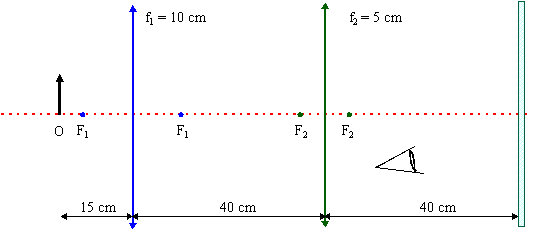
We start with the first lens. We are given that
o1 = 15 cm and f1 = 10 cm. We find i1
from
We find
The image formed by the first lens is the object
for the second lens. Since the lenses are 40 cm apart, the "object"
is 10 cm away from lens #2 on the incident side. The "object"
is thus real and
We are given that f2 = 5 cm. We find
i2 from
We find
The image formed by the second lens is the object
for the plane mirror. The "object" is 30 cm away from
the mirror, so an observer looking at the mirror will see a reflected
image 30 cm behind the mirror.
The final image is behind of the mirror so it is virtual.
The overall magnification is given by
| M | = M1 × M2 × Mmirror |
| = (-i1/o1) × (-i1/o1) × 1 | |
| = -(+30)/(+15) × -(+10)/(+10) × 1 | |
| = +2 |
The final image has the same orientation as the object and is
twice as big.
Note how crucial it is in this problem to know exactly where
the observer is.
What would you have to do if the observer was on the same side of lens #1 as the object and was looking through the lens?
Questions? mike.coombes@kpu.ca
![[Return to Kwantlen Homepage]](http://www.kpu.ca/images/return_button.gif)