![[Return to Physics Homepage]](./../../physics.gif)
![[Return to Mike Coombes' Homepage]](./../../coombes.gif)
![[Return to List of Handouts]](./../../handouts.gif)
![[Return to Problem Sets]](./../../problems.gif)
![[Return to List of Solutions]](./../../solutions.gif)
To see the top of your head, a light ray must leave
your head and be reflected in the mirror. Similarly to see your
foot, a light ray must leave your foot and be reflected in the
mirror. The reflected rays obey the Law of Reflection,
θincident
= θreflected.
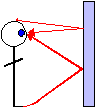
Examining the diagram, we see that the required portion of the mirror is about one-half the person's height or .9 m .
![[Return to Top of Page]](./../../top.gif)
Light rays obey the Law of Reflection when they encounter plane mirrors. The path of the ray is sketched below.
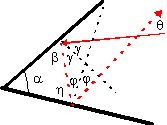
Using geometry
| α + β + η | = π | (1) |
| γ + β | = ½π | (2) |
| η + φ | = ½π | (3) |
| θ | = π - 2γ - 2φ | (4) |
Using the first three equations to eliminate γ
and φ from equation (4), we find
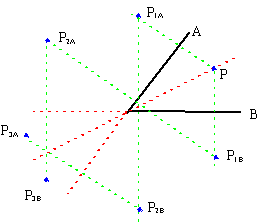
Images in plane mirrors are always the same distance
behind a mirror as the object is in front of the mirror.
For the object at P there will be a primary image
formed in each mirror A and B. These images are labelled P1A
and P1B in the diagram. The subscript indicate that
these are the primary images and which mirror you have to be looking
at to see the image.
Next an image in one mirror will act as an object
for the second mirror as long as the image is in front of the
plane of the second mirror. So we will get a set of secondary
images. The image of P1A is labelled P2B
in the diagram. The image of P1B is labelled P2A
in the diagram.
The images labelled P2A and P2B
are still in front of the plane of the other mirror. So we will
get a set of tertiary images. The image of P2A is
labelled P3B in the diagram. The image of P2B
is labelled P3A in the diagram.
There are no images P3A and P3B
as P3A is behind the plane of mirror B and P3B
is behind the plane of mirror A.
We thus have a total of 6 images.
Images in plane mirrors are always the same distance
behind a mirror as the object is in front of the mirror.
For the object at P there will be a primary image
formed in each mirror A, B, and C. These images are labelled
P1A, P1B, and P1C in the diagram.
The subscript indicate that these are the primary images and
which mirror you have to be looking at to see the image.
Next an image in one mirror will act as an object for the second mirror as long as the image is in front of the plane of the second mirror. P1B is on the plane of mirrors A and C, so it will not cause any further reflections. Image P1A is in front of the plane of mirror C, we get a secondary image P2C. Image P1C is in front of the plane of mirror A, we get a secondary image P2A.
Image P2A is in front of the plane of mirror C, we get a tertiary image P3C. Image P2C is in front of the plane of mirror A, we get a tertiary image P3A. The placement of the mirrors is such that the image locations of P3A and P3C coincide.
The tertiary images are behind the plane of the mirrors,
so there will be no further reflections.
There is a total of five images.
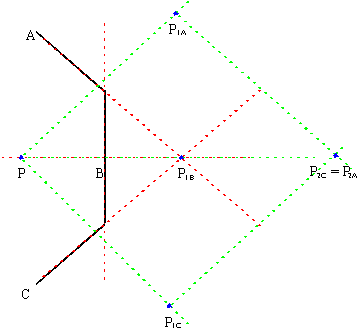
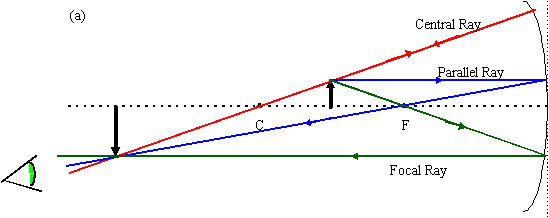
Image is real, inverted, approximately twice as
large, past C.
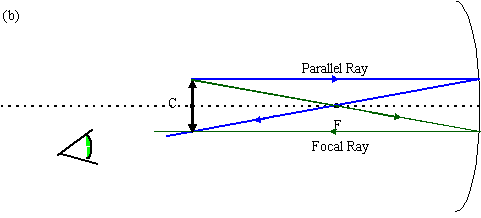
Image is real, inverted, same size, at C.
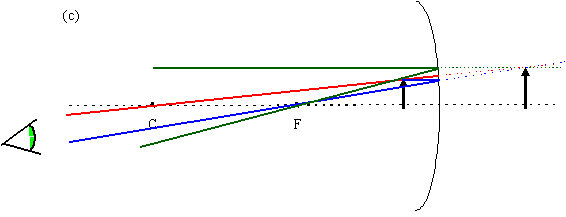
Image is virtual, erect, approximately 30% larger, behind mirror.
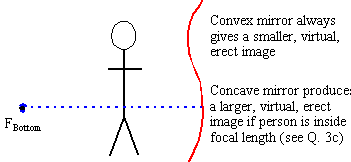
Funhouse mirrors are two mirrors, of different
focal lengths, joined together. In each case the image must be
erect or upright which means that the image must be virtual.
The top mirror must shrink an object, i.e. Mup <
1. The bottom mirror must enlarge the object, Mbottom
< 1.
This can be achieved with an S-shaped mirror.
Since the mirror is concave, f = +30. Since the object is in front of the object, o = +25. Using the lens formula
Isolating 1/i,
Inverting, we find
Since i < 0, the image is behind the mirror.
As a result it must be virtual, since no rays can come from behind
the mirror.
The magnification is given by
The image is six times larger than the object. The image is erect since M is positive.
Since the mirror is convex, f = -30. Since the object is in front of the object, o = +25. Using the lens formula
Isolating 1/i,
Inverting, we find
Since i < 0, the image is behind the mirror.
As a result it must be virtual, since no rays can come from behind
the mirror.
The magnification is given by
The image is 55% as large as the object. The image is erect since M is positive.
Questions? mike.coombes@kpu.ca
![[Return to Kwantlen Homepage]](http://www.kpu.ca/images/return_button.gif)