[Return to Physics Homepage]     [Return to Mike Coombes' Homepage]     [Return to List of Handouts]     [Return to Sample Tests]


Electricity & Magnetism Test #1

PHYSICS 1220

25 March 1997


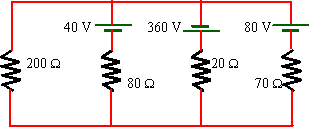
  1. (10) Find the conventional current through each resistor in the circuit shown below. Be sure to indicate the direction in which each current flows.

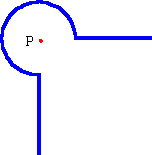
  2. (10) A wire has been bent into the shape shown in the diagram below. The curved portion is three-quarters of a circle. The radius of the curved piece is R and the wire carries a linear charge density λ. The straight pieces each have length 5R. Find the electrostatic potential at point P at the centre of the circular piece. Hint - consider each piece separately.

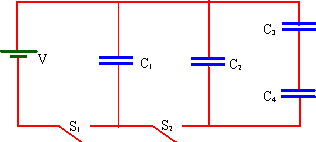
  3. (10) In the circuit below, V = 20.0 Volts, C1 = 6.00 μF, C2 = 1.00 μF, C3 = 4.00 μF, and C4 = 4.00 μF.
    (a) Switch S1 is closed and C1 is allowed to charge fully. What is the charge on C1?
    (b) Switch S1 is now reopened and then switch S2 is closed. What is the final charge on each capacitor? (Hint - first consider the equivalent capacitor C234)

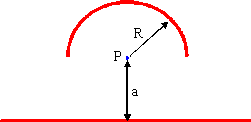
  4. (10) In the diagram below are two wires both with charge density λ. One piece is bent into a semicircle of radius R. The other is an infinitely long ( L >> R ) wire.
    (a) What is the electric field at point P due solely to the semicircular wire? Point P is the centre of the full circle.
    (b) What is the electric field at P due to the long straight wire? (You may use Gauss' Law to derive this result if you wish.)
    (b) What should a be for there to be no net field at point P?

  5. (15) An insulating sphere of radius R has a volume charge density given by

    ρ = ρ0(a - r/b)

    where ρ0, a, and b are positive constants and r is the radial distance from the centre of the sphere.
    (a) Determine the magnitude of the electric field for (i) r < R and (ii) r > R. Sketch the results.
    (b) Use the result from part (a) the determine the potential difference between r = 0 and r = R. Which point is at the higher potential?
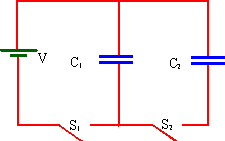
  6. (10) In the circuit below, V = 20.0 Volts, C1 = 6.00 μF, and C2 = 3.00 μF. Consider the following possibilities. Each case starts with the switches opened and the capacitors discharged.
    (a) Switch S1 is closed and C1 is allowed to charge fully. Next switch S1 is now reopened and then switch S2 is closed. What is the final charge on each capacitor?
    (b) A dielectric of k = 5.00 is put between the plates of a discharged C1. Switch S1 is closed and C1 is allowed to charge fully. Next switch S1 is now reopened and then switch S2 is closed. What is the final charge on each capacitor?
    (c) Switch S1 is closed and C1 is allowed to charge fully. Next switch S1 is now reopened and then a dielectric of k = 5.00 is placed between the plates of a discharged C1. Then switch S2 is closed. What is the final charge on each capacitor?


Some useful formulas

Coulomb's Law and Electric Fields:

F = kq1q2/r2 F= q0E EPoint Charge = kQ/r2
Ewire = 2kλ/r Eplate = Σ/2ε0 Esphere = KQ/r2

Gauss' Law

φE = òE ·ndA = Qinside/ε0
cylinders - E(a)2πaL = [2πL òr(r)rdr]/ε0
spheres - E(a)4πa2 = [4pòr(r)r2dr]/ε0

Electrostatic Potential

ΔV = V(b) - V(a) = -òbaE·dl = -òbaE(r)dr
Vpoint charge = kQ/r V = V1 + V2 + ... ΔK =ΔU = -qΔV

Capacitors

C = Q/V CP = C1+C2 1/Cs = 1/C1+1/C2
Cplates = ε0A/d Eplates = Q/ε0A Cdielectric = kC0
Edielectric = kE0 Σb = [(k-1)/k]sf U = ½Q2/C = ½QV = ½CV2
charging: Q = Cε(1 - e-t/RC) I = (ε /R)e-t/RC
discharging: Q = Q0e-t/RC I = (ε /R)e-t/RC

Resistors

Rs = R1 + R2 1/Rp = 1/R1 + 1/R2
V = IR P = I2R = V2/R = VI
åEi -åIiRi = 0 åqin =åqout

Constants

k = 8.99 × 10⁹ N m2/C2 ε0 = 8.85 × 10¹² F/m μ0 = 4π × 107 T-m/A

Identities and Integrals

if ax2+bx+c=0, x = {b±[b2- 4ac]½}/2a S = Rθ, dS = Rdθ
òxndx = xn+1/(n+1) + Còx-1dx = lnx + C
òebxdx = ebx/b + C òxebxdx = (x - b)ebx + C
òcosΩxdx = (sinΩx)/Ω + C òsinΩxdx = -(cosΩx)/Ω + C
ò(a/[a2+x2]3/2)dx = 1/[a[a2+x2]1/2] + C ò(x/[a2+x2]3/2)dx = -1/[a2+x2]1/2 + C


[Return to Physics Homepage]     [Return to Mike Coombes' Homepage]     [Return to List of Handouts]     [Return to Sample Tests]

Questions? mike.coombes@kpu.ca

[Return to Kwantlen Homepage]