![[Return to Physics Home Page]](./../../physics.gif)
![[Return to Mike Coombes' Home Page]](./../../coombes.gif)
![[Return to List of Handouts]](./../../handouts.gif)
![[Return to Problem Sets]](./../../problems.gif)
![[Return to List of Solutions]](./../../solutions.gif)
Physics 1220 In-Class Problems: Law of Biot-Savart &
Ampere's Law
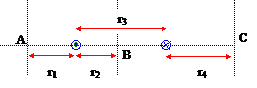
- Two wires are carrying conventional currents, I1
= 30.0 A and I2 = 22.0 A,
in opposite directions. Determine the direction and magnitude of the
net magnetic field at points A, B,
and C where r1 = 0.250 m, r2
= 0.350 m, r3 = 0.700
m, and r4 = 0.500 m.
- Determine
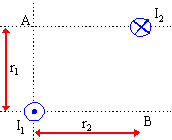
the direction and magnitude of the net
magnetic field at point A and B due to the two wires shown below. The
wires carry
conventional current I1 = 650 mA and I2
=
475 mA. Point A is
a distance r = 1.20
m from wire 1 and point B is r2 =
2.20 m away.
- In the diagram
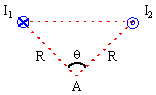
below, the cross–section of two wires is
shown. The wire on the left carries a current of I1
= 12.5 A
directed into the paper while the left has current I2
= 8.5 A
directed out of the paper. Both wires are R = 0.45 m from
point A and the θ =
90° What is the
magnetic field in component form at A?
- A +6.00 μC
charge is moving with a speed of 7.50 × 10⁶
m/s parallel
to a long, straight wire. The wire carries a current of 67.0
A in a direction opposite to that of the moving charge, and is
5.00 cm from the charge. Find the magnitude and direction of
the force on the charge.
- Two rigid rods are oriented parallel to each other
and to the ground. The rods carry the same current in the same
direction. The length of each rod is 0.85 m, while the mass of
each is 0.073 kg. One rod is held in place above the ground,
and the other floats beneath it at a distance of 8.2 × 10⁻³
m. Determine the current in the rods.
- An electron is travelling 10.0 cm above and parallel
to a long thin wire carrying 8.00 A of current. The conventional
current is out of the paper as shown and the wire is parallel
to the surface of the earth. What is the wire's magnetic field
at the electron location? With what speed and direction must
the electron be moving such that the magnetic force exactly balances
the force due to gravity? The charge of an electron is -1.60
× 10-19 C and its mass is 9.11
× 10-31 kg.
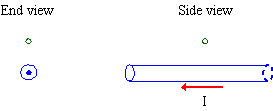
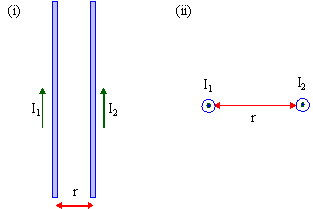
- Two current carrying wires are parallel to each
as shown in diagram (i) below. The side view is given in diagram
(ii). The wires are 0.35 m apart. The current in the first wire
is 25 A and 18 A in the second. The wires are 15.0 m long. What
is the magnetic field (magnitude and direction) at the second
wire due to the first wire? What is the force (magnitude and
direction) on the second wire because of the magnetic field?
Law of Biot-Savart
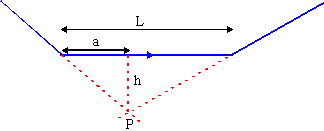
- A wire carrying a current I is shaped as shown
below. Find the magnitude of the magnetic field at point P using
the Law of Biot-Savart. The identity ∫dx[x2+b2]-3/2
= x/(b2[x2+b2]½
+ C) may be of assistance.
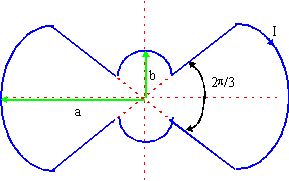
- A wire carrying a current I is shaped as shown
below. The arcs are circular of radii a and b. The straight
pieces a radial to the centre of the shape. Find the magnitude
of the magnetic field at the centre of the shape using the Law
of Biot-Savart. The relationship S = rθ
may be of use.
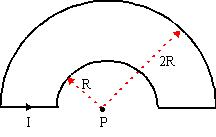
- A loop of wire has the shape of two concentric
semicircles connected by two radial segments. The loop carries
current I as shown. Find the magnetic field at the point P using
the Law of Biot-Savart.
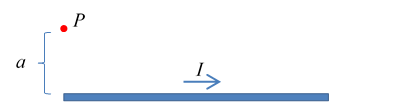
- A thin very long (treat as semi-infinite) wire carries a conventional current
I as shown. Find the magnetic field at point P which is a distance
a from the end of the wire.
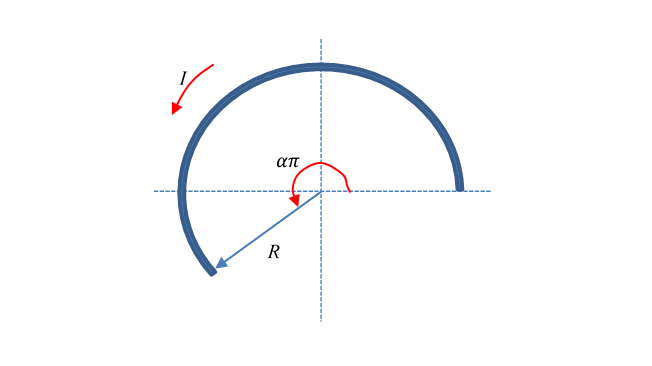
- The magnetic field at the centre of radius of curvature of a loop is a very
common problem. In this problem, the arc has radius of curvature R that goes
from zero to απ and the conventional current I is counter clockwise.
Find and solve the integral expression for the magnetic field. The relationships
S = Rθ may be of use and dℓ =
dℓ [−i sinθ + j cosθ]
may be helpful.
Ampere's Law
- A long copper wire of cross-sectional radius
R carries a uniform current I. Use
Ampere's Law to determine B as a function of the distance
a from
the centre of the wire. Sketch the result.
- A coaxial cable consists of two concentric very
thin, very long, cylindrical shells of radius R and 2R. The shells
carry equal
and opposite currents I. Determine the
magnetic field B as a function of the distance a from the centre of the
wire. Sketch the result.
- A long copper pipe with thick walls has an inner
radius R and an outer radius 2R. A current I flows along this
wall, uniformly distributed over the cross-sectional area of the
copper. Use Ampere's
Law to find the magnetic fields as a function of radial distance
from the centre of the pipe. Sketch the result.
- A coaxial cable consists of a long cylindrical
copper wire of radius r1 surrounded by a
cylindrical
insulating shell of outer radius r2 . A final
conducting
cylindrical shell of outer radius r3 surrounds
the
insulating shell. The wire and conducting shell carry equal but
opposite currents I uniformly distributed over their volumes. Find
formulas for
the magnetic field in each of the regions 0 < a < r1,
r1 < a < r2,
r2 < a
< r3 , and a > r3, where a is the radial distance from the centre of the cable. Sketch the
result.
- A long copper wire of cross-sectional radius
R carries a current density j(r) = Ae-Kr. Use
Ampere's
Law to determine B as a function of the distance a from the centre
of the wire. Sketch the result. The integral identity ∫
e-axxdx
= -(x/a)e-ax + e-ax/a + C
may be of use.
Questions?
mike.coombes@kpu.ca
![[Return to Kwantlen Homepage]](http://www.kpu.ca/images/return_button.gif)