![[Return to Physics Home Page]](./../../physics.gif)
![[Return to Mike Coombes' Home Page]](./../../coombes.gif)
![[Return to List of Handouts]](./../../handouts.gif)
![[Return to Problem Sets]](./../../problems.gif)
![[Return to List of Solutions]](./../../solutions.gif)
Induction, Faraday's Law, and Lenz' Law
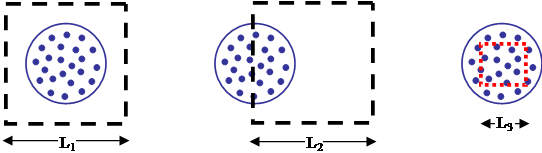
- The diagram below shows a uniform magnetic field confined
to a cylindrical region of space (seen end on). The magnitude of the field is B
= 1.72 T. The circular cross-section of the region has a radius of 0.10 m. The
magnetic field is also shown with three different square regions. The sides of
the square regions are L1 = L2 = 0.30 m and L3
= 0.10 m.
(a) Find the flux in each square region.
(b) If the flux is increasing 0.025 T/s, what is
the induced emf around the perimeter of each square region–
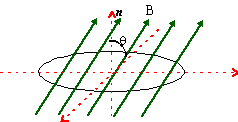
- In the diagram below, a circular loop is in a
uniform magnetic field B = 0.045 T. The field is oriented at
an angle of θ
= 25° to normal to the loop. The radius of the loop is 10 cm.
(a) Find the magnetic flux through the loop.
(b) If the magnetic field decreases at a rate
of 0.050 T/s, find the induced emf in the loop.
(c) If, instead, the radius of the loop increases
at 0.10 m/s, find the induced emf in the loop.
(d) If direction of the magnetic field increases
at the rate of 2.5 rad/s find the induced emf in the loop.
(e) If all the above changes occur at the same time,
find the induced emf in the loop.
(f) Which way would a current flow in each case.
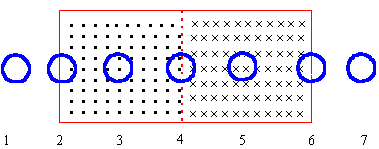
- A single circular hoop moves with constant velocity
through regions where uniform magnetic fields of the same magnitude
are directed either into or out of the plane of the page as indicated
below. Determined the direction of the induced current, if any,
at each of the seven marked positions. HINT: sketch the flux as
a function of position.
-
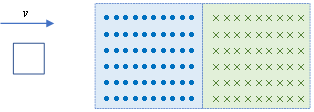
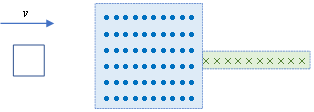
A square 0.1 m × 0.1 m metal coil is travelling at v = 1 m/s toward
a region of space with two magnetic fields side by side. The regions are each
0.4 m wide. In the first region, the magnetic field is a constant 0.9 T directed
out while the field is a constant 0.9 T inward in the second region.
(a) Plot Φ vs t where t = 0 is when the square first reaches the magnetic field region. Label the axes!
(b) Plot ϵ vs t where t = 0 is when the square first reaches the magnetic field region. Label the axes!
(c) How would your answers change if the coil is travelling at v = 2 m/s?
-
A square 0.1 m × 0.1 m metal coil is travelling at v = 1 m/s toward
a region of space with two magnetic fields side by side. The regions are each
0.4 m wide. In the first region, the magnetic field is a constant 0.9 T directed
out while the field is a constant 0.9 T inward in the second region. The second
region is 0.05 m high and is centered on the oncoming coil.
(a) Plot Φ vs t where t = 0 is when the square first reaches the magnetic field region. Label the axes!
(b) Plot ϵ vs t where t = 0 is when the square first reaches the magnetic field region. Label the axes!
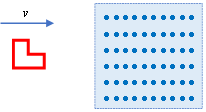
- An L-shaped metal coil is travelling at v = 2 m/s toward a
region of space with a magnetic field. The region is 0.4 m wide. The magnetic
field is a constant 0.8 T directed outward. The L-shape is 0.10 m on the long
sides and 0.05 m on the short sides.
(a) Plot Φ vs t where t = 0 is when the square first reaches the magnetic field region. Label the axes!
(b) Plot ϵ vs t where t = 0 is when the square first reaches the magnetic field region. Label the axes!
-
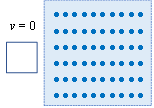
A square 0.1 m × 0.1 m metal coil is at rest just at the edge a region of
space with a magnetic field of 0.8 T out. The region is 0.4 m wide. At t
= 0 s, the coil accelerates forward with a = 2 m/s2.
(a) Determine Φ as a function of time.
(b) Determine ϵ as a function of time.
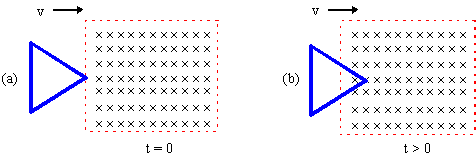
- In diagram (a) below, an equilateral triangle
is just entering, at time t = 0, a region of constant magnetic
field B = 0.335 T into the page. In diagram (b) at some later
time t > 0, the triangle has moved a distance x into the magnetic
field. The triangle has sides of length L = 1.20 m long and is
moving to the right at constant speed v = dx/dt = 2.50 m/s.
(a) Derive an expression for the magnetic flux φm
as a function of x. Hints: The area of a triangle is one-half
the base times the height. Consider similar triangles.
(b) What is the magnitude of the induced emf at t = 0.30 s?
(c) What is the direction of the induced emf at t
= 0.30 s? Fully explain your reasoning.
(d) If the resistance of the wire is 0.50 Ω,
what is the current in the wire?
- The DC-10 jet aircraft has a wingspan of 47 m.
If such an aircraft is flying horizontally at 960 km/h at a place
where the vertical component of the earth's magnetic field is
60 μT, what
is the induced emf between its wingtips?
-
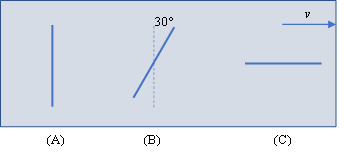
The diagram below shows three 1.0 m long, thin rods moving at v = 100
m/s through a magnetic field of strength B = 0.75 T out of the page.
Find the motional emf in each case.
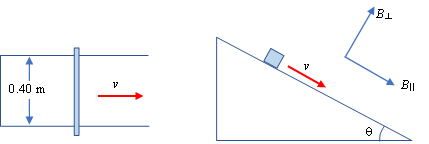
- Two parallel conducting rails are inclined at
30 degrees to the horizontal, and are joined at the top by a length
of copper wire; the rails and wire have negligible resistance.
A 0.40 m long conducting rod of resistance 2.00 Ω
slides without friction down the rails. Sliding through the magnetic
field induces a current in the rod. The current-carrying rod
then experiences a force from the external magnetic field. Assuming
that the component of the magnetic field perpendicular to the
incline, B9, points up, what magnitude must it have to ensure
that the rod slides with a constant velocity of 5.00 m/s. The
mass of the rod is 50.0 g. If the perpendicular component of
the magnetic field pointed down what effect would this have?
Why can we neglect the parallel component of the magnetic field,
Bz?
Questions?
mike.coombes@kpu.ca
![[Return to Kwantlen Homepage]](http://www.kpu.ca/images/return_button.gif)