![[Return to Physics Home Page]](./../../physics.gif)
![[Return to Mike Coombes' Home Page]](./../../coombes.gif)
![[Return to List of Handouts]](./../../handouts.gif)
![[Return to Problem Sets]](./../../problems.gif)
![[Return to List of Solutions]](./../../solutions.gif)
Physics 1220 In-Class Problems: Images Formed by Lenses
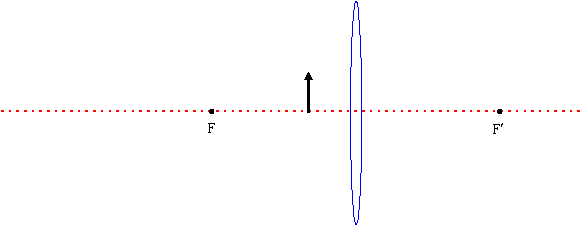
- Use the Principle Ray Technique to find the image,
created by a converging lens, of an object placed between the
first focal point F and the lens. Characterize the image.
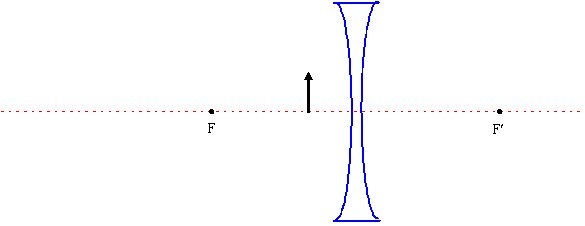
- Use the Principle Ray Technique to find the image,
created by a diverging lens, of an object placed between F and
the lens. Characterize the image.
- The convex lens of a magnifying glass has a focal
length of 20 cm. At what distance from the postage stamp must
you hold this lens if the image of the stamp is to be twice as
large as the stamp and
(a) the image is inverted, or
(b) the image is erect?
- A lens forms an image of an object. The object
is 20.0 cm from the lens. The image is 5.00 cm from the lens
on the same side as the object.
(a) What is the focal length of the lens? Is the
lens converging or diverging?
(b) If the object is 2.00 cm tall, how tall is the
image? Is it erect or inverted?
- An optical system comprises an object, of height
3 mm, fixed at a distance of 1.60 m from a screen. A converging
lens can be moved freely in the space between the object and the
screen. It is found that there are TWO positions of the lens
which will give a real image on the screen, and that these two
positions are 80 cm apart. Determine the focal length of the
lens and the sizes of the two images. A neat diagram is required.
Think about the symmetry of the problem.
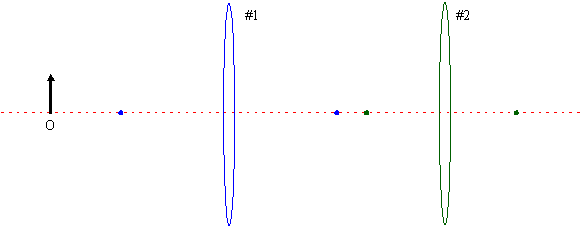
- Two converging lenses have focal lengths f1
= 30 cm and f2 = 20 cm. They are placed 60 cm apart
along the same axis and an object is placed 50 cm from lens #1
on the side opposite lens #2. Locate the final image and calculate
its overall magnification. State the final image characteristics
relative to the original object.
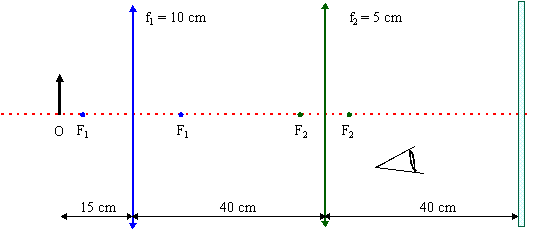
- For the optical system shown below, determine
the final image position as seen by the observer of the object
at position O, due to the lenses and the plane mirror.
Questions?
mike.coombes@kpu.ca
![[Return to Kwantlen Homepage]](http://www.kpu.ca/images/return_button.gif)