![[Return to Physics Home Page]](./../../physics.gif)
![[Return to Mike Coombes' Home Page]](./../../coombes.gif)
![[Return to List of Handouts]](./../../handouts.gif)
![[Return to Problem Sets]](./../../problems.gif)
![[Return to List of Solutions]](./../../solutions.gif)
Physics 1220 In-Class Problems: Images Formed by Mirrors
- Determine the minimum height of a wall mirror that will permit a 1.8-metre tall
person to view his or her entire height. Sketch rays from the top and bottom of the
person, and determine the proper placement of the mirror such that the full
image is seen, regardless of the person's distance from the mirror.
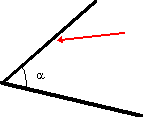
- Two plane mirrors are inclined to one another at an angle α.
A ray travelling in the plane as shown below is incident on one of the mirrors. Applying
the Law of Reflection, show that the path of the ray after the two reflections is deviated
by an angle which is independent of the angle of incidence. Express your answer in terms
of α.
- In the diagram below are two plane mirrors set at an angle of 60° to one another.
A point P is on the bisector of the angle between the two mirrors. Find all the possible
images.

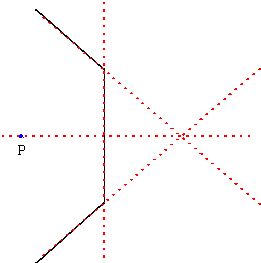
- Three mirrors are arranged as in the diagram below. Find all the images of point P.
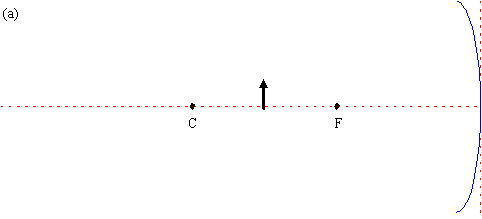
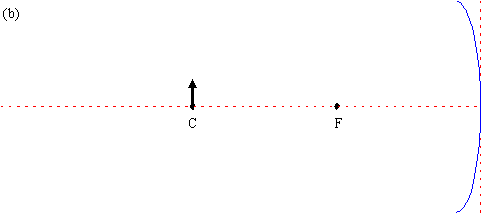
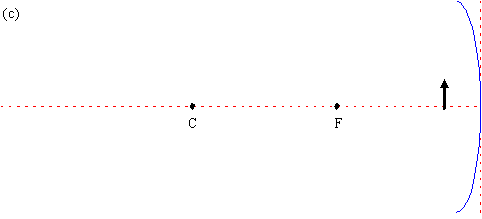
- Use the Principle Ray Technique to find the image,
created by a concave spherical mirror, of an object placed (a)
between C and F, (b) at C, and (c) between F and the mirror.
In each case, characterize the image, if possible.
- When people stand in front of a type of mirror
found in amusement parks, they see themselves with small heads
and large lower torsos. Explain how this is accomplished.
- An object is placed 25 cm in front of a concave
mirror of focal length 30 cm. Calculate the image distance and
the magnification. Characterize the image.
- An object is placed 25 cm in front of a convex
mirror of focal length 30 cm. Calculate the image distance and
the magnification. Characterize the image.
Questions?
mike.coombes@kpu.ca
![[Return to Kwantlen Homepage]](http://www.kpu.ca/images/return_button.gif)