![[Return to Physics Homepage]](./../../physics.gif)
![[Return to Mike Coombes' Homepage]](./../../coombes.gif)
![[Return to List of Handouts]](./../../handouts.gif)
![[Return to Problem Sets]](./../../problems.gif)
![[Return to List of Solutions]](./../../solutions.gif)
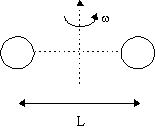
The moment of inertia for point particles is given
by  . Rewriting this for L yields
  .
.
![[Return to Top of Page]](./../../top.gif)
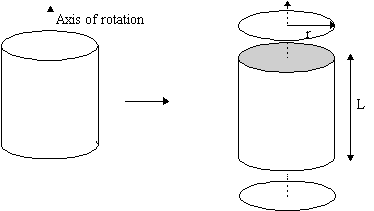
(a) The mass has three components, M = Mlid
+ Mshell + Mbottom = 50 g, where the lid
and the bottom are identical. Mass is proportional to the surface
area for uniform objects. The area of the lid and bottom is that
of a circle, Acircle = πr2
. The surface area of a
cylindrical shell is Ashell = 2πrL.
So the total area of can is Atotal = 2Acircle + Ashell =
2πrL + 2πr2 =
2πr(r + L).
So the mass of the lid or
bottom is given by 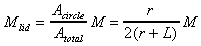 . Thus Mlid
= 5.392 g.
. Thus Mlid
= 5.392 g.
(b) Similarly, the mass of the shell is given by
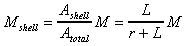 . Thus Mshell = 39.216 g.
(c) The total moment of inertia of the beer can is given by the sum of the individual pieces, Itotal = Ilid + Ishell + Ibottom. Since each piece is revolving about its centre of mass, we do not need the parallel axis theorem. Looking up the moments of inertia of a flat solid disk and a thin cylindrical shell, we have Itotal = 2×½Mlidr2 + Mshellr2 = 4.86 × 10⁻⁵ kg-m2.

(a) The moment of inertia of a composite body is
equal to the sum of the moments of its individual pieces,
 .For
axis A, the rod is rotating about its centre of mass. Each sphere
is a distance R+L/2 from the axis of rotation, so we must use
the parallel axis theorem. Recall that the moment of inertia
of a rod about its centre is
.For
axis A, the rod is rotating about its centre of mass. Each sphere
is a distance R+L/2 from the axis of rotation, so we must use
the parallel axis theorem. Recall that the moment of inertia
of a rod about its centre is  and that
the moment of inertia of a solid sphere about its centre is
and that
the moment of inertia of a solid sphere about its centre is  .
Thus we have
.
Thus we have

(b) For axis B, the rod's centre is R+L/2 away from the axis of rotation. One sphere's centre is L+2R from the axis of rotation. The last sphere is rotating about axis B. Thus r

(c) The bar and both spheres are rotating about their own centres when rotating about axis c. However, note that the bar is a cylinder or radius r in this configuration.

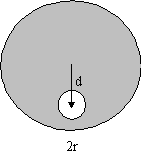
We must treat the hole as an object of negative
mass. The inertia of the object is then just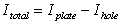 .
The plate and the hole are just disks and the inertia of a disk
is
.
The plate and the hole are just disks and the inertia of a disk
is  . The hole is not rotating about its
own centre of mass, so we must use the parallel axis theorem,
. The hole is not rotating about its
own centre of mass, so we must use the parallel axis theorem,
 .
. .
. .
.
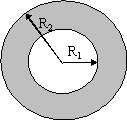
We must treat the hole at the centre as a sphere
of negative mass. Since the moment of inertia of a sphere about
its centre is  , the moment of inertia
of this object is
, the moment of inertia
of this object is
 .
. .
.  .
.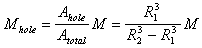 .
. .
.
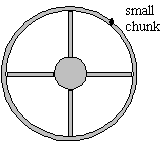
The moment of inertia of a composite body is equal
to the sum of the moments of its individual pieces,  .
The rods are not rotating about their centre of mass, so we must
use the parallel axis theorem. The centre of each rod is Rcyl+L/2
from the axis of rotation at the centre of the object. The moments
of inertia for a cylindrical shell, a disk, and a rod are MR2,
.
The rods are not rotating about their centre of mass, so we must
use the parallel axis theorem. The centre of each rod is Rcyl+L/2
from the axis of rotation at the centre of the object. The moments
of inertia for a cylindrical shell, a disk, and a rod are MR2,
 , and
, and  respectively.
The moment of inertia of a point mass is
respectively.
The moment of inertia of a point mass is  .
Thus the total moment of inertia is:
.
Thus the total moment of inertia is:
 .
.
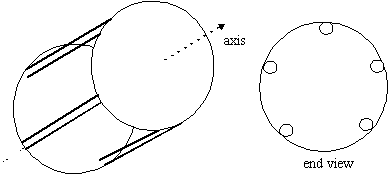
The moment of inertia of a composite body is equal
to the sum of the moments of its individual pieces,  .
The cylinders are not rotating about their centre of mass, so
we must use the parallel axis theorem. The centre of each rod
is Rdisk- Rcyl from the axis of rotation
at the centre of the object. The moments of inertia for a a disk
or a cylindrical rod are is
.
The cylinders are not rotating about their centre of mass, so
we must use the parallel axis theorem. The centre of each rod
is Rdisk- Rcyl from the axis of rotation
at the centre of the object. The moments of inertia for a a disk
or a cylindrical rod are is  . The moment
of inertia of a point mass is
. The moment
of inertia of a point mass is  . Thus
the total moment of inertia is:
. Thus
the total moment of inertia is:
 .
.
Questions? mike.coombes@kpu.ca
![[Return to Kwantlen Homepage]](http://www.kpu.ca/images/return_button.gif)