![[Return to Physics Homepage]](./../../physics.gif)
![[Return to Mike Coombes' Homepage]](./../../coombes.gif)
![[Return to List of Handouts]](./../../handouts.gif)
![[Return to Problem Sets]](./../../problems.gif)
![[Return to List of Solutions]](./../../solutions.gif)
| Questions: | 1 | 2 | 3 | 4 | 5 | 6 | 7 | 8 | 9 | 10 | 11 |
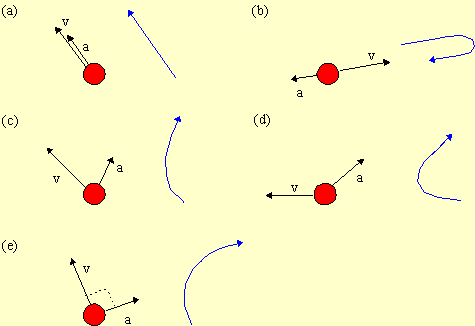
As time passes, the velocity will tend to point in the direction of a.
![[Return to Top of Page]](./../../top.gif)
A particle has initial position r0 = <5 m, -3 m, 0 m> and initial velocity v0 = <0.4 m/s, -4 m/s, 2 m/s>. The acceleration is constant, a = <3 m/s2, 4 m/s2, -2m/s2>. Find the position of the particle after t = 2.5 seconds. What was the magnitude of the particle's displacement during this time?
The i, j, and k components are completely independent of one another. The final x position of the particle depends only on the x components, similarly for the y and z components. Thus the problem reduces to handling three 1D kinematics problems. For the given information, we use our kinematics equation to find x, y, and z.
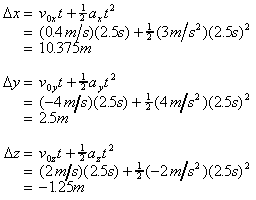
Thus the final displacement is thus r = <x, y, z> = <10.375 m, 2.5 m, -1.25 m>.
The magnitude of the displacement is found by using the 3D version of Pythagoras' Theorem:
 .
.
The straight-line distance between the starting and end points is 10.7 m.
To find the final position of the particle, one must examine the definition of displacement, r = rf - r0, which can be rearranged into rf = r0 + r. Thus we find that rf = r0 + r = <5 m, -3 m, 0 m> + <10.375 m, 2.5 m, -1.25 m> = <15.375 m, -0.5 m, -1.25 m>.
You are trapped on the top of a burning building. Death is imminent and help is nowhere in sight. There is a safe building 6.50 m away and 3.00 m lower. You decide to try and make it across. You run horizontally off your building at 8.10 m/s. Do you make it across? If you don't, how much faster must you be going?
First we sketch the situation and possible outcomes.
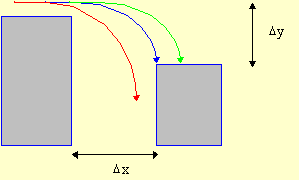
While you are jumping, you are a projectile. We solve projectile motion problems by considering the x and y components separately, keeping in mind that the time in air is common. We write out the i and j information in separate columns including the information that we can infer or that we are supposed to know like the fact that running horizontally implies that voy = 0..
|
|
|
||
| Δxsafe = 6.50 m | Δysafe = -3.00 m | minus indicates down | |
| ax = 0 | No x component for projectiles | ay = -g = -9.81 m/s2 | gravity acts down |
| v0x = 8.10 m/s | v0y = 0 m/s | horizontal takeoff means
no vertical component |
|
| tair = ? | common | tair = ? |
Looking at the x information, we see that we have enough data to find tair. The kinematics equation that has all four quantities is Δx = v0xt + ½axt2. Since ax = 0 for a projectile, this equation become Δx = v0xt. Solving for t, we get
This is the time it would take you to cross a horizontal distance of 6.50 m. You must be in the air for at least this long if you are to safely make it across to the next building.
On the other hand, looking at the y information, we see that we also have enough data to find tair. The kinematics equation that has all four quantities is Δy = v0yt + ½ayt2. We know v0y = 0 since you ran off the roof horizontally and that ay = -g, thus this equation becomes Δy = -½gt2. Solving for t, we get
This is the time it takes you to fall a vertical distance of 3.00 m. If you do reach the other building, then this is how long you were in the air.
Since the time it takes to cross the horizontal distance is less than the time you have, you have don't make it across.
To make it across safely you of course would need to run off the roof faster. Since ax = 0 for projectiles, the kinematics equation become Δx = v0xt where t is now the 0.7821 s. Solving for v0x, we get ,
If you were able to run at 8.31 m/s you would safely make it to the other building.
A stunt motorcyclist is trying to jump over fifteen buses set side to side. Each bus is 2.50 m wide and a 30.0° ramp has been installed on either side of the line of buses. What is the minimum speed at which she must travel to safely reach the other side. How long will she be in the air?
First we sketch the situation and possible outcomes.
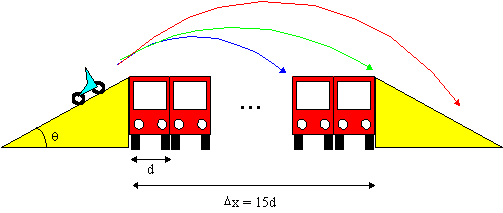
While the motorcyclist is jumping, she is a projectile. We solve projectile motion problems by considering the x and y components separately, keeping in mind that the time in air is common. We write out the i and j information in separate columns including the information that we can infer or that we are supposed to know. We see from the sketch that if the motorcyclist is successful, then this is an example of level-to-level flight and Δy = 0. Note that the initial velocity is broken into components.
|
|
|
||
| Δxsafe = 15×2.50 m = 37.5 m | Δysafe = 0 | level to level flight | |
| ax = 0 | No x component
for projectiles |
ay = -g = -9.81 m/s2 | gravity acts down |
| v0x = v0 cosθ | v0 is unknown | v0y = v0 sinθ | |
| tair = ? | common | tair = ? | common |
Looking at the x any y information, we see that we have two unknowns, v0 and t, for both. While we cannot solve any equation for x or y since there are two unknowns, both can be solved together. The appropriate kinematics equations that has all four quantities for x and for y is:
We substitute in known quantities to get
We can divide the second equation by t and we get
We rewrite the first equation as t = Δx / v0 cos, which we substitute into the second equation to get v0 sin= ½g[Δx / v0 cosθ]. Getting v0 by itself we have v0 = {g/(2sin cosθ)}½. Plugging in the appropriate numbers, we get v0 = 20.61 m/s = 74.2 km/h. Since is the speed that the motorcyclist must have on liftoff to successfully reach the other ramp.
We can substitute this value into t = Δx / v0 cosθ to find the time in air to be 2.10 s.
A boy throws a rock with speed v = 18.3 m/s at an angle of θ = 57.0° over a building. The rock lands on the roof 15.0 m in the x direction from the boy. How long was the rock in the air? How much taller, height h, is the building than the boy? Ignore air resistance.
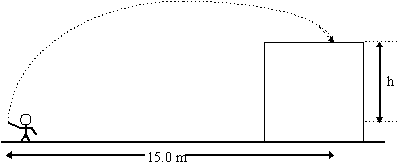
The rock is a projectile. We solve projectile motion problems by considering the x and y components separately, keeping in mind that the time in air is common. We write out the i and j information in separate columns including the information that we can infer or that we are supposed to know. We see from the sketch that h = Δy, the vertical displacement. Note that the initial velocity is broken into components.
|
|
|
||
| Δx = 15.0 m | Δy = h | ||
| ax = 0 | No x component for projectiles |
ay = -g = -9.81 m/s2 | gravity acts down |
| v0x = v0
cosθ
= 18.3 × cos(57°) = 9.9669 m/s |
v0y = v0
sinθ
= 18.3 × sin(57°) = 15.3477 m/s |
||
| tair = ? | common | tair = ? | common |
Looking at the x information, we see that we have enough data to find tair. The kinematics equation that has all four quantities is Δx = v0xt + ½axt2. Since ax = 0 for a projectile, this equation become Δx = v0xt. Solving for t, we get
Looking at the y information, we see that we now have enough data to find h. The kinematics equation that has all four quantities is Δy = v0yt + ½ayt2. Since Δy = h and ay = -g, this equation become h = v0yt - ½gt2. Substituting in the appropriate numbers reveals that h = 12.0 m. The building is 12.0 m taller that the boy where we have assumed that the ball left the boy's hand at head height which is a reasonable assumption.
 θ
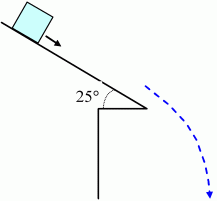
θWhen the tile slides down the roof, it travels in a straight line. That is a 1D kinematics problem. When it leaves the roof, it becomes a projectile problem.
(a) We solve the 1D problem first. We write down all the given data and unknowns:
| Δx = 3.75 m | |
| v0 = 0 | starts from rest |
| a = 2.10 m/s2 | |
| vf | need this for the second part |
Inspecting the data, we see that we can use the kinematics equation 2aΔx = (vf)2 - (v0)2. Solving for vf, we find
This is the speed that the tile leaves the roof and is the initial velocity for the second part of the problem.
(b) The vertical component of the velocity of the tile as it leaves the roof is v0x = -vfsin(25°) = -1.6772 m/s. Note that the minus sign indicates that the tile is moving downwards.
(c) The horizontal component of the velocity of the tile as it leaves the roof is v0x = vfcos(25°) = 3.5968 m/s.
(d) The tile is now a projectile. We solve projectile motion problems by considering the x and y components separately, keeping in mind that the time in air is common. We write out the i and j information in separate columns including the information that we can infer or that we are supposed to know. We see from the sketch that Δy is the vertical distance that the tile falls. Note that the initial velocity is broken into components.
|
|
|
||
| Δx = ? | Δy = -8.40 m | minus means down | |
| ax = 0 | No x component
for projectiles |
ay = -g = -9.81 m/s2 | gravity acts down |
| v0x = 3.5968 m/s | v0y = -1.6772 m/s | ||
| tair = ? | common | tair = ? | common |
Looking at the y information, we see that we have enough data to find tair. The kinematics equation that has all four quantities is Δy = v0yt +½ayt2. Substituting in the appropriate numbers reveals that we have a quadratic in t:
The two solution to this quadratic are t = 1.149 s and t = -1.491 s. We take the positive solution as that is the solution for times after the tile left the roof.
(e) Looking at the x information, we see that we now have enough data to find Δx. The kinematics equation that has all four quantities is Δx = v0xt + ½axt2. Since ax = 0 for a projectile, this equation become Δx = v0xt. Substituting in the appropriate numbers, we get Δx = v0xt = 3.5968 m/s × 1.149 s = 4.13 m. The tile land 4.13 m from the eave of the roof.
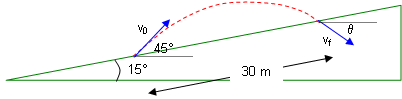
We know
| v0 = i v0cos(45°) + j v0 sin(45°) |
| vf = i vf cos(θ) – j vf sin(θ) |
| a = – j g = – j 9.81 m/s2 |
| Δr
= i 30 cos(15°) + j
30 sin(15°) m
= i 28.978 + j 7.765 m |
Applying our kinematic equations to the situation:
| vf cos(θ) = v0 cos(45°) | (1) |
| 28.978 = v0 cos(45°) t | (2) |
| 7.765 = v0 sin(45°)t – ½gt2 | (3) |
| –vf sin(θ) = v0 sin(45°) – gt | (4) |
| 2(9.81)(7.765) = [–vf sin(θ)]2 – [v0 sin(45°)]2 | (5) |
Examining the equations, we find that we can eliminate v0t from equation (3) using equation (2). This yields
7.765 = [28.978/cos(45°)] sin(45°) – ½gt2 .
This can be simplified and solved for t. We find t = 2.0796 s. Knowing t, equation (2) can be solved to yield v0 = 19.706 m/s. With v0 and t, equations (1) and (4) become vf cos(θ) = 13.934 and vf sin(θ) = 6.467. The ratio of these two equations yields tan(θ) = 0.4641 or θ = 24.9°. Also vf = 15.36 m/s.
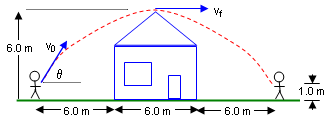
The main point of interest is the rooftop. To just clear the roof, requires that the roof be at the top of the parabola. We know
| v0 = i v0 cos(θ) + j v0 sin(θ) |
| vf = i vf + j 0 |
| a = – j g = – j 9.81 m/s2 |
| Δr = i 9 + j 5 m |
Applying our kinematic equations to the situation:
| vf = v0 cos(θ) | (1) |
| 9 = v0 cos(θ) t | (2) |
| 5 = v0 sin(θ)t – ½gt2 | (3) |
| 0 = v0 sin(θ) – gt | (4) |
| 2(–9.81)(5) = –[v0 sin(θ)]2 | (5) |
Equation (5) allows us to find the y component of the initial velocity v0y = v0 sin(θ) = 9.905 m/s. We can use this result to find t from equation 4, t = 1.0096 s. Knowing t we can use equation (2) to find the x component of the initial velocity v0x = v0 cos(θ) = 8.914 m/s. Thus the initial velocity is
v0 = i 8.914 + j 9.905 m/s .
The angle θ can be found from the ratio [v0 sin(θ)] / [v0 cos(θ)] = 9.905/8.914 or, more simply, tan(θ) = 1.111 which yields θ = 48.0°.
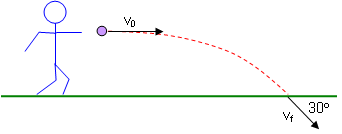
We know
| v0 = i v0 + j 0 |
| vf = i vf cos(30°) – j vf sin(30°) |
| a = – j g = – j 9.81 m/s2 |
| Δr = i Δx – j 1.10 m |
Applying our kinematic equations to the situation:
| v0 = vf cos(30°) | (1) |
| Δx = v0 t | (2) |
| –1.10 = –½gt2 | (3) |
| – vf sin(30°) = –gt | (4) |
| 2(–9.81)(-1.10) = [–vf sin(30°)]2 | (5) |
To determine v0, we need to know vf or Δx in equation (1) or (2). We can use equation (5) to find vf = 9.291 m/s. Thus, from equation (1), v0 = 8.046 m/s.
Since the earth is rotating at constant speed, there is a slight centripetal acceleration. For a person on the equator, calculate this acceleration. The earth has a radius of 6380 km and recall that it takes one day to make a complete rotation.
The definition of centripetal acceleration is ac = v2/R. If we assume uniform circular motion, then v = 2πR/T, where T is the period of motion - one day in this case. Substituting the equation for v into the equation for ac yields,
The definition of centripetal acceleration is ac = v2/R. If we assume uniform circular motion, then v = 2πR/T, where T is the period of motion - one year in this case. Substituting the equation for v into the equation for ac yields,
Questions? mike.coombes@kpu.ca
![[Return to Kwantlen Homepage]](http://www.kpu.ca/images/return_button.gif)