![[Return to Physics Homepage]](../physics.gif)
![[Return to Mike Coombes' Homepage]](../coombes.gif)
![[Return to List of Handouts]](../handouts.gif)
![[Return to Sample Tests]](../tests.gif)
Physics 1120 --- Test #1 --- 18 Feb 98
- A bicyclist uniformly increases his pedaling from 30 rev/min
to 120 rev/min in 5.0 s. For that time interval determine:
(a) the linear acceleration of the bike,
(b) the final linear speed of the bike, and
(c) the distance traveled by the bike.
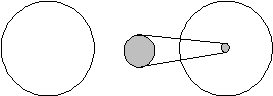
As shown in the diagram below, the pedal gear has a radius of
12.0 cm, the back wheel gear has a radius of 3.5 cm, and the
back wheel itself has a radius of 38.0 cm.
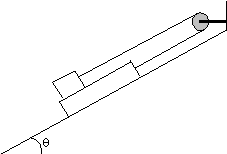
- Two blocks are connected by a rope wound around an ideal massless,
frictionless, pulley as shown in the diagram below. The mass
of the top block is m1 = 5.0 kg. The mass of the second
block is m2 = 25.0 kg. The coefficient of kinetic
friction between the two blocks is µblocks= 0.22. The coefficient of
kinetic friction between the bottom block and the incline is µincline
= 0.14. The incline makes an angle of θ = 35.0° with the horizontal.
Determine the acceleration of the blocks while they remain in
contact.
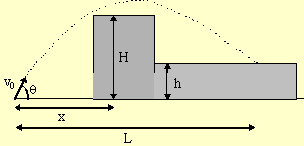
- A softball player throws a ball at a speed of v0
= 25 m/s at an angle θ= 55.0° over a split-level building. The
front higher part of the building has a height H = 8.7 m. The
lower part has a height h = 4.0 m. The player notices that the
pitch just misses the front edge of the building as shown in the
diagram below.
(a) How far away, x, is the front of the building?
(b) How far away, L, does the ball land?
(c) How long was the ball in the air?
- In short sprints, runners can be assumed to maintain constant
speeds. In a practice run, runner 1 whose speed is 11.0 m/s,
starts the race 5.0 m behind runner 2 whose speed is 10.5 m/s.
Despite the headstart, runner 1 wins the race by a distance of
1.0 m.
(a) Provide a neat sketch of the position versus time graph for
the runners.
(b) How long did the race last?
(c) How far did each runner travel?
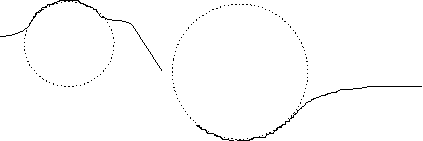
- A car is traveling at a constant speed of 90 km/h over a series
of rolling hills and valleys. These hills and valleys follow
circular arc. As the driver crests the first hill, he notices
a sign which reads "Newton Hill - R = 200 m". At the
bottom of the next valley, he is disappointed by the lack of a
road sign for the valley. However, since he feels twice
as heavy at the bottom of the valley as he feels at the
top of the hill, he deduces the radius of curvature of the valley
on his own. What is that radius of curvature?
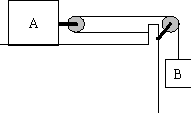
- Two blocks mA = 15.0 kg and mB = 3.0
kg are connected by a massless rope and two massless, frictionless,
pulleys as shown in the diagram below.
(a) If block A move to the right a distance x, how far down will
block B move. From this, if the acceleration of block A is a
, what is the acceleration of block B?
(b) The coefficient of sliding friction between block A and the
surface is µ = 0.25. Determine the acceleration of each block.
(c) Determine the tension in the rope.
Questions?
mike.coombes@kwantlen.ca
![[Return to Kwantlen Homepage]](http://www.kwantlen.ca/images/return_button.gif)