![[Return to Physics Homepage]](../physics.gif)
![[Return to Mike Coombes' Homepage]](../coombes.gif)
![[Return to List of Handouts]](../handouts.gif)
![[Return to Sample Tests]](../tests.gif)
Final Examination
Physics 1120
17 April 1998
Instructions
- Please answer all the questions on this test.
- All questions are worth 10 marks each.
- Show all your work.
- For problems involving force and/or torque, include free body diagrams.
- One 8½ × 11 sheet containing formulas is allowed.
- Formula sheet and examination paper must be submitted with examination.
- Time to do the test is three hours maximum.
- If you have any questions, raise your hand and remain seated.
- Please start each question on a new page in your booklet.
-
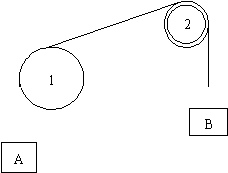
A rope connecting two blocks is strung over two real pulleys as shown in
the diagram below. Determine the acceleration of the blocks and angular
acceleration of the two pulleys. Block A is has mass of 10.0 kg. Block
B has a mass of 6.00 kg. Pulley 1 is a solid disk, has a mass of 0.55 kg,
and a radius of 0.12 m. Pulley 2 is a ring, has mass 0.28 kg, and a radius
of 0.08 m. The rope does not slip.
-
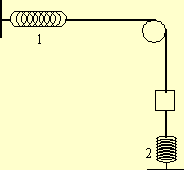
A block of mass M is connected via ropes to two springs. The horizontal
spring (1) has spring constant K1 while the vertical spring
(2) has spring constant K2. The pulley is a solid disk with
mass mp. Initially nothing is moving and the vertical spring
is at equilibrium. The horizontal spring, however, is stretched an amount
x. When the block is released it moves upwards. Obtain an expression
for the speed of the block when the horizontal
spring is back at equilibrium.
(For bonus marks, use calculus to find the value of x for which v is
a maximum.)
-
(a) You are in an absolutely quiet room with two appliances both of which
are turned off. When the photocopier is on by itself, the sound level at
your location is 75.0 dB. When the coffee grinder is on by itself, the
sound level at your location is 81.0 dB. What will be sound level when
both are turned on?
(b) The diagram below shows a standing wave in a 25.0 cm string
which is under a tension of 12.0 N. The linear density of the string is
1.50 × 10⁻³ kg/m. What is the frequency of the vibration
which is generating this standing wave?

-
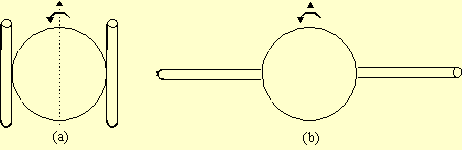
To conserve room on the space shuttle, a satellite is launched as shown
in diagram (a). After launch tiny internal motors position the arms as
shown in diagram (b). The satellite consists of a spherical body and two
arms which are cylindrical rods. The sphere has a mass of 200 kg and a
radius of 0.75 m. Each arm is 1.40 m long, has a radius of 0.05 m, and
a mass of 15.0 kg.
(a) What is the moment of inertia of the satellite in diagram (a)?
(b) What is the moment of inertia of the satellite in diagram (b)?
(c) If the satellite must have a final rate of rotation of 70.0 revolution
per min, how fast must it be rotating when it is released from the shuttle?
(d) How much (non-conservative) work, do the tiny motors do in changing
the satellites shape?
-
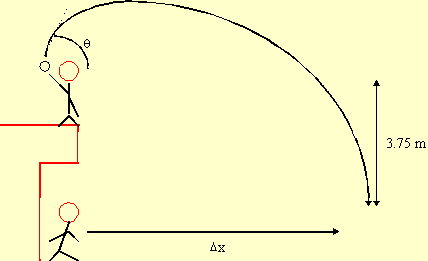
Two boys are playing in the snow in the diagram below. One boy is standing
on the edge of the roof while the other is 3.75 m underneath the first.
The boy on the ground runs forward at 5.20 m/s. The boy on the roof can
throw a snowball at 8.50 m/s.
(a) At what angle should the boy on the roof throw the snowball so
that it hits the running boy on the top of his head?
(b) What distance x did the boy get to?
(c) How long was the snowball in the air?
-
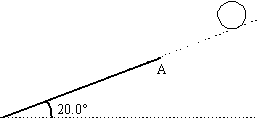
A ball is placed on an incline as shown in the diagram below. The upper
part of the incline is frictionless, so the ball slides but does NOT rotate.
At point A, when its speed is 4.50 m/s, it reaches a rough portion of the
incline where µk = 0.20. Here the ball starts to rotate.
(a) How long does it take for the ball to roll without slipping?
(b) How far down the incline from point A does this occur?
-
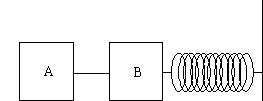
(a) The diagram below shows two blocks connected by a thin massless rod. The
right block is connected to a wall by a spring with K = 2000 N/m. Block
A has a mass of 10.0 kg while block B has a mass of 8.00 kg. The rod
will break if the tension in the rod exceeds 75.0 N. The spring is compressed
and the blocks are allowed to oscillate back and forth. What is the maximum
compression that the spring can have, if the rod is not to break. The
surface is frictionless.
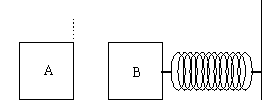
(b) A block B, attached to a spring of spring constant K = 1400 N/m,
is compressed 30.0 cm. A block A is placed at the now vacant equilibrium
position of block B. Block B is released and undergoes a totally inelastic
collision with block A. What is the speed of block B after the collision?
-
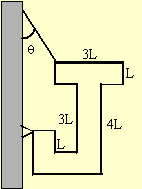
The sign below has a total mass of 50.0 kg. The given angle is = 25.0°
and L = 0.20 m.
(a) Find the centre of mass of the sign relative to the hinge.
(b) Find the tension in the cable.
(c) Find the horizontal and vertical components of the hinge force.
-
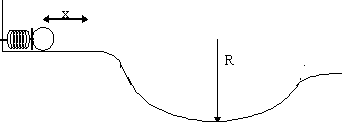
In the diagram below, a ball is pressed into a spring a distance x. When
released, the ball rolls without slipping to point A at the bottom
of a semicircular valley. The apparent weight of the ball at point A is
5/3rd of its normal weight. If the spring constant is 1500 N/m and the
ball has a mass of 250 g, find x. The radius of the valley is R = 1.35
m.
Formulas
Error Propagation
| Adding or Subtracting |
Δ(A+B-C)= ΔA
+ ΔB + ΔC |
| Multiplying or Dividing |
Δ(AB/C)= (AB/C)(ΔA/A
+ ΔB/B + ΔC/C) |
| Powers and Roots |
Δ(Az) = zAz-1ΔA |
| Special Fuctions |
sin(θ±Δθ)
= sin(θ)±Δθ
cos(θ)
cos(θ±Δθ)
= cos(θ)±Δθ
sin(θ)
tan(θ±Δθ)
= tan(θ)±Δθ
/cos2(θ)
e(x±Δx) = ex±Δxex
ln(x±Δx) = ln(x)±Δx/x |
|
Note: Δθ must be stated in radians! |
Kinematics
| vaverage = Δx/Δt |
Ωaverage = Δθ/Δt |
| vaverage = (vf+v0)/2 |
Ωaverage = (Ωf+
Ω0)/2 |
| aaverage = Δv/Δt |
αaverage = Δω/Δt |
| Δx = vaveraget |
Δθ =
Ωaveraget |
| Δx = v0t + ½at2 |
Δθ =
Ω0t
+ ½αt2 |
| v = v0 + at |
Ω = Ω0
+ αt |
| v2 = (v0)2 + 2aΔx |
Ω2 = (Ω0)2
+ 2αΔθ |
Translation <-> Rotation
| s = Rθ |
vtan = RΩ |
atan = Rα |
ac = v2/R |
Newton's Laws
| ΣFx = max |
ΣFy = may |
fmax static = μsN |
fkinetic = μkN |
Gravitation
| F = Gm1m1/R2 |
g(R) = GMplanet/R2 |
v = [GMplanet/R]½ |
T2 = 4π2R2/
GMcentral |
| G = 6.672 × 10⁻¹¹ N-m2/kg2 |
g = 9.81 m/s2 |
Rolling
vlinear = vtangential
Torque
| τ = Iα |
τ = r ×
F |
τz = xFy
- yFx |
Centre of Mass
| xCM = Σmixi |
yCM = Σmiyi |
zCM = Σmizi |
|
Moment of Inertia
| Iparticles = Σmiri2 |
Itotal = I1 + I2 + I3
... |
I = Icm + Md2 |
Work and Energy
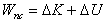 |
Klinear = ½mv2 |
Krotational = ½IΩ2 |
| Ugravity = mgh |
Uspring = ½Kx2 |
|
Collisions
| p = mv |
 |
Pf = Pi |
| v1f - v1f = -(v1i - v2i) |
I = Δp = FaverageΔt |
Angular Momentum
| L = r × p |
Lz = xpy - ypx = rpsinφ |
Llinear = bmv |
| Lorbital = r2mΩ |
LA = IAΩA |
Ltotal = L1 + L2
+
L3 ... |
| Lfinal = Linitial |
Simple Harmonic Motion
Waves
Standing Waves
If the string is fixed at both ends or air column is open at both
ends
Use 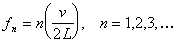
Use 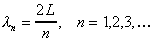
If the string or air column has one open end and one fixed end
Use 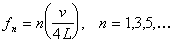
Use 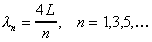
Sound Level / Decibels / Sound Intensity
| ITotal = I1 + I2 + I3
... |
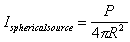 |
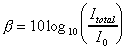 |
| ITotal = I0 × 10(β/10) |
I0 = 1 × 10-12 W/m2 |
Doppler Shift
Use 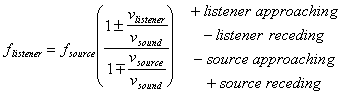
Interference
Constructive interference (maximum amplitude) when
Δx
= nλ, n =
1, 2, 3, ...
Destructive interference (zero or minimum amplitude) when
Δx
= nλ/2,
n
= 1, 3, 5, ...
Questions?mike.coombes@kwantlen.ca
![[Return to Kwantlen Homepage]](http://www.kwantlen.ca/images/return_button.gif)