![[Return to Physics Homepage]](../../physics.gif)
![[Return to Mike Coombes' Homepage]](../../coombes.gif)
![[Return to List of Handouts]](../../handouts.gif)
![[Return to Problem Sets]](../../problems.gif)
![[Return to List of Solutions]](../../solutions.gif)
Standing Waves and Resonance
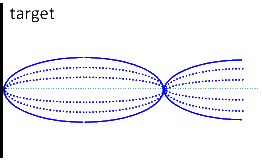
A wire of length 4.35 m and mass 137 g is under a tension of 125 N. A standing wave has formed which has seven nodes including the endpoints. What is the frequency of this wave? Which harmonic is it? What is the fundamental frequency? The maximum amplitude at the antinodes is 0.0075 m, write an equation for this standing wave.
A string fixed at one end only is vibrating in its third harmonic. The wave function is y(x,t) = 0.02sin(3.13x)cos(512t), where y and x are in metres and t is in seconds. (a) What is the wavelength of the wave? (b) What is the length of the string. (c) What is the speed of the transverse wave in the string?
Three successive resonance frequencies for a certain string are 175, 245, and 315 Hz. (a) Find the ratio of these three modes. (b) How can you tell that this sting has an antinode at one end? (c) What is the fundamental frequency? (d) Which harmonics are these resonance frequencies? (e) If the speed of transverse waves on this string is 125 m/s, find the length of the string?

Sound Level
A typical speaker diaphragm vibrates with a maximum displacement of 2.00 mm. Assuming that this is also the maximum displacement of the nearby air molecules, find the maximum pressure amplitude. Take the frequency of the speaker to be f = 3000 Hz, the density of the air to be ρ = 1.29 kg/m3, and the speed of sound to be 340 m/s.
When one student is doing an exam in an otherwise very quiet room, the sound level is 45 dB. What is the intensity of the noise produced by the student? If there are 30 equally noisy students in the room, and assuming that you are the same distance from all the students, what would the new sound level be?
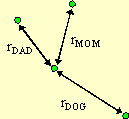
You've been out very late and when you come home your parents are very angry and start shouting at you. This upsets the family dog who starts howling. The diagram below shows their positions with you in the middle. The distances are rDAD = 1.20 m, rMOM = 1.35 m, and rDOG = 2.00 m. The power in their voices are respectively, PDAD = 1.25 mW, PMOM = 0.85 mW, and PDOG = 1.00 mW. Find the intensity of sound from each source at your position. Treat the sources as incoherent (in the physical sense) and find the sound level. Be sure to include the effects of the normal background sound level of 40 dB. I0 = 10-12 W/m2.
Doppler Shift
A driver travels north on a highway at a speed of 25 m/s. A police car, driving south at a speed of 40 m/s, approaches with its siren sounding at a base frequency of 2500 Hz. (a) What frequency is heard by the driver as the police car approaches? (b) What frequency is heard by the driver after the police car passes him? If the driver had been travelling south, what would your results have been for (a) and (b)? The speed of sound in air is v = 340 m/s.
In sonar, an intermittent high frequency sound pulse is broadcast in all directions. The sound is reflected from solid objects and returns to broadcaster. The time it took for the echo to return and the direction from which the echo came are used to locate nearby objects. This is Echo Location. By measuring the Doppler Shift of the echo, the speed of the object can be found. There is an added complication in that the Doppler Shift occurs twice, once from the source to the receiver, and then from the receiver (now a source of the echo) back to the original source (which is now a receiver of the echo). The echo will have a frequency
f´ = f0 [(1 ± ur/v)/(1 ± us/v][(1 ± us/v)/(1 ± ur/v)] .
A submarine traveling at 17 km/h sends out pulses at 38.7 MHz. The delay in the echo off a second sub has been rapidly decreasing and is currently 75 ms. How far apart are the two subs? If the second sub is moving at 22 km/h, what is the frequency of the returned echo? The speed of sound in seawater is 1.54 km/s.
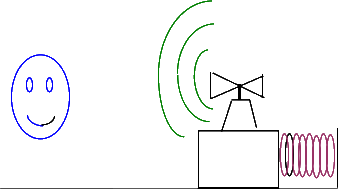
A siren with a frequency f0 = 2000 Hz is attached to a block. The siren and block together have a mass of 2.00 kg. The block is attached to a spring of unknown spring constant K. The spring is compressed an unknown distance and then released. The siren and block oscillate back and forth. A listener hears the source as emitting a varying frequency since the siren is moving. The highest frequency that the listener hears is 2060 Hz. The listener also determines that he hears this highest frequency repeat every 1.50 seconds. The speed of sound in air is 343 m/s. (a) How fast is the block moving when the listener hears the highest frequency? (b) Where in its motion is the block when the listener hears the highest frequency? (c) What is the lowest frequency that the listener would hear? (d) Where in its motion is the block when the listener hears the lowest frequency? (e) What is the period and angular frequency of the block? (f) What is the amplitude of the displacement of the block? (g) What is the spring constant of the spring?
Beats
The beat frequency between an unknown tuning fork and a 500 Hz tuning fork is 12 Hz. Compared with a 504 Hz tuning fork, the beat frequency is 16 Hz. What is the frequency of the unknown tuning fork?
You have two 400-Hz tuning forks which you ring together. You drop one fork down a well. Before the fork hits bottom and stops ringing you hear a beat frequency of 15 Hz. How deep is the well?
Questions?mike.coombes@kpu.ca
![[Return to Kwantlen Homepage]](http://www.kpu.ca/images/return_button.gif)