![[Return to Physics Homepage]](../../physics.gif)
![[Return to Mike Coombes' Homepage]](../../coombes.gif)
![[Return to List of Handouts]](../../handouts.gif)
![[Return to Problem Sets]](../../problems.gif)
![[Return to List of Solutions]](../../solutions.gif)
A wave on a string has the formula y = 0.030sin(0.55x − 62.8t + π/3). What is the wavelength, frequency, period, phase constant, and speed of the wave. The string has a linear density μ = 0.020 kg/m. What is the tension in the string? What is the rate of energy flow of the wave? Sketch the reference circle, the snapshot graph at t = 0, and the history graph at x = 0.
On a point on a string, a peak of a harmonic wave is observed to pass every 0.050 s. The distance between peaks is 0.75 m. The height of the peak is 0.025 m. Assume that the wave is moving to the left. What is the equation of this wave (take t = 0 and x = 0 at the first peak)? What is the phase constant? What is the speed of the wave? The string has a linear density μ = 0.020 kg/m. What is the tension in the string? What is the rate of energy flow of the wave? Sketch the reference circle, the snapshot graph at t = 0, and the history graph at x = 0.
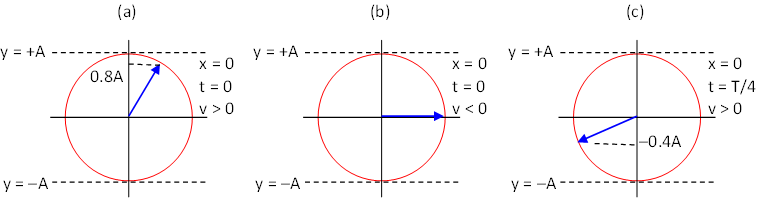
Sketch the associated snapshot and history graphs for the following reference circle diagrams. What is the phase constant φ0 in each case?
Consider the snapshot graph below for a wave moving to the right at t = 0. What is the phase constant φ0? Sketch the reference circle at the indicated points A, B, C, and D. Where exactly does point A occur? Point B?

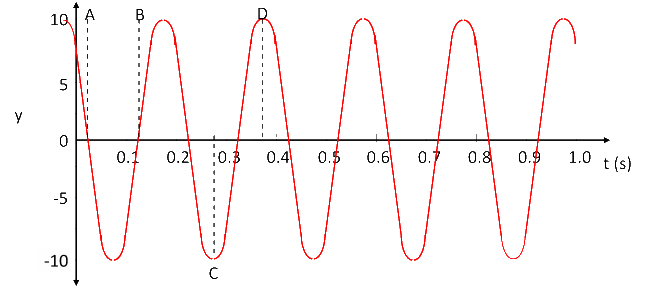
Consider the history graph below for a wave moving to the right at x = 0. What is the phase constant φ0? Sketch the reference circle at the indicated points A, B, C, and D. When exactly does point A occur? Point B?
Superposition in 1D and 2D
Two out-of-phase harmonic waves are traveling on a string. They each have an amplitude of 5.0 mm. The resultant wave has an amplitude of 3.5 mm. What is the phase difference between these two waves?
Two speakers are in a line but one speaker is a distance d behind the other. You are 4.50 m in front of the nearest speaker. The sound is wavelength λ = 1.50 m.
(a) The speakers are in phase. What is the smallest non-zero d if you hear constructive interference?
(b) The speakers are in phase. What is the smallest non-zero d if you hear destructive interference?
(c) The front speaker leads the back speaker by 90°. What is the smallest non-zero d if you hear constructive interference?
(d) The front speaker leads the back speaker by 90°. What is the smallest non-zero d if you hear destructive interference?
Two loudspeakers are located 3.00 m apart on the stage of an auditorium. A detector is placed 20.0 m from one speaker and 21.2 m from the other. A signal generator drives the two speakers in phase and sweeps through the range (2 KHz - 20 KHz). Assume that the speed of sound in air is 343 m/s.
(a) What is lowest note (frequency) for which destructive interference is a maximum?
(b) What is highest note for which destructive interference is a maximum?
(c) What is the lowest note for which constructive interference is a maximum?
(d) What is the highest note for which constructive interference is a maximum?
Two stereo speakers, driven by the amplifier so that the sources are in phase, are arranged so that the sound is loudest at your position. What is the minimum distance that you are farther away from one speaker than the other? The frequency of the tone from the speakers is 750 Hz and the speed of sound in air is 340 m/s.

Questions?mike.coombes@kpu.ca
![[Return to Kwantlen Homepage]](http://www.kpu.ca/images/return_button.gif)