![[Return to Physics Homepage]](./../../physics.gif)
![[Return to Mike Coombes' Homepage]](./../../coombes.gif)
![[Return to List of Handouts]](./../../handouts.gif)
![[Return to List of Notes and Examples]](./../../notes.gif)
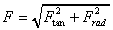 and
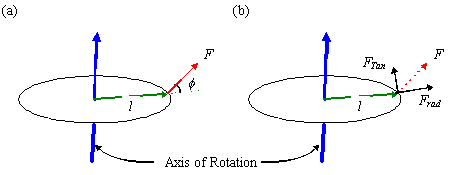
tanφ = Frad/Ftan.
Note that Frad is in the same direction as l,
and that Ftan is perpendicular to l
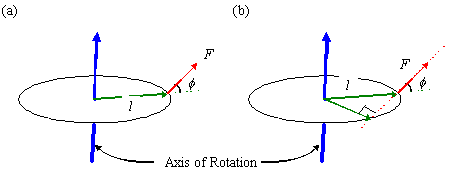
and
tanφ = Frad/Ftan.
Note that Frad is in the same direction as l,
and that Ftan is perpendicular to l
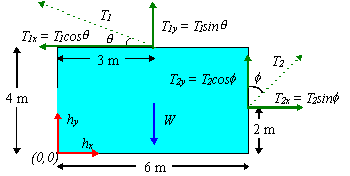
The diagram below shows a uniform rectangular sign
attached to two walls by a hinge and two wires. The sign has a
mass m = 75.0 kg. The tension in the upper cable is twice that
of the side cable. Find the tension in the two cables. Find the
vertical and horizontal components of the hinge force.
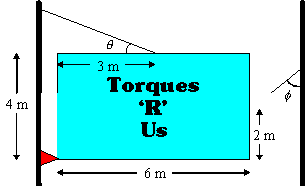
The sign is uniform so the centre of mass is at the geometric centre of the sign. The hinge force is unknown. Unlike the tension in the wires, we do not know it direction. We therefore break the hinge force into its i and j components, hx and hy. Since there are two unknowns at the hinge, it is a good idea to place our pivot point there. Next we draw the extended free-body diagram.
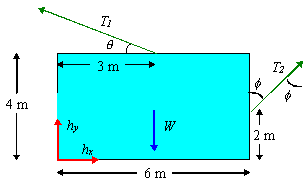
For static equilibrium, we apply Newton's Second Law to the above free body diagram
| ΣFx = 0 | ΣFy = 0 |
| hx - T1cosθ + T2sinφ = 0 | hy + T1sinθ + T2cosφ - W = 0 |
which gives us two force equations. As well we are told T1 = 2T2.
We will determine the torques from hx, hy, T1, T2, and W. First we choose the pivot point (labeled A in the following diagrams) from which to calculate all our torques. The hinge is a good place to choose the pivot point since we have two unknowns there. Hence the torques due to hx, and hy are zero since the distance l is zero. Let's look at our diagram with all the distances noted.
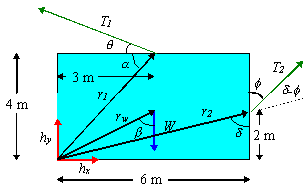
Putting our results into a table:
 |
 |
 |
|
 |
 |
 |
|
 |
 |
 |
Our last equation for static equilibrium is therefore

We now have four equations with four unknowns T1,
T2, hx, and hy.
In theory, the problem is finished but there is some messy algebra
left to complete.
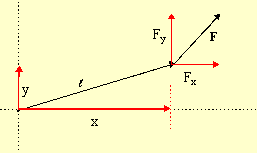
An alternate way to solve this problem is to calculate the torque using the i and j components of each force and the x and y coordinates of the location each force with the pivot point as the origin (0,0).
Putting the results into a table, we have:
The torque equation for static equilibrium call also be written
as
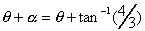
Note that this result is identical to previous result. You may wish to confirm that r1sin(θ+α) = 3sinθ - 4cosθ and that r2sin(γ-φ) = 6sinφ - 2cosφ.
The diagram below shows a 'P'-shaped sign attached to a wall by a hinge and a wire. The sign is constructed of uniform material and has a mass m = 100.0 kg. The centre of the 'P' is a square 1 m × 1 m hole. Find the tension in the wire and the components of the hinge force.
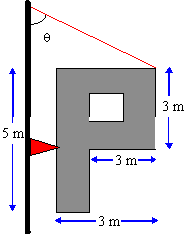
The sign in this problem does not have a simple shape. Just by
looking at the sign we cannot determine where the Centre of Mass
is. We are told, however, that the sign is uniform which means
that the any two pieces of the sign with the same area have the
same mass. A quick calculation shows that the area of the sign
is 10 m2. Since the sign has a total mass of 100 kg,
each 1 m2 has a mass of 10 kg. Let's break the sign
into simpler pieces as in the diagram below.

The masses of the four pieces 1, 2, 3, and 4, are 50 kg, 20 kg, 10 kg, and 20 kg respectively. And for these simple pieces we know where each Centre of Mass is. So next we construct an extended free body diagram.
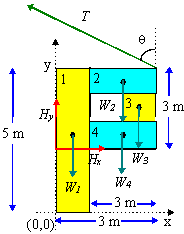
We apply Newton's Second Law,
| ΣFx = 0 | ΣFy = 0 |
| Hx - Tsinθ = 0 | Hy + Tcosθ - W1 - W2 - W3 - W4 = 0 |
The second method for determining torque is the easiest here since
the locations of the weights are easy to find and since these
forces are purely vertical. Taking the hinge as the pivot point,
we have:
Our last equation for static equilibrium is therefore
We have three unknowns, Hx, Hy,
and T, and three equations so the problem is solved except
for the algebra.
To see how much faster this method is, you may wish to do the
above problem by the first method.
Questions? mike.coombes@kpu.ca
![[Return to Kwantlen Homepage]](http://www.kpu.ca/images/return_button.gif)