![[Return to Physics Homepage]](./../../physics.gif)
![[Return to Mike Coombes' Homepage]](./../../coombes.gif)
![[Return to List of Handouts]](./../../handouts.gif)
![[Return to Problem Sets]](./../../problems.gif)
![[Return to List of Solutions]](./../../solutions.gif)
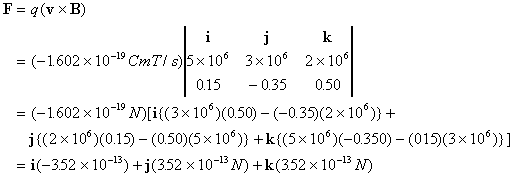
The force on a charge moving in a magnetic field
is F= q(v × B) .
![[Return to Top of Page]](./../../top.gif)
The magnitude of the magnetic force is given by
F = |qvBsin(θ)|.
Determining the direction of the force
involves the following. First the velocity vector, v,
and the magnetic field vector, B, define a plane.
The magnetic force is perpendicular to this plane, either into
or out of it. We use the Right Hand Rule to determine which.
We rotate our right hand palm in the most manner which is most
comfortable. The thumb of the right hand is now perpendicular
to the plane and a positive charge will experience a force in
the direction along the thumb. A negative charge will be anti-parallel
to the direction of the thumb.
(a) q = +5.0 μC, v = 15.0 × 10³ m/s, B = 0.25 T, θ = 65°
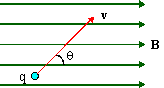
F = 1.699 × 10⁻² N
The plane formed by v and B is the surface of the paper. Turning your palm from v to B, your thumb points into the paper. The charge is positive, so the force is into the paper.
(b) q = -3.0 μC, v = 6.0 × 10³ m/s, B = 0.25 T, θ = 122°
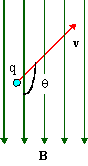
F = 3.816 × 10⁻³ N
The plane formed by v and B
is the surface of the paper. Turning your palm from v
to B, your thumb points into the paper. The charge
is negative, so the force is out the paper.
(c) q = +5.0 μC, v = 15.0 × 10³ m/s, B = 0.25 T
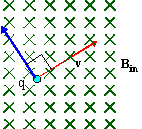
Note θ = 90°,
F = 1.875 × 10⁻² N
The edge of the plane formed by v
and B runs along v and is the perpendicular
to surface of the paper. Turning your palm from v
into the paper along B, your thumb points along
the paper. The charge is positive, so the force is as shown in
the diagram.
(d) q = -5.0 μC, v = 15.0 × 10³ m/s, B = 0.25 T
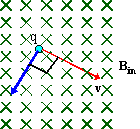
Note θ = 90°,
F = 1.875 × 10⁻² N
The edge of the plane formed by v
and B runs along v and is the perpendicular
to surface of the paper. Turning your palm from v
into the paper along B, your thumb points along
the paper. The charge is negative, so the force is as shown in
the diagram.
(e) q = +5.0 μC, v = 15.0 × 10³ m/s, B = 0.25 T
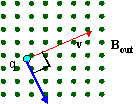
Note θ = 90°,
F = 1.875 × 10⁻² N
The edge of the plane formed by v
and B runs along v and is the perpendicular
to surface of the paper. Turning your palm from v
out of the paper along B, your thumb points along
the paper. The charge is positive, so the force is as shown in
the diagram.
(f) q = -5.0 μC, v = 15.0 × 10³ m/s, B = 0.25 T
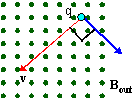
Note θ = 90°,
F = 1.875 × 10⁻² N
The edge of the plane formed by v and B runs along v and is the perpendicular to surface of the paper. Turning your palm from v out of the paper along B, your thumb points along the paper. The charge is negative, so the force is as shown in the diagram.
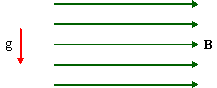
Since the weight acts down, the magnetic force on
the electron must act up to cancel. Since the velocity v
is perpendicular to F and B, this means that the electron can
only be moving into the page or out of the page. Using the right
hand rule, a velocity crossed into the given magnetic field direction,
would end up yielding a downward force for a positive charge.
Since the electron has a negative charge, the electron moving
into the page does give an upward force. This upward force has
magnitude F = evB and must cancel the weight W = mg. Hence we
have
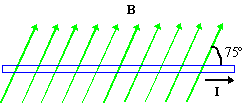
The magnitude of the magnetic force is given by
F = ILBsin(θ). Here,
The 120-m line experiences a total magnetic force
of 8.11 N. Note that the direction of the force would be out
of the paper.
First we sketch the behaviour or the electron, assuming
that the magnetic field points out of the paper.
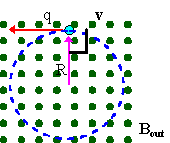
The magnetic force is F = qvBsin(90°) = evB. It is
directed to the centre of the circle, so it is the centripetal
force. Applying Newton's Second Law
| evB = mv2/R . | (1) |
Solving (1) for R, we get
For an object to travel in a circle with constant speed
where T is the period and f is the cyclotron frequency. Thus
| f = v/(2πR) . | (2) |
From (1), v = eBR/m, thus
Note that the cyclotron frequency is independent of the velocity of the charge.
First we sketch the behaviour or the protons, assuming that the magnetic field points out of the paper.
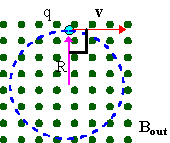
The magnetic force is F = qvBsin(90°) = qvB. It is
directed to the centre of the circle, so it is the centripetal
force. Applying Newton's Second Law
Solving for v, we get
Note that the magnitude of the charge of a proton is the same as that of an electron.
For an object to travel in a circle with constant speed
where T is the period and f is the cyclotron frequency. Thus
As well,
In a velocity selector, the electric force exactly
balances the magnetic force, qE = qvB1, yielding an
equation for the velocity of the charge
| v = E/B1 , | (1) |
where B1 is the magnetic field strength
in the selector.
In the mass spectrometer, the charge is bent into
a circular path. The radius of the path, as derived in question
5, is
| R = mv/qB2 , | (2) |
where B2 is the magnetic field strength
in the spectrometer. Combining (1) and (2) yields an equation
for the mass of the charge
A singly ionized atom has the same magnitude of charge as the electron it lost. Using the given information,
The ion has a mass of 3.28 × 10⁻²⁵ kg.
The mass of one mole of these ions is
Examining a Periodic Table, one finds that Au, gold, has this atomic mass.
From question 7, we have
| v = E/B1 , | (1) |
where B1 is the magnetic field strength
in the selector, and
| R = mv/qB2 , | (2) |
where B2 is the magnetic field strength
in the spectrometer. Combining (1) and (2) yields an equation
for the radius
A doubly-ionized atom has the same magnitude of charge as the electrons it lost, i.e. 2e. Using the given information,
The radius of the path is 6.8 cm.
The dipole moment is defined μ = IA,
where I is the current and A is the area enclosed by the current. In the
Bohr model an electron is travelling about the core in a circle.
Thus A = πR2, where R is
the radius of the electron orbit. A atomic electron current is given by
where T is the time it takes for the electron to make one orbit. For uniform circular motion, T = 2πR/v. So I = ev/2πR .
Thus the dipole moment is
| μ | = (ev/2πR)(πR2) |
| = ½evR | |
| = ½(1.602 × 10⁻¹⁹ C)(2.20 × 10⁶ m/s)(5.29 × 10-11 m/s) | |
| = 9.3 × 10⁻²⁴ Cm2/s |
Questions? mike.coombes@kpu.ca
![[Return to Kwantlen Homepage]](http://www.kpu.ca/images/return_button.gif)