![[Return to Physics Home Page]](./../../physics.gif)
![[Return to Mike Coombes' Home Page]](./../../coombes.gif)
![[Return to List of Handouts]](./../../handouts.gif)
![[Return to Problem Sets]](./../../problems.gif)
![[Return to List of Solutions]](./../../solutions.gif)
(a) q = +5.0 μC, v = 15.0 × 10³ m/s, B = 0.25 T, θ = 65°
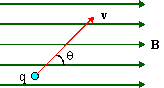
(b) q = -3.0 μC, v = 6.0 × 10³ m/s, B = 0.25 T, θ = 122°
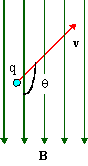
(c) q = +5.0 μC, v = 15.0 × 10³ m/s, B = 0.25 T
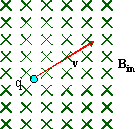
(d) q = -5.0 μC, v = 15.0 × 10³ m/s, B = 0.25 T
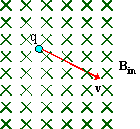
(e) q = +5.0 μC, v = 15.0 × 10³ m/s, B = 0.25 T
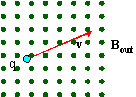
(f) q = -5.0 μC, v = 15.0 x × 103 m/s, B = 0.25 T
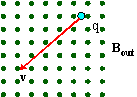
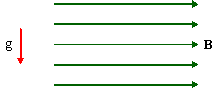
The earth's magnetic field is approximately 5
× 10-5 T. If an electron is travelling perpendicular
to the field at 1000 m/s, determine its cyclotron radius and frequency.
Ignore the effects of gravity and the electric field of the atmosphere.
The mass of an electron is 9.11 × 10⁻³¹ kg.
Questions? mike.coombes@kpu.ca
![[Return to Kwantlen Homepage]](http://www.kpu.ca/images/return_button.gif)