![[Return to Physics Homepage]](./../../physics.gif)
![[Return to Mike Coombes' Homepage]](./../../coombes.gif)
![[Return to List of Handouts]](./../../handouts.gif)
![[Return to Problem Sets]](./../../problems.gif)
![[Return to List of Solutions]](./../../solutions.gif)
Questions: 1 2 3 4 5 6 7 8 9 10
Physics 1101 |
Waves and Sound Level |
The speed of a wave on a string is given by the
formula  , where is the
linear density given by
, where is the
linear density given by  .
Thus the speed is
.
Thus the speed is
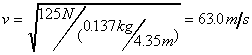 .
.If we double the tension, v = 89.1 m/s .
If we double the mass, v = 44.5 m/s .
![[Return to Top of Page]](./../../top.gif)
First recall that the formula for a wave on a string
is given by 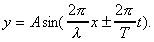 Thus, by
inspection, we have A = 0.030 m,
Thus, by
inspection, we have A = 0.030 m,  ,
and
,
and  . Solving for
λ and T yields λ
= 11.4 m and T = 0.100 s.
. Solving for
λ and T yields λ
= 11.4 m and T = 0.100 s.
We know that frequency is given by f = 1/T = 10.0 Hz.
As well, the speed of the wave is given by v = λ/T = 114 m/s.
To find the tension in the string, we take
 and rewrite it as
 . For the given values,
Ftension = 260 N.
. For the given values,
Ftension = 260 N.
The rate of energy flow, or energy per unit time, or power, is given by
the formula  , where
ω = 2πf. For the
given values, P = 4.05 Watts.
, where
ω = 2πf. For the
given values, P = 4.05 Watts.
Since the peak of the harmonic wave is observed to pass every 0.050 s, T = 0.050 s. Since the distance between successive peaks is one wavelength, λ = 0.75 m. The amplitude of a wave is given by the height of the peak, so A = 0.025 m.
Next recall that the formula for a wave on a string is given by
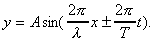 For waves moving to the
left, we need the + sign. So the required equation must be
For waves moving to the
left, we need the + sign. So the required equation must be

The speed of the wave is given by v = λ/T = 1.50 m/s.
From the previous question, we saw that
 could be rearranged to give
 . For the given values,
Ftension = 0.045 N.
. For the given values,
Ftension = 0.045 N.
The rate of energy flow, or energy
per unit time, or power, is given by the formula
 , where
ω = 2πf. For
the given values, P = 0.296 Watts.
, where
ω = 2πf. For
the given values, P = 0.296 Watts.
Since intensity drops as the square of the distance (for spherical sound sources), Inear = P0 / rnear2 and Ifar = P0 / rfar2 where P0 is the sound power emitted by the volcano. Since we don't know P0 we elimate it from the two equations to get Inear rnear2 = Ifarrfar2. Solving for Ifar yields
Inear = Ifar rfar2 / rnear2 = (1 × 10⁻⁸ W/m2) × (100 km)2 / (100 m)2 = 1 × 10⁻² W/m2.
Sound intensity is related to sound level by the
formula, I = I0 ×
10-(β/10). So the intensity
of one student is
For incoherent sound sources, intensity adds. So
with the 30 students the sound intensity is
Using the formula for sound level,
The sound level in the classroom reaches 60 dB.
These are all incoherent sound sources, so the intensities add
Assuming that we are dealing with spherical sound sources, I =
P / 4πr2, so
The background intensity is found from the background sound
level
using
Thus the total intensity is Itotal = 12.71 × 10⁻⁵
W/m2 and the sound level at your position is,
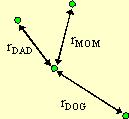
The formula for the Doppler Shift is given by
To use the above equation, we need to know how the driver and
police constable are moving relative to one another, as is shown
in the diagram below.
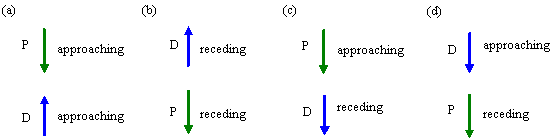
(a) fa = (2500 Hz)[1 + 25/340]/[1 - 40/340] = 3042 Hz
.
(b) fb = (2500 Hz)[1 - 25/340]/[1 + 40/340] = 2072 Hz
.
(c) fc = (2500 Hz)[1 - 25/340]/[1 - 40/340] = 2625Hz .
(d) fd = (2500 Hz)[1 + 25/340]/[1 + 40/340] = 2401 Hz .
f' = f0 [(1 ± ur/v)/(1 ± us/v][(1 ± us/v)/(1 ± ur/v)] .
The sound is emitted by the first sub, hits the second and
returns
to the first. Sound travels much faster than subs, so we may assume
that the distance the sound travels is 2L.

The distance the sound travels is related to t, by
Thus the distance between the two sub is
The altered frequency that the first sub hears is

Intensity drops as the square of the distance away, so the intensity of the sonar pulse reaching the bat is
Ibug = P0 / r2 = (0.020 W) / (5.0 m)2 = 0.00080 W/m2.
The total sound power that reflects off the bat (assuming none is absorbed) is
Pbug = Ibug × Abug = (0.00080 W/m2) × (100 mm2) × (1 m / 1000 mm)2 = 8.0 × 10⁻⁸ W.
Now this sound power radiates spherically back to the bat, so the intensity of the reflection is
Ibat = Pbug / r2 = (8.0 × 10⁻⁸ W) / (5.0 m)2 = 3.2 × 10⁻⁹ W/m2.
Owls have to quietly listen for squeaks from the small
animals they hunt and then they swoop in for the kill. Owls have very
keen night vision but it would be dangerous to fly in complete darkness
in the woods or a barn. Bats use sonar to find flying prey, usually
insects, that may be silent. With sonar, false reflections can be a
problem but flying insects are usually some distance from other
reflecting objects. On the other hand, a bat might have trouble
locating an insect on the ground as there would be too many
reflactions.
Questions? mike.coombes@kpu.ca
![[Return to Kwantlen Homepage]](http://www.kpu.ca/images/return_button.gif)