![[Return to Physics Homepage]](./../../physics.gif)
![[Return to Mike Coombes' Homepage]](./../../coombes.gif)
![[Return to List of Handouts]](./../../handouts.gif)
![[Return to Problem Sets]](./../../problems.gif)
![[Return to List of Solutions]](./../../solutions.gif)
| Questions: | 1 | 2 | 3 | 4 | 5 | 6 | 7 | 8 | 9 | 10 |
(a) 3.5 km2 = 3.5 km × km = 3.5 km × km × (1000 m / 1km) × (1000 m / 1km) = 3.5 × 10⁶ m2
(b) 56 g/cm3 = 56 g/(cm × cm × cm) = 56 g/(cm × cm × cm) × (1 kg / 1000 g) × (100 cm / 1 m) × (100 cm / 1 m) × (100 cm / 1 m) = 56 × 103 kg/m3
(c) 70 km/h = 72 km/ h × (1 kg / 1000 g) × (1 km / 1000 m) × (1 h / 3600 s) = 19.44 m/s
(d) 15 m/s = 15 m/s × (1 km / 1000 m) × (3600 s / 1 h) = 54 km/h
![[Return to Top of Page]](../../top.gif)
Write vectors equations for each diagram below.
| (a) | 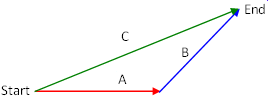 |
(b) | 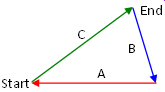 |
| (c) | 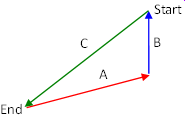 |
(d) | 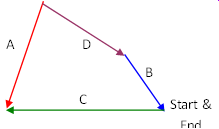 |
| (e) | 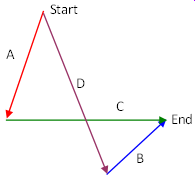 |
(f) | 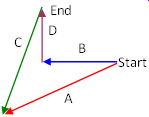 |
| (a) |  |
(b) |  |
| (c) |  |
(d) |  |
| (e) |  |
(f) |  |
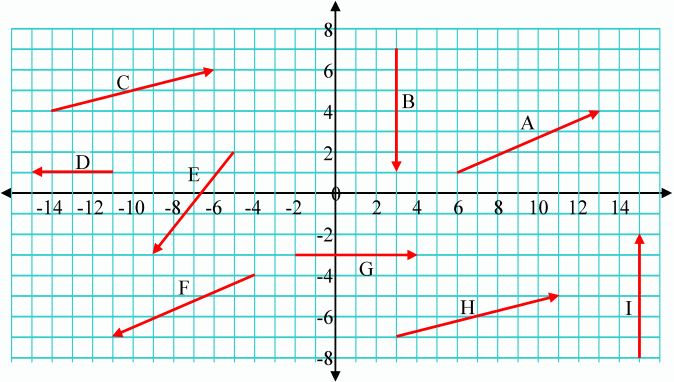
The following diagram shows a variety of displacement
vectors. Express each vector in component (ij)
notation.
| (i) |  |
(ii) |  |
| (iii) |  |
(iv) |  |
| (v) |  |
(vi) |  |
| (vii) |  |
(viii) |  |
| (ix) |  |
||
Note that a vector such as (i) may be written as A
= i7 + j3
when typed, as it is easier to produce since arrow and hat symbols are
not common, or as  in math class.
|
sign of x comp = |
+ |
sign of x comp = |
– |
sign of x comp = |
– |
|
sign of y comp = |
+ |
sign of y comp = |
+ |
sign of y comp = |
+ |
|
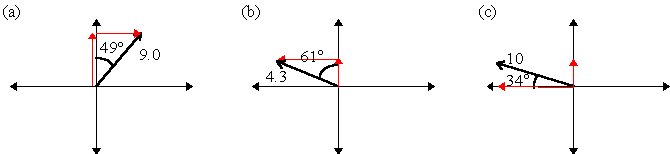
(a) |
A |
= i[+9.0sin(49°)] + j[+9.0cos(49°)] |
|
= i[6.7924] + j[5.9045] |
||
|
(b) |
B |
= i[–4.3sin(61° )] + j[+4.3cos(61° )] |
|
= i[–3.7609] + j[2.0847] |
||
|
(c) |
C |
= i[–10cos(34° )] + j[+10sin(34° )] |
|
= i[–8.2904] + j[5.5919] |
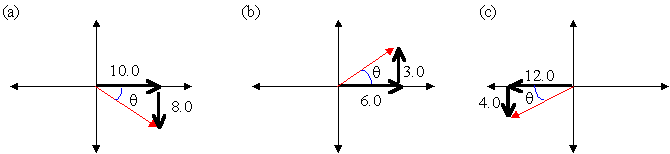
| A | = 10i - 8j | B | = 6i + 3j | C | = -12i - 4j |
| A | = [(10.0)2+(8.0)2]½ | B | = [(6.0)2+(3.0)2]½ | C | = [(12.0)2+(4.0)2]½ |
| = 12.8062 | = 6.7082 | = 12.6491 | |||
| θ | = arctan(8/10) | θ | = arctan(3/6) | θ | = arctan (4/12) |
| = 38.66° | = 26.57° | = 18.43° | |||
| A | = (12.81, 38.7° b.h.) | B | = (6.71, 26.6° a.h.) | C | = (12.65, 198.43° a.h.) |
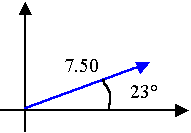
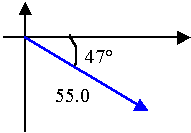
| (a) | A = 7.50 m/s2 at 23° a.h. | (b) | B = 55 m at 47° b.h. |
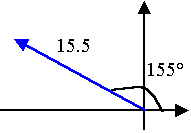
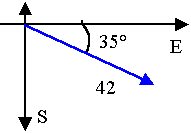
| (c) | C = 15.5 m/s at 155° a.h. | (d) | D = 42 m at 35° S of E |
(a) |
|
(b) |
|
||||
| A |
= i[+7.5cos(23°)] + j[+7.5sin(23°)] |
B |
= i[+55cos(47°)] + j[–55sin(47°)] |
||||
|
= i[6.9038] + j[2.9305] |
= i[35.5099] – j[40.2245] |
||||||
|
(c) |
|
(d) |
|
||||
| C |
= i[+15.5cos(155°)] + j[+15.5sin(155°)] |
D |
= i[+42cos(35°)] + j[–42sin(35°)] |
||||
|
= i[–14.0478] + j[6.5506] |
= i[34.4044] – j[24.0902] |
||||||
(a) For vector problems, we first draw a neat sketch of the vectors and the vector operation of interest. Here we are adding three vectors.
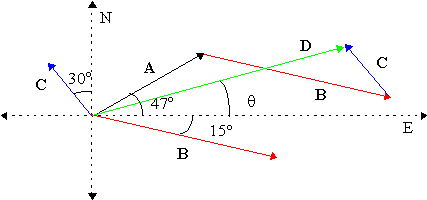
Then to solve the problem numerically, we break the vectors into their components and add them to get the components of vector D. Then we convert to polar coordinate form.
A = i57cos(47°) + j57sin(47°) = i38.8739 + j41.6872 .
B = i72cos(15°) − j–72sin(15°) = i69.5467 − j18.6350 .
C = −i24cos(30°) + j24cos(30° ) = −i12 + j20.7846 .
The vector relationship is D = A + B + C. The result is
D = i96.4206 + j43.8368.
Using Pythagoras’ Theorem, D = [(96.4206)2 + (43.8368)2]½ = 105.92 m. The angle θ = tan–1(|Dy/Dx|) = tan–1(43.8368/96.4206) = 24.45° . The components of D are in the NE quadrant, thus the person's displacement is 106 m at 24.4° north of east.
(b) To return, the person would have to travel in the direction opposite to his/her displacement, i.e. 106 m at 24.4° south of west.
(a) The magnitude of the momenta of the cars are:
p1 = m1v1 = (1200 kg)(22 m/s) = 2.64 × 10⁴ kg-m/s;
p2 = m2v2 = (1450 kg)(18 m/s) = 2.61 × 10⁴ kg-m/s.
Therefore
p1 = 2.64 × 10⁴ kg-m/s at 30.0° S of W
p2 = 2.61 × 10⁴ kg-m/s at 55.0° W of N(b) For vector problems, we first draw a neat sketch of the vectors and the vector operation of interest. Here we are adding two vectors.
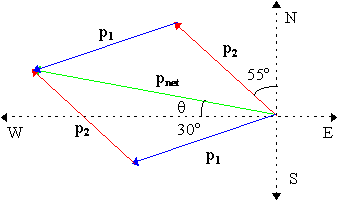
Then to solve the problem numerically, we break the vectors into their components and add them to get the components of vector Pnet. Then we convert to polar coordinate form.
p1 = −i(2.64×10⁴)cos(30°) + −j(2.64×10⁴)sin(30°) = −i(2.2863 × 10⁴) − j(1.3200 × 10⁴) .
p2 = −i(2.61×10⁴)sin(55°) + j(2.61×10⁴)cos(55°) = −i(2.1380 × 10⁴) + j(1.4970 × 10⁴)
The resultant Pnet = p1 + p2 is
Pnet = −i(4.4243 × 10⁴) + j(0.1770 × 10⁴).
Using Pythagoras' Theorem, Pnet = [(–4.4243× 10⁴)2 + (0.1770× 10⁴)2]½ = 4.428 × 10⁴ kg-m/s. The angle θ = tan–1(|Pnet y/Pnet x|) = tan–1(0.1770/4.4243) = 2.3° . Pnet is in the N-W quandrant. Thus, the net momentum of the two cars 4.428 × 10⁴ kg-m/s at 2.3° north of west.
We are looking for F2 = F3 – F1, a vector subtraction. For vector problems, we first draw a neat sketch of the vectors and the vector operation of interest.
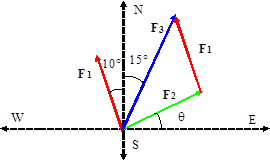
Then to solve the problem numerically, we break the vectors into their components and subtract them to get the components of vector F2. Then we convert to polar coordinate form.
F3 = i150sin(15°) + j150cos(15°) = i38.823 + j144.889 .
F1 = −i100sin(10°) + j10cos(10°) = −i17.365 + j98.481
The difference F2 = F3 − F1 is
F2 = i56.188 + j46.408.
Using Pythagoras’ Theorem, F2 = [(56.188)2 + (46.408)2]½ = 72.875 N. The angle θ = tan–1(|F2y/F2x|) = tan–1(46.408/56.188) = 39.55° . Force F2 in in the N-E quadrant, thus the force is 72.9 N at 39.6° north of east.
We are looking for R2 = Rf – R1, a vector subtraction. For vector problems, we first draw a neat sketch of the vectors and the vector operation of interest.
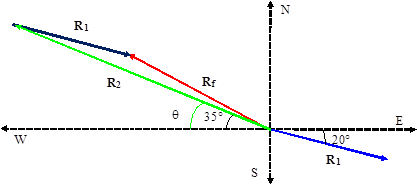
Then to solve the problem numerically, we break the vectors into their components and subtract them to get the components of vector R2. Then we convert to polar coordinate form.
Rf = −i225cos(35°) + j225sin(35°) = −i184/309 + j129.055 .
R1 = i150cos(20°) + −j150sin(20°) = i140.954 − j51.303
The difference R2 = Rf − R1 is
R2 = −i325.263 + j180.358.
Using Pythagoras’ Theorem, R2 = [(–325.263)2 + (180.358)2]½ = 371.921 m. The angle θ = tan–1(|R2y/R2x|) = tan–1(180.358/325.263) = 29.01° . R2 is in the N-W quadrant, thus the displacement is 372 m at 29.0° north of west.
Questions? mike.coombes@kpu.ca
![[Return to Kwantlen Homepage]](http://www.kpu.ca/images/return_button.gif)