![[Return to Physics Homepage]](./../../physics.gif)
![[Return to Mike Coombes' Homepage]](./../../coombes.gif)
![[Return to List of Handouts]](./../../handouts.gif)
![[Return to Problem Sets]](./../../problems.gif)
![[Return to List of Solutions]](./../../solutions.gif)
Questions: 1 2 3 4 5 6 7 8 9 10 11
| Physics 1101 | Static Equilibrium |
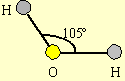
The problem expects you to recall that the mass of an oxygen atom is 16 times that of a hydrogen atom. The first step is to choose a coordinate system, such as the one in the diagram, and locate each particle. The chosen origin is the centre of the box.
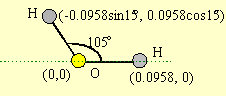
| Atom | Mass (H) | xi | yi | mixi | miyi |
| H | 1 | -0.0958sin15 | 0.0958cos15 | -0.02479 | 0.09254 |
| O | 16 | 0 | 0 | 0 | 0 |
| H | 1 | 0.0958 | 0 | 0.0958 | 0 |
| Totals: | 18 | 0.07101 | 0.09254 |
The coordinates of the centre of mass are given by
The centre of mass is located at (0.0039 nm, 0.0051 nm). Answers will vary based on the choice of coordinate system.
![[Return to Top of Page]](./../../top.gif)
In dealing with real objects rather than particles, we treat the complex object as a grouping of simpler shapes. The CM of the simpler shapes is at their easy to find geometric centre if the object is uniform. Each pierce can now be considered a particle with the mass of the piece located at the CM of that piece. We have, in effect, turned the complex shape into a collection of particles. In this case, each of the five sides can be considered a separate particle.
The next step is to choose a coordinate system, such as the one in the diagram below, and locate each particle. The origin is at the centre of the box.
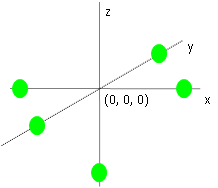
| Side | Mass | xi | yi | zi | mixi | miyi | mizi |
| bottom | M | 0 | 0 | -½L | 0 | 0 | -½ML |
| front | M | 0 | -½L | 0 | 0 | -½ML | 0 |
| back | M | 0 | ½L | 0 | 0 | ½ML | 0 |
| left | M | -½L | 0 | 0 | -½ML | 0 | 0 |
| right | M | ½L | 0 | 0 | ½ML | 0 | 0 |
| Totals: | 5M | 0 | 0 | -½ML |
The coordinates of the centre of mass are given by
The centre of mass is located at (0, 0, -L/10). Answers will vary based on the choice of coordinate system.
It is also permissible to use symmetry arguments. For example,
the figure in the diagram is only unbalanced in the z direction,
thus we know that xcm = ycm = 0. We only
needed the z columns in the above table.
In dealing with real objects rather than particles, we treat the complex object as a grouping of simpler shapes. The CM of the simpler shapes is easy to find, it is the geometric centre if the object is uniform. Each pierce can now be considered a particle with the mass of the piece located at the CM of that piece. We have, in effect, turned the complex shape into a collection of particles. In this case, we have one particle of mass M located in the centre of the lighter side, and a mass of 2M in the centre of the heavier side.
The next step is to choose a coordinate system, such as the one in the diagram below, and locate each particle. The origin is in the centre of the join of the two plates.
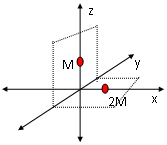
Using the symmetry of the problem, we see that the CM must be located in the xz plane, we know that ycm = 0.
| Side | Mass | xi | zi | mixi | mizi |
| side | M | 0 | ½L | 0 | ½ML |
| bottom | 2M | ½L | 0 | ML | 0 |
| Totals: | 3M | ML | ½ML |
The components of the centre of mass are given by
The centre of mass is located at (L/3, 0, L/6). Answers will vary based on the choice of coordinate system.
| (a) | 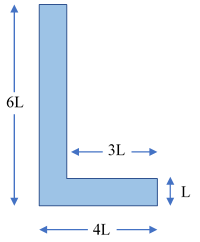 |
(b) | 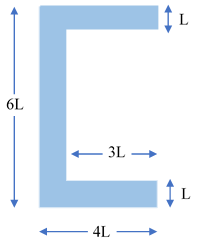 |
(c) | 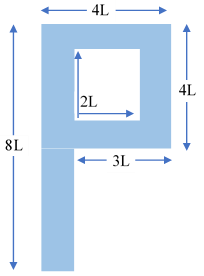 |
In dealing with real objects rather than particles, we treat the complex object as a grouping of simpler shapes. The CM of the simpler shapes is easy to find, it is the geometric centre if the object is uniform. Each pierce can now be considered a particle with the mass of the piece located at the CM of that piece. We have, in effect, turned the complex shape into a collection of particles.
| (a) | 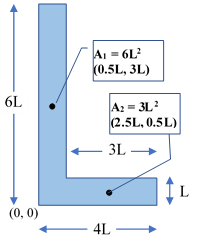 |
The area and the location of CM of each rectangle with respect to the given origin (0,0) is found. Since the sign is uniform, mass can be replaced by area in the formula xCM = (Σmixi)/Mtotal. xCM = (6L2 × 0.5L + 3L2 × 2.5L)/(6L2 + 3L2) = (10.5L)/9 = (21/18)L yCM = (6L2 × 3L + 3L2 × 0.5L)/(6L2 + 3L2) = (19.5L)/9 = (39/18)L |
| ||
| (b) | 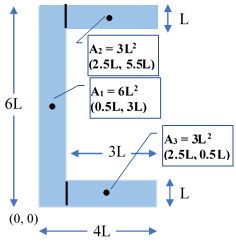 |
The area and the location of CM of each rectangle with respect to the given
origin (0,0) is found. Since the sign is uniform, mass can be replaced by area
in the formula xCM = (Σmixi)/Mtotal.
xCM = (6L2 × 0.5L + 3L2 × 2.5L + 3L2 × 2.5)/(6L2 + 3L2 + 3L2) = (18L)/12 = (3/2)L The shape is symmetric vertically about a line drawn horizontally through the middle, so by symmetry yCM = 3L. However, we can check if desired that we get the same answer using the formula. yCM = (6L2 × 3L + 3L2 × 5.5L + 3L2 × 0.5L)/(6L2 + 3L2 + 3L2) = (36L)/12 = 3L. |
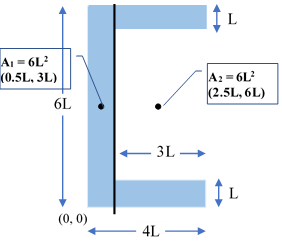 |
Alternate decomposition. We should always aim for the biggest
symmetric shapes that we see. In this diagram, we have treated the two
horizontal rectangles as one object. The area and the location of CM of
the two pieces with respect to the given
origin (0,0) is found. This won't change our answer, but will be a shorter calculation.
Since the sign is uniform, mass can be replaced by area
in the formula xCM = (Σmixi)/Mtotal.
xCM = (6L2 × 0.5L + 6L2 × 2.5)/(6L2 + 6L2) = (18L)/12 = (3/2)L The vertical symmetry is even more obvious with this decomposition, so by symmetry yCM = 3L. However, we can check if desired that we get the same answer using the formula. yCM = (6L2 × 3L + 6L2 × 3L)/(6L2 + 6L2) = (36L)/12 = 3L. |
|
| ||
| (c) | 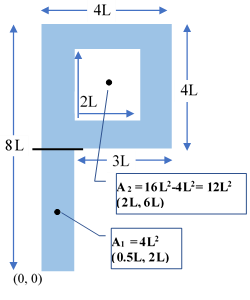 |
The P shape has been split into a vertical rectangle and a hollow square. The area and the location of CM of each piece with respect to the given origin (0,0) is found. Since the sign is uniform, mass can be replaced by area in the formula xCM = (Σmixi)/Mtotal. xCM = (4L2 × 0.5L + 12L2 × 2L)/(4L2 + 12L2) = (26L)/16 = (13/8)L yCM = (4L2 × 2L + 12L2 × 6L)/(4L2 + 12L2) = (80L)/16 = 5L |
The problem mentioned that the object is free to pivot, to rotate. This indicates that we are dealing with a Static Equilibrium problem. We solve Static Equilibrium problems by sketching the extended free-body diagram, an FBD where the location of the all forces are indicated so that torques can be calculated. Then we determine the three equations necessary for static equilibrium, ΣFx = 0, ΣFy = 0, and Στz = 0.
The forces that we know are working on the L-shaped object are a normal from the nail and the weight which acts from the centre of mass. Ordinarily, for complex shapes, we first determine the CM. However, in this case, it is easier to consider the two arms of the objects as being separate objects. The long arm will have a mass (2/3)mg and the short arm will be (1/3)mg. We do not have a simple method of figuring out which way the normal points. As with all pins, we consider it as two forces one vertical and one horizontal.
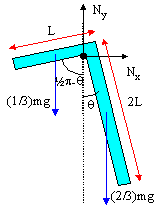
| ΣFx = 0 | ΣFy = 0 |
| Nx = 0 | Ny − (1/3)mg − (2/3)mg = 0 |
These tell us the obvious, the normal has no horizontal component
and that it supports the weight of the object.
We will use Method A for the torques since that method is easiest to apply here. We will take the nail as the pivot point since this eliminates the torques from the nail.
| r | F | direction | τz = rFsinθ | |
| 0 | Nx | - | - | 0 |
| 0 | Ny | - | - | 0 |
| L/2 | (1/3)mg | π+θ | CW | -mgLsin(π+θ)/6 |
| L | (2/3)mg | θ | CCW | 2mgLsinθ/3 |
Since Στz = 0, the equation we get is
Eliminating common terms and noting sin(π+θ) = cosθ, this becomes
or
Using the identity,
tanθ = sinθ/cosθ,
we thus have θ = tan-1(1/4) = 14.0°.
The long side makes a 14.0° angle with the vertical.
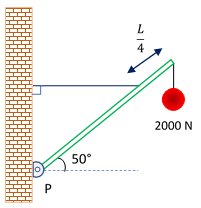
The problem mentions forces and looking at the diagram shows
that the object would rotate in the absence of any one of these
forces. This indicates that we are dealing with a Static Equilibrium
problem. We solve Static Equilibrium problems by sketching the
extended free-body diagram, an FBD where the location of the all
forces are indicated so that torques can be calculated. Then
we determine the three equations necessary for static equilibrium,
ΣFx = 0,
ΣFy = 0,
and Στz = 0.
The forces that we know are working on the boom are a normal from the pin, the weight which acts from the centre of mass, and the two tensions. We are given T2. The CM is obviously at the centre of the boom. We do not have a simple method of figuring out which way the normal points, instead we consider it as two forces one vertical and one horizontal.
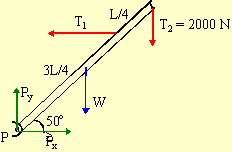
| ΣFx = 0 | ΣFy = 0 |
| Px − T1 = 0 | Py − mg − T2 = 0 |
These tell us the obvious, that Px = T1
and Py = mg + T2 = 2400 N.
We will use Method A for the torques since that method is easiest to apply here since the distances and angles are relatively easy to find. We will take the pin as the pivot point since this eliminates the torques from the pin.
| r | F | θ | direction | τz = rFsinθ |
| 0 | Px | - | - | 0 |
| 0 | Py | - | - | 0 |
| L/2 | W | 40° | CW | -LWsin(40°)/2 |
| (3/4)L | T1 | 50° | CCW | 3LT1sin(50°)/4 |
| L | T2 | 40° | CW | -LT2sin(40°) |
Since Στz = 0, the equation we get is
Eliminating L from the above and rearranging to get T1
by itself yields,
Using the values we are given, we find T1 = 2461 N.
Since we know Px = T1, we also know the pin
force is
The magnitude of this force is P = [(Px)2
+ (Py)2 ]½ = 3438 N. The
force is directed at an angle θ = tan-1(Py/Px)
= 44.3° to the horizontal. Note that the pin force is not pointed
solely along the length of the boom as one might expect.
Big Point To Remember: Pin forces are not always directed in the obvious direction.
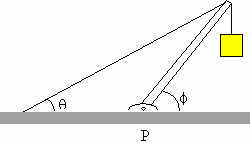
The problem mentions forces and looking at the diagram
shows that the object would rotate in the absence of any one of
these forces. This indicates that we are dealing with a Static
Equilibrium problem. We solve Static Equilibrium problems by
sketching the extended free-body diagram, an FBD where the location
of the all forces are indicated so that torques can be calculated.
Then we determine the three equations necessary for static equilibrium,
ΣFx = 0,
ΣFy = 0,
and Στz = 0.
The forces that we know are working on the boom are a normal from the pin, the weight which acts from the centre of mass, and the two tensions. The CM is obviously at the centre of the boom. We do not have a simple method of figuring out which way the normal points, instead we consider it as two forces one vertical and one horizontal.
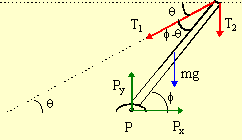
| Fx = 0 | ΣFy = 0 |
| Px − T1cos(π/2-θ) = 0 | Py − mg − T2 − T1sinθ = 0 |
These tell us that Px = T1cosθ and Py = mg + T2 + T1sinθ. We are given the mass of the load so we know T2 = mloadg = 4905 N.
We will use Method A for the torques since that method is easiest to apply here since the distances and angles are relatively easy to find. We will take the pin as the pivot point since this eliminates the torques from the pin.
| r | F | θ | direction | τz = rFsinθ |
| 0 | Px | - | - | 0 |
| 0 | Py | - | - | 0 |
| L/2 | mg | π/2 − φ | CW | -Lmgsin(π/2-φ)/2 |
| L | T1 | θ − φ | CCW | LT1sin(θ-φ) |
| L | T2 | π/2 − φ | CW | -LT2sin(π/2-φ) |
Since Στz = 0, the equation we get is
Eliminating L from the above, multiplying through by 2, and using
the identity that sin(π/2-φ)
= cosφ yields,
We rearrange to get T1 by itself,
Using the values we are given, and the value for T2, we find T1 = 15008 N.
We have Px = T1cosθ =
12998 N. As well,
Py = mg + T2 + T1sinθ
= 13587 N. Thus we also know that the pin force is
The magnitude of this force is P = [(Px)2
+ (Py)2 ]½ = 1.88 × 10⁴
N. The force is directed at an angle θ = tan-1(Py/Px)
= 46.3° to the horizontal. Note that the pin force is not pointed
solely along the length of the boom as one might expect.
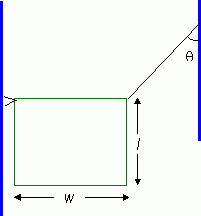
The problem mentions forces and looking at the diagram
shows that the object would rotate in the absence of any one of
these forces. This indicates that we are dealing with a Static
Equilibrium problem. We solve Static Equilibrium problems by
sketching the extended free-body diagram, an FBD where the location
of the all forces are indicated so that torques can be calculated.
Then we determine the three equations necessary for static equilibrium,
ΣFx = 0,
ΣFy = 0,
and Στz = 0.
The forces that we know are working on the sign are a normal from the pin, the weight which acts from the centre of mass, and the tension. The CM is obviously at the centre of the sign. We do not have a simple method of figuring out which way the normal points, instead we consider it as two forces one vertical and one horizontal.
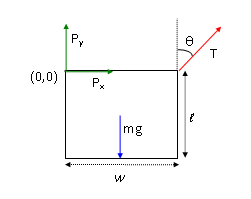
| ΣFx = 0 | ΣFy = 0 |
| Px − Tsinθ = 0 | Py − mg + Tcosθ = 0 |
These tell us that Px = Tsinθ and
Py = mg − Tcosθ.
We will use Method B for the torques since that method is easiest to apply here since the location of the forces easy to find. We will take the pin as the pivot point since this eliminates the torques from the pin.
| x | y | Fx | Fy | τz = xFy − yFx |
| 0 | 0 | Px | Py | 0 |
| w | 0 | Tsinθ | Tcosθ | wTcosθ |
| w/2 | -l/2 | 0 | -mg | -wmg/2 |
Since Στz = 0, the equation we get is
Eliminating w from the above and rearranging yields,
The force equations give Px = Tsinθ = 526 N and Py
= mg − Tcosτq = 245.0 N.
Thus the tension in the rope is 580 N and the horizontal and vertical components of the pin force are 526 N and 245 N respectively.
In dealing with real objects rather than particles, we treat the complex object as a grouping of simpler shapes. The CM of the simpler shapes are easy to find, it is the geometric centre if the object is uniform. Each piece can now be considered a particle with the mass of the piece located at the CM of that piece. We have, in effect, turned the complex shape into a collection of particles.
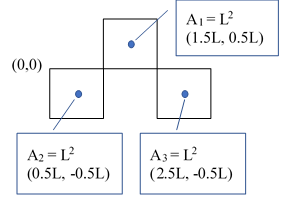 |
The area and the location of CM of each rectangle with respect to the given
origin (0,0) is found. Since the sign is uniform, mass can be replaced by area
in the formula xCM = (Σmixi)/Mtotal.
The horizontal component of the centre of mass of the sign must be on the vertical symmetry axis. However, we will proceed with the calculation just to check. xCM = (L2 × 0.5L + L2 × 1.5L + L2 × 2.5L)/(L2 + L2 + L2) = (4.5L)/3 = 1.5L yCM = (L2 × 0.5L + L2 × −0.5L + L2 × −0.5L)/(L2 + L2 + L2) = (−0.5L)/3 = −L/6 |
The problem mentions forces and looking at the diagram shows that
the object would rotate in the absence of any one of these forces.
This indicates that we are dealing with a Static Equilibrium
problem. We solve Static Equilibrium problems by sketching the
extended free-body diagram, an FBD where the location of the all
forces are indicated so that torques can be calculated. Then
we determine the three equations necessary for static equilibrium,
ΣFx = 0,
ΣFy = 0,
and Στz = 0.
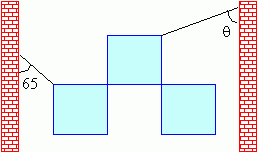
The forces that we know are working on the sign are the two tensions and the weight which acts from the centre of mass of each piece. Each piece has one-third of the total mass and weight.
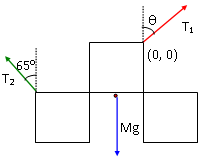
| ΣFx = 0 | ΣFy = 0 |
| T1sinθ − T2sin(65°) = 0 | T1cosθ + T2cos(65°) − Mg = 0 |
These tell us that T1sinθ
= T2sin(65) and
T1cosθ + T2cos(65°) = Mg.
We will use Method B for the torques since that method is easiest to apply here since the location of the forces easy to find. We will locate the pivot at the upper right corner because we have two unknowns there.
| x(m) | y( m) | Fx | Fy | τz = xFy − yFx |
| 0 | 0 | T1sinθ | T1cosθ | 0 |
| -0.64 | -0.32 | -T2sin(65°) | T2cos(65°) | 0.64T2(65°) - 0.32T2sin(65°) |
| −0.16 | −0.16/6 | 0 | −Mg | −(0.16)Mg |
Since Στz = 0, the equation we get is
Rearranging the above yields the tension in the left string,
The force equations give
Taking the ratio of these two results we have
sinθ/cosθ = 0.31725/1.07831
or tanθ = 0.2942. So the unknown angle is
θ = 16.4°. Substituting
the angle back into either of the two equations yields the tension
in the right string T1 = 1.124 N.
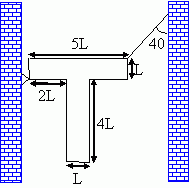
In dealing with real objects rather than particles, we treat the complex object as a grouping of simpler shapes. The CM of the simpler shapes are easy to find, it is the geometric centre if the object is uniform. Each piece can now be considered a particle with the mass of the piece located at the CM of that piece. We have, in effect, turned the complex shape into a collection of particles.
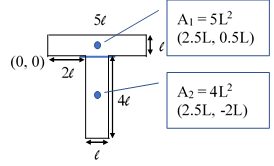 |
The area and the location of CM of each rectangle with respect to the given
origin (0,0) is found. Since the sign is uniform, mass can be replaced by area
in the formula xCM = (Σmixi)/Mtotal.
The horizontal component of the centre of mass of the sign must be on the vertical symmetry axis. However, we will proceed with the calculation just to check. xCM = (5L2 × 2.5L + 4L2 × 2.5L)/(5L2 + 4L2) = 2.5L yCM = (5L2 × 0.5L + 4L2 × −2L)/(5L2 + 4L2) = (−5.5L)/9 = −(11/9)L |
The problem mentions forces and looking at the diagram shows that
the object would rotate in the absence of any one of these forces.
This indicates that we are dealing with a Static Equilibrium
problem. We solve Static Equilibrium problems by sketching the
extended free-body diagram, an FBD where the location of the all
forces are indicated so that torques can be calculated. Then
we determine the three equations necessary for static equilibrium,
ΣFx = 0,
ΣFy = 0,
and Στz = 0.
The forces that we know are working on the sign are the tension, and the weight which acts from the centre of mass, and
the normal force from the hinge. Since we do not know the direction
of the normal force, we show components.
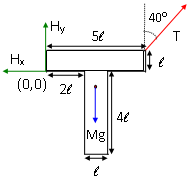
| ΣFx = 0 | ΣFy = 0 |
| -Hx + Tsin(40°) = 0 | Hy + Tcos(40°) − Mg = 0 |
These tell us that Hx = Tsin(40°) and Hy
+ Tcos(40°) = Mg.
We will use Method B for the torques since that method is easiest to apply here since the location of the forces easy to find. We will locate the pivot at the hinge because we have two unknowns there.
| x | y | Fx | Fy | τz = xFy − yFx |
| 0 | 0 | Hx | Hy | 0 |
| 5ℓ | ℓ | Tsin(40°) | Tcos(40°) | 5ℓTcos(40°) − ℓTsin(40°) |
| 2.5ℓ | −ℓ | 0 | −Mg | -2.5Mgℓ |
Since Στz = 0, the equation we get is
Eliminating ℓ and rearranging the above yields the tension
in the rope,
The force equations give
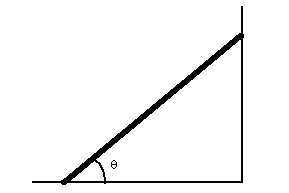
The problem mentions forces and looking at the diagram shows that
the object would rotate in the absence of any one of these forces.
This indicates that we are dealing with a Static Equilibrium
problem. We solve Static Equilibrium problems by sketching the
extended free-body diagram, an FBD where the location of the all
forces are indicated so that torques can be calculated. Then
we determine the three equations necessary for static equilibrium,
ΣFx = 0,
ΣFy = 0,
and Στz = 0.
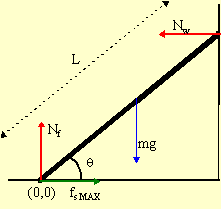
The forces that we know are working on the ladder are the weight which acts from the centre of mass, the normal forces from the wall and floor, and friction. Since the ladder is not moving, we are dealing with static friction. Since we want the smallest angle, we are dealing with fs MAX. Since the ladder has a tendency to move to the left, friction points to the left.
| ΣFx = 0 | ΣFy = 0 |
| fs MAX − Nw = 0 | Nf − mg = 0 |
These tell us that fs MAX = μNw
and Nf = mg. We also know that fs MAX =
μsNf
where Nf is the normal force between the ladder and
floor. As a result, we have fs MAX = μsmg.
Hence Nw = μsmg as well.
We will use Method A for the torques since that method is easiest to apply here since the distances and angles are easy to find. We will locate the pivot at the floor because we have two unknowns there.
| r (m) | F (N) | θ | direction | τz = rFsinθ |
| 0 | fs MAX | - | - | 0 |
| 0 | Nf | - | - | 0 |
| ½L | mg | π/2-θ | CW | -½Lmgsin(π/2-θ) |
| L | Nw | θ | CCW | LNwsinθ |
Since τz = 0, the equation we get is
Eliminating L and noting that sin(π/2-θ)
= cosθ yields,
The force equations gave Nw = μsmg, so we
have
Rearranging and using tanθ
= sinθ /cosτ, we get
If the angle were any smaller than this, the ladder would slip.
Questions? mikec@kpu.ca
![[Return to Kwantlen Homepage]](http://www.kpu.ca/images/return_button.gif)