![[Return to Physics Homepage]](./../../physics.gif)
![[Return to Mike Coombes' Homepage]](./../../coombes.gif)
![[Return to List of Handouts]](./../../handouts.gif)
![[Return to Problem Sets]](./../../problems.gif)
![[Return to List of Solutions]](./../../solutions.gif)
Questions: 1 2 3 4 5 6 7 8 9 10
Physics 1101 |
Superposition and Standing Waves |
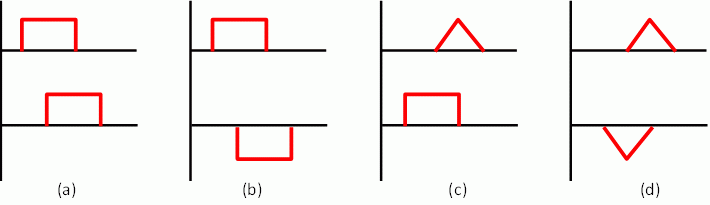
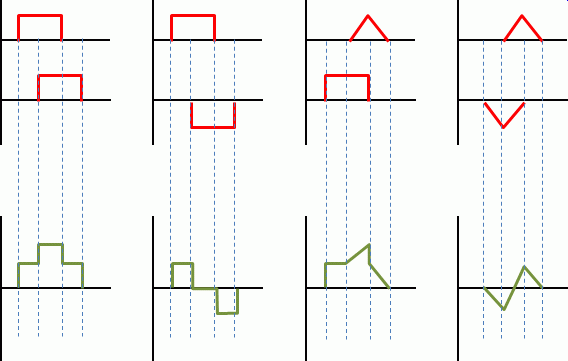
The superposition is the sum of the heights of each at each instant (Asuperposition = A1 + A2)
![[Return to Top of Page]](../../top.gif)
(i) The standing wave of resonance frequencies of
a string fixed at both ends is given by the formula
 where n = 1,2,3,… Since we are given v and
L, we have
where n = 1,2,3,… Since we are given v and
L, we have
The first five frequencies are thus: f1 = 3.33 Hz,
f2 = 6.67 Hz, f3 = 10.0 Hz,
f4 = 13.33 Hz, and f5
= 16.67 Hz.
(ii) The standing wave of resonance frequencies
of a string fixed at only one end is given by the formula
 where n = 1,3,5,… Since we are given v and
L, we have
where n = 1,3,5,… Since we are given v and
L, we have
The first five frequencies are thus: f1 = 1.67 Hz,
f3 = 5.00 Hz, f5 = 8.33 Hz,
f7 = 11.67 Hz, and f9 = 15.00 Hz.
(iii) If we have a sequence of resonance frequencies, we can tell if the string is fixed at both ends or open at one end by looking at the ratio of the frequencies. To find the ratio divide through by the greatest common divisor. For a string fixed at both ends, the ratio will have both even and odd numbers. A string fixed at only one end will have only odd numbers. For example, from part (i) above, the ratio is 1:2:3:4:5, where the common factor 3.33 Hz is factored out. In part (ii), the ratio is 1:3:5:7:9, where the common factor 1.67 Hz is factored out. Notice that the greatest common factor is the fundamental frequency.
![[Return to Top of Page]](./../../top.gif)
First we sketch the standing wave.

The equations for a string fixed at both ends are
 and
and
 . Examining the sketch , we
see that n = #node - 1 = 6, so that this is the sixth harmonic.
We are given L, so we need the speed of the wave v to determine
fn. The speed of the wave can be found from the formula
. Examining the sketch , we
see that n = #node - 1 = 6, so that this is the sixth harmonic.
We are given L, so we need the speed of the wave v to determine
fn. The speed of the wave can be found from the formula
 , where μ
is the linear density given by
, where μ
is the linear density given by  .
Using the given data, the speed may be computed
.
Using the given data, the speed may be computed
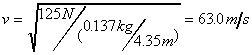 .
.
Hence, 
The fundamental, or n = 1, frequency is f1
= 7.24 Hz.
The equation of a standing wave is given by 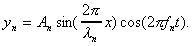 In this case, we have
 ,
,
where  has been used.
The resonance frequencies of a string fixed at only
one end is given by the formula
 where
n = 1,3,5,… The first sentence tells us that n = 9
- the number of quarter wavelengths seen. We use this to sketch
the standing wave.
where
n = 1,3,5,… The first sentence tells us that n = 9
- the number of quarter wavelengths seen. We use this to sketch
the standing wave.

Using the formula, since we have n, v and L,
The fundamental frequency occurs when n = 1, so
The wavelength of a string fixed at both ends is given by the formula
 , where n = 1,3,5,…
Thus we have
, where n = 1,3,5,…
Thus we have
Of course, we could just look at the sketch and
see that one full wavelength is 4 quarters of the nine quarters
displayed, so that the wavelength was just 4/9 times the length
of the string.
(a) The ratio of these three frequencies is 175:245:315, or 535:735:935, or 5:7:9.
(b) For a string fixed at both ends, the resonant
frequencies are given by  ,
where n = 1, 2, 3, 4, … For a string fixed at only one end,
the resonant frequencies are given by
,
where n = 1, 2, 3, 4, … For a string fixed at only one end,
the resonant frequencies are given by
 , where n = 1, 3, 5, 7, 9,
… Since the given sequence has only odd numbers,
we may conclude that the string is fixed at only one end.
, where n = 1, 3, 5, 7, 9,
… Since the given sequence has only odd numbers,
we may conclude that the string is fixed at only one end.
(c) The fundamental frequency is the greatest common factor of the sequence, so f1 = 35.0 Hz.
(d) The harmonics are the 5th, 7th, and 9th.
 .
. .
. .
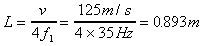
.(e) Since  , we can rearrange
this equation to find the length,
, we can rearrange
this equation to find the length,
 .
.
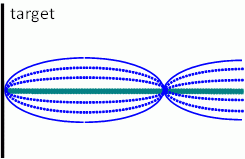
We see that this pattern is the same as the third harmonic of a string fixed at one end and free at the other. In the third harmonic, we see only 3/4th of the length of the full wave, so λ = 4/3 × L = 4/3 × 1.05 m = 1.40 m.
The frequency of vibration is given as f = 110 Hz.
The speed v in the arrow (not the speed of the arrow!) is related to wavelegth and frequency by v = λf = (1.40 m)(110 Hz) = 154 m/s.
The speed of sound is 340 m/s in air. The lowest frequency standing wave is open at both ends and is given by
f = nv / 4L = (1)(340 m/s) / (4)(0.025 m) = 3400 Hz.
For a tube open at on end, the standing waves frequencies
obey the formula
where n = 1,3,5,…
The lowest frequency corresponds to n = 1. Since we are
given v and L, we have
Solving for L yields,
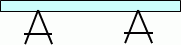
The open ends will be antinodes and the location of the sawhorses must be nodes, so the lowest frequency standing wave in the tube looks like

which is the n = 2 harmonic. The frequency of the standing wave is therefore
f = nv / 2L = (2)(340 m/s) / (2)(3.50 m) = 97.1 Hz.
Let f be the unknown frequency, the beat frequency is defined
as fbeat = |f - fknown|. Therefore, in the
two stated cases, we have
Each of these equations has two possible solutions. However,
since
the beat frequency increased as the know frequency increases,
the solution must be lower than 500 Hz. Hence
Questions? mike.coombes@kpu.ca
![[Return to Kwantlen Homepage]](http://www.kpu.ca/images/return_button.gif)