![[Return to Physics Homepage]](./../../physics.gif)
![[Return to Mike Coombes' Homepage]](./../../coombes.gif)
![[Return to List of Handouts]](./../../handouts.gif)
![[Return to Problem Sets]](./../../problems.gif)
![[Return to List of Solutions]](./../../solutions.gif)
Questions: 1 2 3 4 5 6 7 8 9 10 11 12 13 14 15 16 17 18
| Physics 1101 | Heat |
The heat lost by the lead must be absorbed by the water. The insulated thermos prevents losses to the surroundings, so the heat energy is conserved. Thus
As long as there is no change of state, Q = mcΔT = mc(Tf - Ti). The temperatures should be in Kelvin, so 220.0 °C = 220.0 K + 273.16 K = 493.16 K and 16.0 °C = 16.0 K + 273.16 K = 289.16 K. The lead and water will have the same temperature Tf when they reach equilibrium.
Thus our equation becomes
Getting the terms in Tf isolated on the left hand side yields,
Using the given values
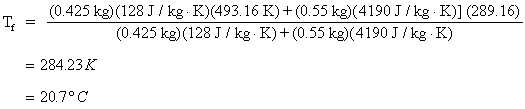
So the lead and water reach equilibrium at 20.7 °C. Notice that in doing this problem, we took the precaution of converting all temperatures from Celsius to Kelvin.
![[Return to Top of Page]](./../../top.gif)
The heat lost by the ice must be absorbed by the water. The insulated thermos prevents losses to the surroundings, so the heat energy is conserved. Thus
The ice must warm from -20 °C (253.16 K) up to 0 °C (273.16 K), then melt, and then the ice water must warm to the final temperature. At the same time the other water cools from 80 °C (353.16 K). The ice water and the other water will have the same temperature Tf when they reach equilibrium. When a material is in one state, Q = mcΔT = mc(Tf - Ti). When ice melts the heat required is given by Qmelting = mLF.
In this case, therefore, we have
or
We isolate Tf
Using the given values
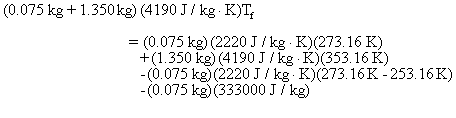
This reduces to
So
The system reaches equilibrium at 64.3 °C.
We are told to assume
Since the rate at which energy is emitted by the microwave is P = 300 W,
where t is the elapsed time. The energy that the water absorbs is given by
Combining the results, yields
We then find the required time to be
It will take the coffee two minutes and twenty seconds to warm up sufficiently.
The heat loss through a conductor is given by Q = κA(Tin - Tout)/L, where A is the surface area and L is the thickness of the conductor. We are given κ so the result is
Not a very large number and not a good way to cool.
Evaporation carries away Q = mLv where Lv = 22.6 × 10⁵ J/kg. Let's assume all the sweat evaporates. The thermal energy it must carry away in one hour is Q = (250 W) × 3600 s = 9 × 10⁵ J. The mass of evaporated sweat is thus
The heat flow through the polyurethane must equal the heat flow through the wood. Let's call the temperature at the boundary Tboundary.
A is common and can be eliminated.
Next collect terms with Tboundary on the same side.
Using the values for κ for polyurethane and wood given in the text and the other values given in the problem we find Tboundary
This reduces to
This yields Tboundary = 6.26 °C.
Examining the appropriate table from the text, the thermal conductivity of glass is Kglass = 1.0 W/m-K and Kair = 0.026 W/m-K.
The effective R-value is given by the formula
where T is the thickness of the layer and K is its thermal conductivity. Thus
The wind has an effective
R-value of 0.84 m2K/W
.
The effective R-value is given by the formula
so
The heat loss through a conductor is given by H = A(Tin - Tout)/R, where A is the surface area. Thus
We didn't need to convert the temperature from Celsius to Kelvin because we are dealing with a difference in temperature. Thus the heater would have to use power at the rate 1.26 × 10⁴ W to keep the cabin at 17 °C.
With the insulation the new R-value is
Thus
Hence the heater need only supply 3400 W of power.
At steady state the temperature at the interface between the insulation and the wood will clearly be some temperature, Ti, between 17 C and -10 °C. As well energy must be conserved, the amount of heat energy passing through the insulation must pass through the wood,
Using our formula
We eliminate the common factor A, and collect terms involving Ti to get
or

This reduces to
The interface is at 11.9 °C.
Since still air is a poor conductor we need only worry about radiation. The top side (area = L2) only of the cube absorbs energy from the sun without reflection. All six sides (area = 6L2) receive energy form the surrounding environment which is at 20 °C. All six sides emit energy at the currently unknown temperature of the box. The energy absorbed must equal the energy readmitted and thus our equation is
Noice that L2 cancels out; the dimensions of the cube do not matter. Also temperature must be in Kelvin not Celsius. Our equation becomes
Or
Substituting the values given
We find Tcube = 304.18 K or 31.0 °C.
The white cube absorbs only 40% of the sunlight so, we need only slightly modify our equation to
Substituting the values given
We find Tcube = 297.71 K or 24.6 °C.
(a) The rate at which a
body radiates energy because of its
temperature
is given by the Stephan-Boltzmann Law,
P = σεAT4,
where T is the
temperature of the body and A is its area. For a blackbody, the
ε = 1. In this problem
(b) The rate at which a body absorbs energy because of the temperature of its surroundings is also given by the Stephan-Boltzmann Law, P = σεAT4, where T is the temperature of the surroundings and A is still the area of the body. For a blackbody, the ε = 1. In this problem
(c) The net loss of power is thus, ΔP = Pe - Pa = 160.5 W.
In one day the energy loss would be
(d) Since we are given the energy in the candy bar, the number of bars required is
So you would need to eat 10.4 bars just to stay warm.
Of course, people aren't blackbodies, they wear insulating clothes and have an insulating layer of fat and skin. So ε < 1, and the energy requirement above is an overestimate. We can estimate ε by noting that a sedentary person needs about 1600 kilocalories per day, or 6700 KJ or 5 Oh!Henry bars. Thus ε must be around 0.5 .
The person is losing thermal energy radiatively as given by the formula
Now ε = 1 for a blackbody. We know A = 1.5 m2 and σ = 5.6703×10⁻⁸. The skin temperature is Tskin = 34 + 273 K = 307 K. For the person to be comfortable Pnet = 100 W.
We can rearrange the above equation for the comfortable ambient temperature
The thermal energy, 100 W, conducts through cloth and obeys the formula
but we don't know the exterior temperature of the catsuit but it will be below the person's skin temperature of 34 C.
By conservation of energy, the same power is radiated from the catsuit according to the formula
From this second formula we can find the catsuit exterior temperature (noting that that Tenvironment = 15 + 273 K = 288 K, A = 1.5 m2, σ = 5.6703×10⁻⁸, and for blackbodies ε = 1)
With this temperature we can return to the first formula and solve for L using κ = 0.040 W/m·K.
A catsuit of 4.4 mm thickness will do the job.
Assuming all radiate cooling
Solving for the temperature of the flushed skin and noting Tenvironment = 25 + 273 K = 298 K, A = 1.5 m2, σ = 5.6703×10⁻⁸, and for blackbodies ε = 1, we find
Since there is the extra cooling of cool blood returning to the core, the flushed skin temperature would actually be lower.
At this higher temperature the radiative cooling is only
where I have used Tskin = 34 + 273 K = 307 K, Tenvironment = 30 + 273 K = 303 K, A = 1.5 m2, σ = 5.6703×10⁻⁸, and for blackbodies ε = 1.
So an extra 100 W - 38.6 W = 61.4 W must be lost by sweating
Sweating involved latent heat Q = mLF and P = Q/t, so to find the mass of sweat in one hour, P = mLF/t can be rearraged to give
So the person sweats 664 g. Note we are ignoring the fact that the person would flush thus raising the skin temperature and threby reducing the amount of sweat produced.
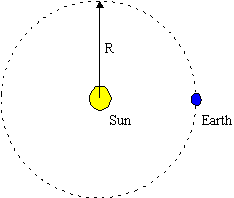
(a) The Sun is a sphere and
it radiates energy uniformly in all
directions.
If we consider a sphere of radius R, where R is the distance from the
Sun
to the Earth, each square metre of that enormous sphere must intercept
the same energy as on earth. Hence the power emitted by the Sun must be
So the Sun emits energy at the rate of 3.79 × 1026 W.
(b) According to the Stephan-Boltzmann Law, the power emitted by the Sun is also
The surface area of the Sun is A = 4π(RS)2. Hence
We treat the Sun as a blackbody so ε = 1. Thus we can find the radius of the Sun,
So the radius of the Sun is 200 times smaller than the distance from the Sun to the Earth.
The rate at which energy is conducted out of the core is
P = A(Tinterior − Tskin) / R where R = L/κ = .03 m / 0.20 J/(s·m·°C) = 0.25 (s·m2·°C) /J
The rate that energy is emitted from your skin is
P = σA(Tskin4 − Tenv4). Remember these temperatures must be in Kelvin.
Let's calculate these powers at different temperatures.
| Tskin (°C) |
Tskin (Kelvin) |
Pconduction (W) |
Pradiation (W) |
| 30 | 303.16 | 70 | 209.2452 |
| 25 | 298.16 | 120 | 163.0088 |
| 20 | 293.16 | 170 | 119.0409 |
| 15 | 288.16 | 220 | 77.26599 |
The skin temperature is set when the two powers equal. From this table we see that this temperature must be between 25 and 20 degrees. Continuing
| Tskin (°C) |
Tskin (Kelvin) |
Pconduction (W) |
Pradiation (W) |
| 25 | 298.16 | 120 | 163.0088 |
| 24 | 297.16 | 130 | 154.0362 |
| 23 | 296.16 | 140 | 145.1537 |
| 22 | 295.16 | 150 | 136.3607 |
| 21 | 294.16 | 160 | 127.6566 |
| 20 | 293.16 | 170 | 119.0409 |
Now it appears that the answer is between 23 and 22 degrees. So continue again
| Tskin (°C) |
Tskin (Kelvin) |
Pconduction (W) |
Pradiation (W) |
| 22.8 | 295.96 | 142 | 143.3879 |
| 22.6 | 295.76 | 144 | 141.6258 |
| 22.4 | 295.56 | 146 | 139.8672 |
| 22.2 | 295.36 | 148 | 138.1121 |
| 22.72 | 295.88 | 142.8 | 142.7 |
Final skin temperature is about 22.7 °C.
The person in the previous problem will cool rapidly since a typical 70 kg person generates 100 W of heat. To keep warm, one can engage in physical activity. How much heat must he generate? What amount of physical activity (work) must he do? Luckily this person is hill climbing, at what rate (in metres per second and metres per hour) must he climb? Assume that he is 25% efficient?
He needs to generate 142.8 W − 100 W = 42.8 W of extra heat.
Since efficiency is given by e = (Work/time / Heat/time), then Work/time = 0.25 × 42.8 W = 10.7 W.
A climbing person is gaining gravitation energy, mgh. So W/t = mgh/t and we are looking for h/t.
Our equation is h/t = (W/t) / mg = 10.7 / (70)(9.81) = 0.0155 m/s or 56 m/h which is not very strenuous.
A kg of ice fills a cube 10 cm on each side. Suppose the ice is at 0 C and the ambient temperature is 20 C. How long will it take to melt completely to water at 0 C? Treat the ice as having ε = 0.95.
The latent heat Q = mLF must be absorbed from the surrounding. The rate that this happens Q/t = mLF/t must equated the net absorbed radiative power.
We know m = 1.0 kg, area A = 6 × (0.1 m) × (0.1 m) = 0.06 m2, LF = 333 kJ/kg, Tice = 0 + 273 K = 273 K, Tenvironment = 20 + 273 K = 293 K, and σ = 5.6703×10⁻⁸. We are given ε = 0.95. So rearranging out equation to find t,
It takes almost 16 hours to melt!
Questions? mike.coombes@kpu.ca
![[Return to Kwantlen Homepage]](http://www.kpu.ca/images/return_button.gif)