![[Return to Physics Homepage]](./../../physics.gif)
![[Return to Mike Coombes' Homepage]](./../../coombes.gif)
![[Return to List of Handouts]](./../../handouts.gif)
![[Return to Problem Sets]](./../../problems.gif)
![[Return to List of Solutions]](./../../solutions.gif)
Questions: 1 2 3 4 5 6 7 8 9 10 11 12 13 14 15 16 17 18 19 20 21 22 23 24 25 26 27 28 29 30 31 32
| Physics 1101 | Work & Energy |
Work
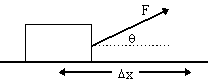
For constant forces, work is defined by W
= FΔxcos(θ).
(a) W = 36.2 J
(b) W = 77.6 J
(c) W = -38.9 J
![[Return to Top of Page]](./../../top.gif)
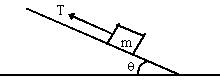
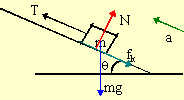
To find the work done by a force, we need to know the magnitude of the force and the angle it makes with the displacement. To find forces, we draw a FBD and use Newton's Second Law.
 |
i | j |
| ΣFx = max | ΣFy = may | |
| T - fk - mgsinθ = ma | N - mgcosθ = 0 |
The second equation informs us that N = mgcosθ. We know fk = μkN = μkmgcosθ.
| Force | Force (N) | θ | W = FΔxcosθ (J) |
| Tension | 150 | 0 | 450 |
| Weight | 147.15 | θ + π/2 | -187 |
| Normal | 133.36 | π/2 | 0 |
| Friction | 26.67 | π | -80 |
In 3D, work is defined W = F · Δr,
which means W = FxΔx
+ FyΔy
+ FzΔz. It is also defined by W
= FΔrcosθ, where
F and R are the magnitudes of the vectors, F and
Δr. Using the 3D version of Pythagoras'
Theorem, F = [(Fx)2 + (Fy)2
+ (Fz)2]½ and
Δr = [(Δx)2
+ (Δy)2
+ (Δz)2]½. If we
find the work using the first form, then θ can
be found from the second by θ
= cos-1(W / FΔr).
(a) W = 1×4 + 2×5 + 3×6 = 32 J.
Since F = [(1)2 + (2)2 + (3)2]½ = 3.7417 N and Δr = [(4)2 + (5)2 + (6)2]½ = 8.7750 m, then θ = cos-1(W / FΔr) = 12.9°.
(b) W = 1×4 + 2×5 + 3×(-6) = -4 J.
Since F = [(1)2 + (2)2 + (3)2]½
= 3.7417 N and Δr = [(4)2
+ (5)2 + (-6)2]½ = 8.7750 m, then
θ = cos-1(W
/ FΔr) = 97.0°.
(c) W = 4×2 + 2×(-8) + 4×2 = 0 J.
Since F = [(4)2 + (2)2 + (4)2]½ = 6.1644 N and Δr = [(2)2 + (-8)2 + (2)2]½ = 8.4853 m, then θ = cos-1(W / FΔr) = 90°.
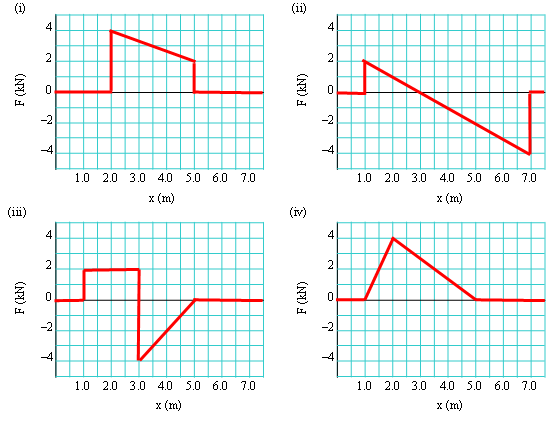
When the force is not constant, one must integrate ∫ F(x) dx. Since we have graphs, integration is simply finding the area under the curve in each case. By convention, a positive force is one pointing to the right. All these shapes consist of rectangles for which area = base × height or triangles for which area = ½ base × height. Remember that the vertical axis is in 1000's of Newtons.
(i) W = ½(2000 N)(3 m) + (2000 N)(3 m) = 9000 J.
(ii) W = ½(2000 N)(2 m) + ½(−4000 N)(4 m) = −6000 J.
(iii) W = (2000 N)(2 m) + ½(−4000 N)(2 m) = 0 J.
(iv) W = ½(4000 N)(4 m) = 8000 J.
Work-energy
(a) Since the block is moving on a flat surface, W = ½mvfinal2 − ½mvinitial2 or vfinal2 = 2W/m + vinitial2.
(i) vfinal2 = 2(9000 J)/(50 kg) + (20.0 m/s)2 = 760. vfinal = 27.6 m/s
(ii) vfinal2 = 2(−6000 J)/(50 kg) + (20.0 m/s)2 = 160. vfinal = 12.6 m/s
(iii) vfinal2 = 2(0 J)/(50 kg) + (20.0 m/s)2 = 400. vfinal = 20.0 m/s.
(iv) vfinal2 = 2(8000 J)/(50 kg) + (20.0 m/s)2 = 720. vfinal = 26.8 m/s.
(b) Work and kinetic energy are scalar quantities. Since you are taking a square root in the calculations above, positive and negative the solutions and therefore directions would be possible. This ambiguity can be a flaw in the work-energy approach. However, if you know the direction of F and D, you can usually guess which direction is more reasonable.
Since we are asked for the work done and have a change in speed,
we make use of the generalized Work-Energy Theorem. Since the
height of the block does not change, there is only a change in
kinetic energy.
To find μ, we need to know the force and the angle it makes with the displacement. To find forces, we draw a FBD and use Newton's Second Law.
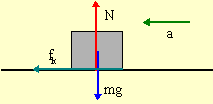 |
||
| ΣFx = max | ΣFy = may | |
| -fk = -ma | N - mg = 0 |
The second equation gives N = mg and we know fk =
μk N, so fk = μk mg. Therefore,
the work done by friction is Wfriction
= -fkΔx = -μkmgΔx.
Rearranging this yields
Since the problem involves a change is speed, we make use of the
Generalized Work-Energy Theorem
There are two nonconservative forces in this problem, friction and the applied force. The work done by friction is given by Wfriction = -fkΔx. The work done by the applied force is WF = FΔx.
To find out more about fk, we draw a FBD and use Newton's Second Law.
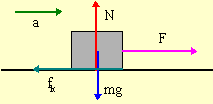 |
||
| ΣFx = max | ΣFy = may | |
| F - fk = ma | N - mg = 0 |
The second equation gives N = mg and we know fk
= μkN, so fk
= μkmg. Thus Wfriction
= -μkmgΔx.
Combining this result with equation (1), we get
Rearranging yields an expression for μk
Using the given values, we find μk = 0.15 .
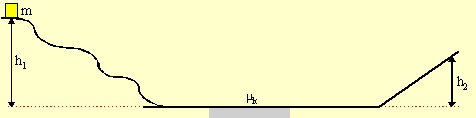
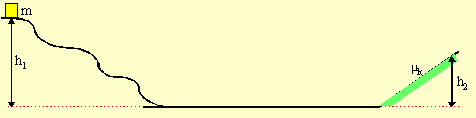
Since the problem involves a change of height and
speed, we make use of the Generalized Work-Energy Theorem. Since
the block's initial and final speeds are zero, we have
The nonconservative force in this problem is friction. To find the work done by friction, we need to know the friction. To find friction, a force, we draw a FBD at the rough surface and use Newton's Second Law.
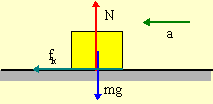 |
||
| ΣFx = max | ΣFy = may | |
| -fk = -ma | N - mg = 0 |
The second equation gives N = mg and we know fk =
μkN, so fk
= μkmg. Therefore,
the work done by friction is Wfriction
= -fkΔx
= -μkmgΔx.
Putting this into equation (1) yields
Solving for h2, we find
Since the problem involves a change of height and
speed, we make use of the Generalized Work-Energy Theorem. Since
the block's initial and final speeds are zero, we have
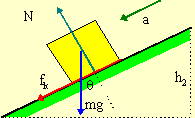
The nonconservative force in this problem is friction. To find the work done by friction, we need to know the friction. To find friction, a force, we draw a FBD at the rough surface and use Newton's Second Law.
 |
||
| ΣFx = max | ΣFy = may | |
| -fk - mgsinθ = -ma | N - mgcosθ = 0 |
The second equation gives N = mgcosθ and we
know fk = μkN, so
fk = μk
mgcosθ. Therefore, the work done by friction
is Wfriction = -fkΔx
= -μkmg
cosθΔx. Putting this into
equation (1) yields
A little trigonometry shows that Δx is related
to h2 by Δx = h2
/ sinθ. Putting this
into the above equation yields
Solving for h2, we find
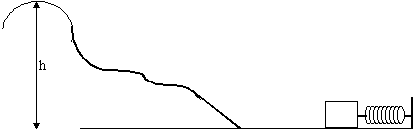
Since the problem involves a change is height and has a spring, we make use of the Generalized Work-Energy Theorem. Since the initial and final speeds are zero,
There are no nonconservative forces so WNC = 0. Getting x by itself yields
Friction is a nonconservative forces so WNC = Wfriction ≥ 0. Thus
Friction does -132 Joules of work.
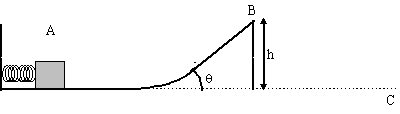
The problem involves a change in height and speed and has a spring, so we apply the generalized Work-Energy Theorem., WNC = ΔE.
There is no friction or air resistance, so WNC = 0. The
spring is compressed initially, so it loses spring potential
energy. The block increases kinetic energy and gains gravitational
potential energy. Our equation is thus
We can use this to find the speed of the block at launch
Now the block is a projectile. To solve a projectile
problem we break the motion into its x and y components and apply
our kinematics equations.
| v0x = vcos(55°) = 3.47523 m/s | v0y = vsin(55°) = 4.96314 m/s |
| Δx = ? | Δy = -4.50 m |
| ax = 0 | ay = -9.81 m/s2 |
| t = ? | t = ? |
We have enough information in the y column to find t using Δy = v0yt + ½at2 ,
Using the quadratic equation, the solutions are t = -0.5773 s and
t = 1.5892 s. We want the positive, or forward in time, solution.
Hence the horizontal distance traveled by the block is
Point C is therefore 5.52 m from B.
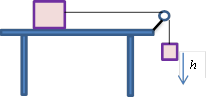
The system is the two blocks connected by the string. The friction from the tabletop does work on the system, Wext = −fkh. Note that the block on the tabletop moves the same distance as the hanging block. Recall that fk = μkN and here N = m2g.
Over the distance h, both blocks will pick up the same speed v, that is, increase kinetic energy. The hanging block drops lower, so loses gravitational potential energy.
We can now write a specific equation for this problem since we know both sides of Wext = ΔE.
−μkm2gh = +½m2v2 + ½m1v2 − m1gh
To get an expression for v, we gather all the terms with h on the left hand side.
m1gh − μkm2gh = ½[m1 + m2]v2
Solving for v, we find
v = [2(m1gh − μkm2gh)/(m1 + m2)]½
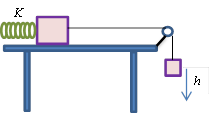
The system is the two blocks connected by the string and the spring. There is no friction, so Wext = 0. Note that the block on the tabletop moves the same distance as the hanging block and that the spring stretches by that amount h.
Over the distance h, both blocks will pick up the same speed v, that is, increase kinetic energy. The hanging block drops lower, so loses gravitational potential energy. The spring stretches gaining spring potential energy.
We can now write a specific equation for this problem since we know both sides of Wext = ΔE.
0 = +½m2v2 + ½m1v2 − m1gh + ½Kh2
To get an expression for v, we gather all the terms with h on the left hand side.
m1gh − ½Kh2 = ½[m1 + m2]v2
Solving for v, we find
v = [(2m1gh − Kh2)/(m1 + m2)]½
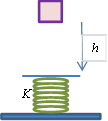
The system is the the block and the spring. The force of the spring on the block and vice versa are internal forces and cancel out. As well there is no friction, so Wext = 0. Note that the block drops distance h plus the compression x of the spring.
The block starts at rest and will again be at rest when the spring is compresses to its maximum, so there is no change in kinetic energy. The block does lose gravitational potential energy and the spring gains spring postential energy.
We can now write a specific equation for this problem since we know both sides of Wext = ΔE.
0 = −mg(h+x) + ½Kx2
This is a quadratic equation in x.
0 = −mgh − mgx + ½Kx2
The solutions are
x = {mg ± [(mg)2 +2Kmgh]½}/K
Only the plus value will give an x > 0, so
x = {mg + [(mg)2 +2Kmgh]½}/K
Power
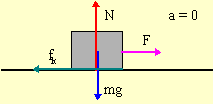
The power required to move the block at constant speed is P = Fv. We are given v, the speed of the block. To get F, a force, we draw a FBD and apply Newton's Second Law,
 |
||
| ΣFx = max | ΣFy = may | |
| F - fk = 0 | N - mg = 0 |
The second equation gives N = mg and we know fk =
μkN, so fk
= μkmg. Therefore,
the applied force is F = μkmg.
Thus the power is
First we convert the velocity to SI units,
We know P = Fv, so
By Newton's Third Law, the water is exerting 2250 N in the reverse direction. It is also removing 7500 W of power which is going into increasing the kinetic energy of the water.
Efficiency
First, 3.0 hp × 746 W / hp = 2238 W. Since the engine is on 35% efficient, only 0.35 × 2238 W = 783.3 W does mechanical work and the rest is converted to heat.
Next, the work done by the engine must equal the
work done by the weight, from Newton's Third Law. The work done
by gravity is
Since power is defined as work done over time, P = W/t,
the time it takes is
If mechanical work is just 35% of the change of energy of the system, then heat transfer must be 75% of the change in energy. Since W = 0.35ΔE, then ΔE = (1.442 × 10⁴ J)/0.35 = 4.12 × 10⁴ J. So Q = 0.65ΔE = 2.68 × 10⁴ J.
Since W = 0.27ΔE, then ΔE = (100 kJ)/0.27 = 370.4 kJ. So Q = (1 − 0.27)ΔE = 270.4 kJ.
If W = 0.27ΔE, then Q = (1 − e)ΔE = 0.73ΔE. Since we are given Q, ΔE = (650 kJ)/0.73 = 890.4 kJ. Therefore W = 0.27(890.4 kJ) = 240.4 kJ.
First recall that 1 W = 1 J/s and that 1 h = 3600 s. So Egas = (8.9 × 10³ J/s)(3600 s) = 3.204 × 10⁷ J.
Here the mechanical work done is simply W = mgh. We know how much work we can get from the gasoline. It is W = 0.22(2)(3.204 × 10⁷ J) = 1.41 × 10⁷ J. Therefore h = W/mg = (1.41 × 10⁷ J)/(1000 kg)/(9.81 m/s2) = 1582 m.
Work, Heat, Energy
Since the person does no mechanical work, the heat produced comes from the food he digested, Q = Ein. In one day the person expends 100 W × 24 h/d × 3600 s/h = 8.64 × 10⁶ J. This means the person needs to consume (8.64 × 10⁶ J) / (450 KJ/bar) = 19.2 bars.
Worker A lift a 25.0 kg box 0.95 m to a conveyor belt that carries the
box to worker B who lowers the box to the floor. The workers move 415 boxes in an
hour this way. Worker A is 22% efficient. Worker B is 26% efficient. Ignore work done by bending and twisting.
(a) What is the work done by worker A? What is the mechanical power output of worker A during this hour?
(b) How much total energy does worker A expend during this time? What is his total power input during this time?
(c) How much heat energy does worker A expend during this time? What is power is he expending as heat input during this time?
(d) Even though worker B is lowering the box (and not just dropping it), he must use energy to generate the force of his muscles to keep the box from falling. Compare the force worker B exerts on the box compared to worker A? Now look at the work definition W=Fdcosθ. How does this formula compare in the two cases? People are not springs, they do not get energy back from doing negative work. To do negative work, we assume people use just about the same amount of food energy as when doing positive work.
(e) What is the work done by worker B? What is the mechanical power output of worker B during this hour?
(f) How much total energy does worker B expend during this time? What is his total power input during this time?
(g) How much heat energy does worker B expend during this time? What is power is he expending as heat input during this time?

(a) Since the box starts at rest and finishes higher at rest, it is easiest to determine the mechanical work done by looking at the change in gravitational potential energy. The work A does lifting one box is W = ΔE = mgh = (25 kg)(9.81 m/s2)(0.95 m) = 232.99 J. Since he moves 415 boxes, Wtotal = 415 × 232.99 J = 96690.8 J. Mechanical power is the rate at which he does work, Pmech = W/t = (96690.8 J)/(3600 s) = 26.86 W.
(b) Since he is efficient, and ε = Wout / Ein, we can rearrange this formula to find Ein = Wout/ε = (96690.8 J)/0.22 = 439503.6 J. Similarly, Pin = Pout/ε = (26.86 W)/0.22 = 122.1 W.
(c) Most of the energy, 1 − 22% = 78% is converted to heat. So Q = 0.78E = (0.78)(439503.6 J) = 342812.8 J. Similary, Pheat = 0.78Pin = (0.78)(122.1 W) = 74.3 W.
(d) If we reasonably assume that the acceleration is zero when lifting or lowering the boxes, then in each case the workers exert F = mg upwards. Worker A lifts the box vertically up, so cosθ = +1. Worker B applies the force upward as the box moves down, so cosθ = −1. Worker A does positive work, but worker B does negative work.
(e) Since people can't absorb energy from the environment, worker B is working just as hard as worker A. W = ΔE = 96690.8 J. Pmech = 26.86 W.
(f) Since he is efficient, and ε = Wout / Ein, we can rearrange this formula to find Ein = Wout/ε = (96690.8 J)/0.26 = 371887.7 J. Similarly, Pin = Pout/ε = (26.86 W)/0.26 = 103.3 W.
(g) Most of the energy, 1 − 26% = 74% is converted to heat. So Q = 0.74E = (0.74)(371887.7 J) = 275196.9 J. Similary, Pheat = 0.78Pin = (0.74)(103.3 W) = 76.4 W.
A 60-kg athlete has a basic metabolic rate of 80 W.
While on a stair climber for 40 minutes, measurements show she is consuming energy at 820 W.
Assume an efficiency of 25%.
(a) What is her mechanical power and mechanical work?
(b) How "high" does she climb? How fast is she climbing?
(c) How much power is going into heat? How much heat does she produce?
(d) To maintain a correct internal body temperature, she sweats. How much excess power and energy must she
get rid of by sweating during her session?
(a) If the athlete is 25% efficient, then only 25% of her total power out of 820 W is going into mechanical work, Pmech = 0.25 × 820 W = 205 W. The work done is W = P × t = 205 W × 40 × 60 s = 492, 000 J.
(b) Since she is raising her bodyweight, W = mgh. Thus h = W/mg = (492,000 J) / (60 kg) / (9.81 m/s2) = 835.9 m. Her speed is v = h/t = (835.9 m) / (2400 s) = 0.35 m/s.
(c) Since she is 25% efficient, 75% of her power input goes to heat. Pheat = 0.75*820 W = 615 W. The heat emittedd to her surroundings is Q = P × t = 615 W × 2400 s = 1,476,000 J.
(d) If her resting metabolic rate is 80 W which all goes to heat to her surroundings, then her excess heat power is 615 W − 80 W = 535 W which in 2400 s is 1,284,000 J. If she does not get rid of this energy, her insides will heat up and that is dangerous.
The text says that a 68-kg runner, running at a constant 15 km/h is consuming
energy at a rate of 1150 W. It appears that the runner is not doing any work since
there is no change in his kinetic energy. However, the air exerts a wind resistance
or drag on him that he has to overcome. You may have noticed that on a
windy day walking running into the
wind is harder than usual, and having the wind at your back makes walking or running easier.
(a) If the runner is 25% efficient, what is the drag force?
(b) If the person at rest uses 100 W, how much excess power does he need to get rid
of by sweating.
(a) We are told the power consumption, Pin, and the efficiency, ε. We can use the definiton of efficiency ε = Pmech/Pin to detemine the mechanical power. Since he is only 25% efficient, Pmech = 0.25Pin = 0.25 × 1150 W = 287.5 W. Since he is running at constant speed, the relationship between power, force, and speed is P = Fv. So F = P/v. Now v = 15 km/h = 4.17 m/s. Thus the drag force, and the force he pushes on the ground to counteract it, is F = (287.5 W)/(4.17 m/s) = 69.0 N. Note that we only use the mechanical power, since the expended heat is not doing anything useful.
(b) Since he is 25% efficient, 75% goes to heat. Pheat = 0.75 × 1150 W = 862.5 W. The excess heat power is the difference between what he is expending now versus when he is at rest, or 862.5 W − 100 W = 762.5 W.
A 75-kg person is pulling and pressing a stiff horizontal spring with constant
K = 40,000 N/m. He pushes it in 15 cm from equilibrium and pulls it out 15 cm from
equilibrium on each repetition. Remember, people have to do work pushing or pulling!
He does 140 repetitions in 20 minutes. He is 25%
efficient.
(a) What is his mechanical work and power for the session?
(b) What is the total energy and power his body uses for this session?
(c) What is the total heat and power expended as heat for this session?
(d) If at rest, he uses 110 W, what excess heat power must he get rid of by sweating?
(a) The force applied must vary as the Hooke Force, F = Kx. Since the force is varying, we cannot use the formula W = Fdcosθ. Fortunately, we can easily determine the change in the spring potential here and W = ΔE. We know that the work done in compressing a spring from equilibrium is ½Kx2 and the work done stretching a spring from equilibrium is also ½Kx2. In each case, the person must supply the force and energy and power, thus W = 2 × ½Kx2 = (40,0000 N/m)(0.15 m)2 = (40,0000)(0.15)2 J = 900 J. For all 140 repetitions, W = 140 × 900 J = 126,000 J. His mechanical power is Pmech = W/t = (126,000 J)/(1200 s) = 105 W.
(b) Since he is 25% efficient, a lot more energy than this went as heat. This efficiency is defined ε = W/Ein. Therefore W = 0.25E and Pmech = 0.25Ptotal, Ptotal = Pmech/0.25 = (105 W) / 0.25 = 420 W. This is the total energy that he is using and comes from the food he ate.
(c) Since he is 25% efficient, 75% of the energy ouput is heat, Pheat = 0.75 Ptotal = 0.75 × 420 W = 315 W.
(d) The excess heat power is the difference between what he is expending now versus when he is at rest, or 315 W − 110 W = 205 W.
A person has many heavy 10.0-kg medicine balls on
a table that is chest high. One after the other, he pushes the medicine balls
from rest to 10.0 m/s. He pushes 100 balls in 8.0 minutes. He is 23% efficient.
(a) What is the work done by the person? What is the mechanical power output of the person during this time?
(b) How much total energy does the person expend during this time? What is his total power input during this time?
(c) How much heat energy does the person expend during this time? What is power is he expending as heat input during this time?
(a) Figuring out the mechanical work done here is difficult since we don't know F or d in the formula W = Fdcosθ. Fortunately, it is easy to determine the change in kinetic energy of the medicine ball and W = ΔE. For one ball, W = +½mv2 = ½(10 kg)(10 m/s)2 = 500 J. In total then, pushing 100 balls, Wtotal = 50,000 J. This is done is 8.0 minutes, so Pmech = W/t = (50,000 J)/(480 s) = 104.2 W.
(b) Since he is 23% efficient, a lot more energy than this went as heat. This efficiency is defined ε = W/Ein or ε = Pmech/Pin. Therefore Ein = W/ε = (50,000 J)/0.23 = 217,391.3 J. And Ptotal = Pmech/ε = (104.2 W) / 0.23 = 452.9 W. This is the total energy that he is using and comes from the food he ate.
(c) Since he is 23% efficient, 77% of the energy ouput is heat, Q = 0.77Ein = 0.77(217,391.3 J) = 167,391.3 J. Pheat = 0.77 Ptotal = 0.77 × 452.9 W = 348.7 W.
First note that 1 Kcal = 4.187 KJ, so 60 Kcal/km = 251.2 KJ/km. Also note that when we are given how much food energy is required to do an action, the efficiency is already taken into account. So we find the person needs to walk 2 × 450 KJ / 251.2 KJ/km = 3.6 km.
When an object moves upward or a person climbs stairs, the mechanical work can be calculated from the change in gravitational potential energy W = mgh. Since a person is not 100% in converting food energy into mechanical work, some energy is also converted to heat, E = W + Q. In this question we are told W = 0.25E, so mgh = 0.25E. Isolating h and using the indicated value of E, we find h = 0.25E / mg = 0.25(2 × 450 KJ) / (70 kg)(9.81 m/s2) = 328 m.
From question 22, in one day the person expends 100 W × 24 h/d × 3600 s/h = 8.64 × 10⁶ J . The means the person needs to consume (8.64 × 10⁶ J) / (450 KJ/bar) = 19.2 bars each day or 134.4 in one week just doing very little. Vigorous exercise requires extra food energy. We need to find the metabolic rate of the person while bicycling, P = 70 kg× 1.0 cal/(s-kg) × 4.187 J/cal = 293 W. So the person is using an extra 193 W while biking. So the extra energy required is 7 d × 8h/d × 3600 s/h × 193 J/s = 3.89 × 10 9 J. This requires (3.89 × 10⁹ J) / (450 KJ/bar) = 86.5 bars. In total, the bicyclist needs to pack 221 bars.
Energy in Food
First note that 1 Kcal = 4.187 KJ, so 9 Kcal/g = 37.68 KJ/g. In one year the person has overeaten 365.25 × 2 × 450 KJ = 3.287 × 10⁵ KJ. So the weight gain is 3.287 × 10⁵ KJ / 37.68 KJ/g = 8.724 × 10³ g = 8.724 kg.
So 200 ml of wine has a mass of 200 g. Since it is 12% alcohol, there are 24 g of alcohol present. Using the table below the energy content is Efood = 24 g × 29 kJ/g = 696 k = 166 Kcal.
This is assuming that there are no significant sources of food energy in the rest of the drink
 | Food | Energy in 1 g (kJ) |
| Protein | 17 | |
| Fat | 38 | |
| Carbohydrates | 17 | |
| Ethanol (alcohol) | 29 | |
| Organic acids | 13 | |
| Polyols (sugar alcohols, sweeteners) | 10 | |
| Fibre | 8 | |
| Source: Wikipedia. Note 1 Kcal = 4.19 KJ | ||
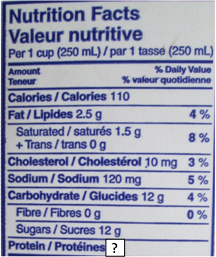
First we convert from Kcal to kJ since the table we use in in kJ. So 110 Kcal × 4.19 kJ/Kcal = 461 kJ. Considering the main components, fat, carbohydrates, and protein, we can write an equation
So solving for N, the number of grams of protein we find
Questions? mike.coombesc@kpu.ca
![[Return to Kwantlen Homepage]](http://www.kpu.ca/images/return_button.gif)