![[Return to Physics Homepage]](./../../physics.gif)
![[Return to Mike Coombes' Homepage]](./../../coombes.gif)
![[Return to List of Handouts]](./../../handouts.gif)
![[Return to Problem Sets]](./../../problems.gif)
![[Return to List of Solutions]](./../../solutions.gif)
Questions: 1 2 3 4 5 6 7 8 9 10 11 12 13 14 15 16 17 18 19 20 21
| Physics 1101 | Collisions |
Linear Collisions
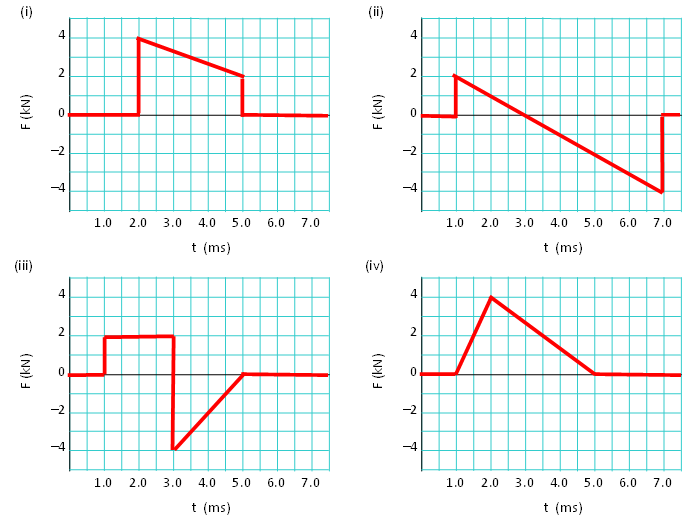
If the impulse is positive, the net area was above the curve and it is directed to the right, if negative to the left.
If the average force is positive it is directed to the right, if negative to the left. The impulse and force have the same direction.
![[Return to Top of Page]](./../../top.gif)
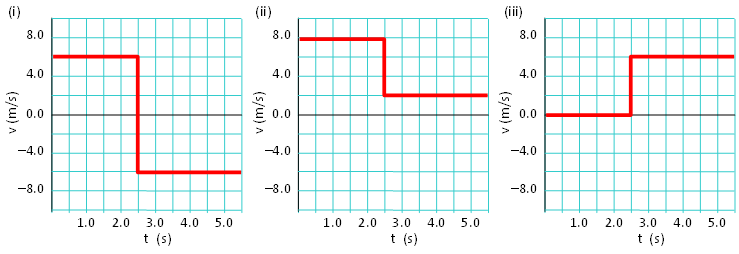
If the impulse is positive it is directed to the right, if negative to the left.
Momentum is defined by p = mv.
Taking the direction of motion as positive, your initial momentum
was zero and your final momentum is
Impulse is defined as the change in momentum
Average force is related to impulse by I
= FaverageΔt, so
This is the average force exerted on you and is in
the same direction as your motion.
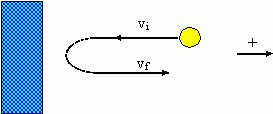
Momentum is defined by p = mv.
Taking the right as positive, the initial momentum of the ball is
The final momentum is
Impulse is defined as the change in momentum
Average force is related to impulse by I = FaverageΔt, and the wall would exert this force on the ball to the right. Therefore
The ball is in contact with the wall for approximately
13 milliseconds.
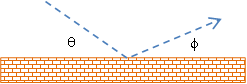
Ix = mvfx − mvix = (0.25) × (12cos20° − 15cos30°) = −0.4285 N-s
Iy = mvfy − mviy = (0.25) × (12sin20° − (−15sin30°)) = +2.9011 N-s
or I = −i0.4285 + j2.9011 N-s.
so Fave = (−i0.4285 + j2.9011 N-s) / (15 ms) = −i28.6 + j193.4 N.
Wearing a seatbelt would not effect the person's initial and final momentum. Since impulse is the change in momentum, the impulse experienced by the person would be the same in either case. However, it is not impulse which is dangerous but the magnitude of the forces acting on the person's body. Impulse and average force are related by I = Faverage Δt. For the same impulse, the average force will be higher as the collision time Δt decreases. Cars are designed to crumple on impact. This crumpling is designed to make a collision last as long as possible. If a person is wearing a seatbelt, the time for the person's change in momentum is the same as that of the car thereby minimizing the force on the occupant. If the person is not wearing a seatbelt, the Law of Inertia dictates that the person will keep moving forward (Note some people describe this by saying that the person was thrown forward by the force of impact. Why is this wrong?). This means that the person will impact the steering wheel or windshield. The steering wheel and windshield can't collapse as nicely as the front of the car so Δt is much smaller and thus the average force is much higher.
The total momentum of the system, the bullets and
the lion, would be zero since there are no external forces to
consider,
where the lion is assumed to be moving in the positive
direction. Rearranging the equation to find n,
It would take 153 bullets to stop the lion dead, so to speak.
We are dealing with a collision, so we know we
must conserve momentum,
We are told that the collision is elastic which means
that kinetic energy is conserved. For a 1D collision, this is
the same as
Substituting in the give data, our equations become
Solving the two equations in two unknowns, we find
v1f = -2.74 m/s and v2f = 2.46 m/s.
In any kind of collision, momentum is conserved so
We are told that the collision is perfectly elastic
which means that kinetic energy is not conserved and that the
rocks stick together, v1f = v2f = vf.
Our equation becomes
This allows us to find vf immediately
The initial kinetic energy is
The final energy is
The difference in energy is
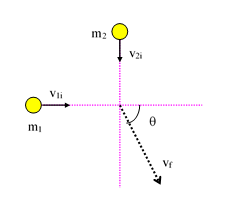
In any kind of free collision, momentum is conserved so
The vector diagram for this equation is

Now momentum and velocity are vector quantities and
the i and j components must be handled
separately
So we can rearrange these equations to find the components
of the final velocity
Using the given values, we find
To find the magnitude and direction of the final
velocity, we use Pythagoras' Theorem and trigonometry,
The final velocity of the pair is 4.27 m/s at 73.0° south of east.
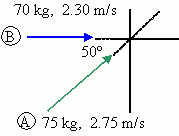
In any kind of free collision, momentum is conserved so
The vector diagram for this problem is
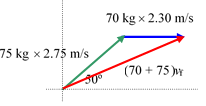
Now momentum and velocity are vector quantities and
the i and j components must be handled
separately
So we can rearrange these equations to find the components
of the final velocity
Using the given values, we find
To find the magnitude and direction of the final
velocity, we use Pythagoras' Theorem and trigonometry,
The final velocity of the pair is 2.30 m/s at 28.3° above horizontal.
The force on player B has to do with the impulse acting on him and his change of momentum,
Now force and impulse are vector quantities and the i and j components must be handled separately.
Fave x = (mBvBfx - mBvBix)/Δt , (3a)
Fave y = (mbvBfy - mBvBiy)/Δt . (3b)
Using the given values, we find
Fave x = (70 kg)[(2.025 m/s) - (2.30 m/s)] / (0.30 s) = -64.17 N , (4a)
Fave y = (70 kg)[(1.090 m/s) - (0)] / (0.30 s) = 254.33 N . (4b)
To find the magnitude and direction of the average force, we use Pythagoras' Theorem and trigonometry,
The average force on player B is 262 N at 94.2° above horizontal.
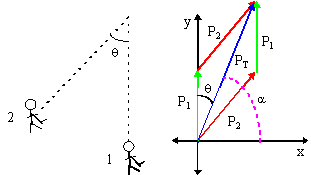
Since the collision is totally inelastic and in two dimensions,
we find that we are dealing with a vector addition problem,
PT = P1 + P2.
First we calculate the magnitude of each player's momentum using
p = mv,
Then we find PT by the component method,
| P1x | = 0 | P1y | = 243 |
| P2x | = 254.2sin(32°)
= 134.705 |
P2y | = 254.2cos(32°)
= 215.574 |
| PTx | = 134.705 | PTy | = 458.574 |
Using the Pythagorean formula we find,
Using trigonometry, we find the angle from
So the total momentum of the two players is PT = (478,73.6°).
Now PT = (m1 + m2)vf,
so the final velocity must be in the same direction as the total
momentum. The magnitude of the velocity is
So the final velocity of the two players just after the collision is vf = (2.78 m/s, 73.6°).
Angular Momentum
Angular momentum is defined as the cross product
of position and momentum, L = r ×
p. The direction of the angular momentum is perpendicular
to the plane formed by the position and momentum vectors. For this
problem that means either into the paper, denoted by
×, or out of the paper, ☉.
To find the direction, we sweep our right hand
through the smallest angle formed by the vector. The way the
thumb points indicates the direction of the angular momentum.
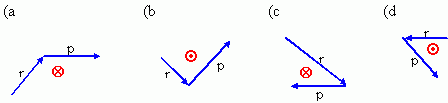
The angular momentum can be found either by evaluating
the determinant or by using L = rpsinφ.
We will use the first method to find L. We can find
the angle between the momentum and position vectors using
φ = sin-1(L/rp). We find
the magnitudeof the vectors using the 3D form of the
Pythagorean Theorem.
(a)
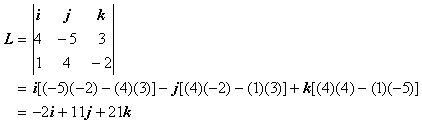
L = [(-2)2 + (11)2 + (21)2]½
= 23.791 kg-m2/s
r = [(4)2 + (-5)2 + (3)2]½
= 7.0711 m
p = [(1)2 + (4)2 + (-2)2]½
= 4.5826 kg-m/s
φ = sin-1(L/rp) = sin-1[ 23.791 / (7.0711 × 4.5826)] = 47.2°
(b)

L = [(1)2 + (20)2 + (13)2]½
= 23.875 kg-m2/s
r = [(1)2 + (-2)2 + (3)2]½
= 3.7417 m
p = [(7)2 + (-1)2 + (1)2]½
= 7.1414 kg-m/s
φ = sin-1(L/rp) = sin-1[ 23.875
/ (3.7417 × 7.1414)] = 63.3°
(c)
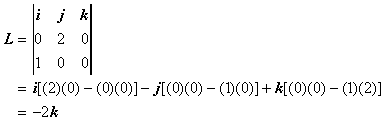
L = [(0)2 + (0)2 + (-2)2]½
= 2 kg-m2/s
r = [(0)2 + (2)2 + (0)2]½
= 2 m
p = [(1)2 + (0)2 + (0)2]½
= 1 kg-m/s
φ = sin-1(L/rp) = sin-1[ 2
/ (2 × 1)] = 90°
We are given the shape of the record. The angular momentum of a rotating body is L = Iω.
An LP is a solid disk. Consulting a table of moments of inertia,
we find I = ½MR2. The angular velocity must be
converted to rad/s
Thus we find the angular momentum of the LP to be
Torque is equal to the change in angular momentum
with time
We have a collision that results in a change in
rotation, and the shapes are specified, so we conserve angular momentum,
The objects are rotating so their angular momentum is given by
L = Iω. Thus in this particular case,
equation (1) becomes
Solving, we find
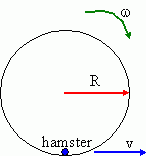
Before the hamster starts running, the exercise wheel is not rotating.
Considered as a system, angular momentum must be conserved.
For this particular problem, we know the shape of the wheel but not that of the
hamster. We will treat the hamster as a particle.
The wheel is a rotating object so its angular momentum
is given by Lwheel = -Iω
, where the minus sign indicates that it is into the paper. For a
point particle, the angular momentum is Lhamster = Rmv out
of the paper. Thus we have
So the angular velocity of the wheel is
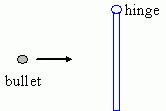
Since we have a collision in which there is a change in rotation, we apply the Law of Conservation of Angular Momentum,
We are not given the shape of the bullet, so we treat it as a particle.
Initially the bullet is traveling in a straight
line so its angular momentum is bmv, where b is the distance of
closest approach to the point of rotation. Since everything will
rotate about the door hinge, we take the hinge as the point of
rotation. Hence b = ½L. After the collision, the bullet
is stuck in the door and rotates with the door in a circle. The
angular momentum of an object moving in a circle is
r2mω, where r is the radius
of rotation. Clearly r = ½L.
Initially the door is not rotating and thus has no angular momentum.
Afterwards, it is rotating and thus has an angular momentum given by
Iω since we know it's shape. Note that the door is not rotating
about its centre of mass, so we need to use the parallel axis
theorem. Consulting a table, we find Icm = (1/12)ML2.
The centre of mass is d = ½L from the hinge.
Thus equation (1) applied to this problem is
Dividing through by ½L and solving for ω,
we find
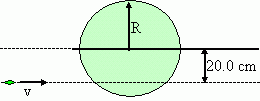
(a) Since we have a collision in which there is a change in rotation, we apply the Law of Conservation of Angular Momentum,
We don't know the shape of the playdough, so we will treat it as a particle.
Initially the playdough is travelling in a straight
line so its angular momentum is bmv, where b is the distance of
closest approach to the point of rotation. Since everything will
rotate about the centre of the disk, we take the centre as the
point of rotation. Thus b = 0.20 m. After the collision, the
playdough is stuck on the disk and rotates with the door in a
circle. We know the shape of the disk and the angular momentum of a particle
(the playdough) moving in a circle
is r2mω, where r is the
radius of rotation. Clearly r = R, the radius of the disk.
Initially the disk is not rotating and thus has no angular momentum. Afterwards, it is rotating and thus has an angular momentum given by Iω. Consulting a table of moments of inertia, we find I = ½MR2.
Thus equation (1) applied to this problem is
Solving for ω, we find
(b) If everything stops, Lf = 0. Equation (1) becomes
Solving for ωinitial, we get
The minus sign indicates that the disk would have
to rotate clockwise.
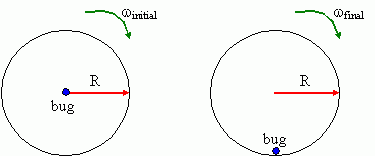
There will be a change in rotation as the bug moves,
so we use the Law of Conservation of Angular Momentum
Assuming that the bug doesn't slip then it rotates
at the same velocity as the disk. Thus bug rotates in a circle.
We don't know the shape of the bug, so we treat it as a particle. The angular
momentum of a particle moving in a circle is
r2mω,
where r is the radius of rotation. At the centre of the disk
r = 0, initially. At the final position, the edge of the disk, r = R.
We know the shape of the disk. The disk is rotating and thus has an angular momentum
by Iω. Consulting a table of moments of
inertia, we find I = ½MR2.
Thus equation (1) applied to this problem is
Dividing through by ½R2 and solving
for ωf, we find
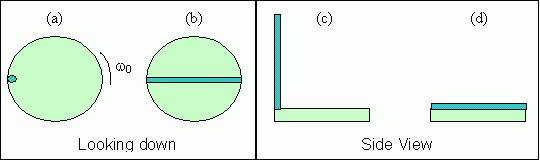
As the system changes shape, there will be a change in rotation, so we use the Law of Conservation of Angular Momentum
We know the shape of all the objects. Initially the cylindrical rod is a small disk rotating
about the centre of the big disk The angular momentum of a rotating
object is Iω. However, note that the
cylindrical rod is not rotating about its own centre of mass. We must
use the parallel axis theorem with d = R - r. Consulting a table
of moments of inertia, the moment for a small disk is Icm
= ½mr2. When the cylindrical rod falls, it is still
a rotating object and its angular momentum is given by
Iω, but now is has the shape
of a rod. Consulting a table of moments of inertia, we find I
=(1/12)mL2. According to the diagram, L = 2R = 0.50 m
In both cases the disk is rotating and thus has an
angular momentum by Iω. Consulting a
table of moments of inertia, we find I = ½MR2.
Thus equation (1) applied to this problem is
Solving for ωf, we find
Substituting in the given values, we get
ωf ={[(1.25)[½(0.02)2 + (0.25 − 0.02)2] + ½(10)(0.25)2}(15) / {1/12(1.25)(0.5)2 + ½(10)(0.25)2} = 16.78 rad/s.
We know that that W = ΔEsystem. Here the system is the two objects. The objects are rotating and the rotational kinetic energy of a rotating object is KErotational = ½ω2 and we already know the moments of inertia of the objects and the angular velocities.
W = ½[Irod + Ibig disk]ωf2 − ½[Ismall disk + Ibig disk]ω02
W = ½[(1/12)mL2 + ½MR2]ωf2 − ½[(½mr2 + m(R-r)2) + ½MR2]ω02
W = ½[1/12(1.25)(0.5)2 + ½(10)(0.25)2](16.78)2 − ½[(1.25){½(0.02)2 + (0.25 − 0.02)2} + ½(10)(0.25)2](15)2 = 5.08 J
Questions? mike.coombes@kpu.ca
![[Return to Kwantlen Homepage]](http://www.kpu.ca/images/return_button.gif)