![[Return to Physics Homepage]](./../../physics.gif)
![[Return to Mike Coombes' Homepage]](./../../coombes.gif)
![[Return to List of Handouts]](./../../handouts.gif)
![[Return to Problem Sets]](./../../problems.gif)
![[Return to List of Solutions]](./../../solutions.gif)
Questions: 1 2 3 4 5 6 7 8 9 10 11 12 13 14 15
A well-labeled sketch usually helps make the problem clearer.
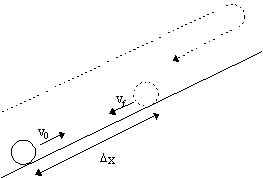
(a) Next, we list the list the given information and what we are looking for:
| v0 = +5.0 m/s |
| vf = −1.5 m/s |
| Δx = +5.5 m |
| a = ? |
| vaverage = ? |
| t = ? |
Note that I have taken the direction up the incline
as positive and that the signs are explicitly stated. It is a
very common source of error to leave out or to not consider the
signs of directions of all vector quantities.
To find the acceleration, we find the kinematics
equation that contains a and the given quantities. Examining
our equations we see that we can use 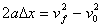 .
Rearranging this equation to find a yields
.
Rearranging this equation to find a yields  .
Notice that the acceleration is negative. This means that the
acceleration points down the incline. It means that an object
traveling up an incline will slow, turn around, and roll down
the incline.
.
Notice that the acceleration is negative. This means that the
acceleration points down the incline. It means that an object
traveling up an incline will slow, turn around, and roll down
the incline.
The average velocity is defined 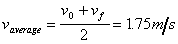 .
.
To find the time, we find the kinematics equation
that contains a and the given quantities. Examining our equations
we see that we can use  . Rearranging
this equation to find t yields
. Rearranging
this equation to find t yields 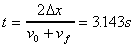 .
.
(b) When an object moving in 1D turns around we
know that the object is instantaneously at rest and that its velocity
at that point is v3 = 0. The information that we know
is thus:
| v0 = +5.0 m/s | |
| v3 = 0 m/s | This is our new final velocity |
| a = −2.068 m/s2 | From part (a) |
| Δx = ? | |
| vaverage = ? | |
| t = ? |
Notice that the acceleration is a constant of the
motion; it has the same value in both parts of the problem.
To find the displacement from the initial position
where the ball turns around, we find the kinematics equation that
contains x and the given quantities. Examining our equations
we see that we can use 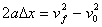 . Rearranging
this equation to find x yields
. Rearranging
this equation to find x yields  . Notice
that this value is bigger than the original 5.5 m and is consistent
with the sketch, i.e. the ball was farther up the incline when
it turned around.
. Notice
that this value is bigger than the original 5.5 m and is consistent
with the sketch, i.e. the ball was farther up the incline when
it turned around.
To find the time it takes for the ball to reach
the point where it turns around, we find the kinematics equation
that contains t and the given quantities. Examining our equations
we see that we can use  . Rearranging
this equation to find t yields
. Rearranging
this equation to find t yields  .Notice
that this value is smaller than the time in part (a) and is consistent
with the sketch, i.e. the ball hasn't come back down the incline
yet.
.Notice
that this value is smaller than the time in part (a) and is consistent
with the sketch, i.e. the ball hasn't come back down the incline
yet.
![[Return to Top of Page]](./../../top.gif)
To solve this problem, we list the given information and what we are looking for:
| v0 = 0.0 m/s | since the bullet is initially at rest |
| vf = 500 m/s | velocity of the bullet as it leaves the barrel |
| a = 70,000 m/s2 | |
| Δx = ? | the length of the barrel |
| t = ? | the time it takes to travel the barrel |
| vaverage = ? |
To find the length of the barrel, we find the kinematics
equation that contains x and the given quantities. Examining
our equations we see that we can use 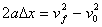 .
Rearranging this equation to find a yields
.
Rearranging this equation to find a yields  .
.
To find the time it takes for the bullet to travel
the length of barrel, we find the kinematics equation that contains
t and the given quantities. Examining our equations we see that
we can use  . Rearranging this equation
to find t yields
. Rearranging this equation
to find t yields  .
.
The average velocity is defined  .
.
To solve this problem, we list the list the given
information
| Red Car | Blue Car |
|---|---|
| v0 red = 0.0 m/s | v0 blue = 62.0 km/h = 17.222 m/s |
| ared = 2.00 m/s2 | ablue = 0 m/s2 (constant velocity) |
| Δxred = ? | Δxblue = ? |
| tred = ? | tblue = ? |
This is an example of a two-body constrained kinematics
problem. Even if a sketch was not explicitly required, we would
need one anyway to get the constraints. For the sketch, recall
that on a d versus t curve an object moving forward with a uniform
acceleration should be represented by a line curving upwards while
an object with constant forward velocity is represented by a straight
line with a positive slope.
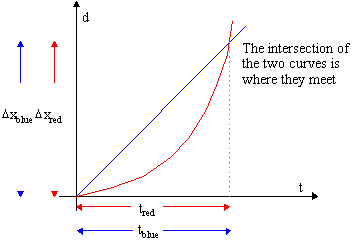
Looking at the sketch, we see that our constraints
are:
To solve the problem, we must find the kinematics
equation that contains the known quantities, v0 and
a, and the unknown quantities, Δx and t. Examining our equations
we see that we can use Δx= v0t + ½at2.
We substitute this equation into both sides of equation (1).
This yields,
We then use equation (2) to replace tred
and tblue by t,
Plugging in the values of the given quantities yields,
The solution of this equation is t = 17.222 seconds.
This is the time that elapses before the two cars meet again.
With a value for t, we can find how far down the road the red car has traveled;
As a check, we can find how far down the road the blue car has traveled;
So the cars meet 297 m down the road.
According to our definition of average velocity,
vaverage red= Δxred/t = (297
m)/(17.2 s) = 17.2 m/s. Since the blue car maintains a constant
velocity, vaverage blue= v0 blue
= 17.2 m/s. The two quantities are the same since the two cars
have traveled the same distance in the same amount of time.
To solve this problem, we list the list the given
information
| Constable | Motorist |
|---|---|
| v0 police = 0.0 m/s | v0 speeder = 110 km/h = 30.556 m/s |
| apolice = 2.00 m/s2 | aspeeder = 0 m/s2 (constant velocity) |
| Δxpolice = ? | Δxspeeder = ? |
| tpolice = ? | tspeeder = ? |
This is an example of a two-body constrained kinematics
problem. We need a sketch to get the constraints. For the sketch,
recall that on a d versus t curve an object moving forward with
a uniform acceleration should be represented by a line curving
upwards while an object with constant forward velocity is represented
by a straight line with a positive slope.
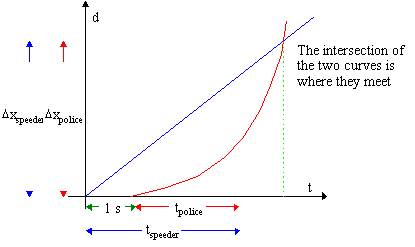
Looking at the sketch, we see that our constraints
are:
To solve the problem, we must find the kinematics
equation that contains the known quantities, v0 and
a, and the unknown quantities, Δx and t. Examining our equations
we see that we can use Δx= v0t + ½at2.
We substitute this equation into both sides of equation (1).
This yields,
We then use equation (2) to replace tspeeder
by tpolice + 1,
Plugging in the values of the given quantities yields,
This is a quadratic in tpolice. Solving
the quadratic yields, tpolice = 30.07 seconds. It
takes the police constable 30.1s to catch up with the speeder.
The speeder was traveling for 31.1 s.
With a value for tpolice, we can find how far down the road the police car has traveled;
As a check, we can find how far down the road the speeder's car has traveled;
So the cars meet 949 m down the road.
To solve this problem, we list the given information and what we are looking for:
| v0 = 12.0 m/s | velocity as it leaves the hand |
| vtop = 0 m/s | since it turns around |
| vf = -12.0 m/s | symmetry says it must have this value when it returns to the same height |
| a = -9.81 m/s | only gravity is acting |
| Δy = 0 | since it returns to the same height |
| tair = ? | the time it takes for the entire trip |
| tup = tdown = ½tair = ? | symmetry requires this |
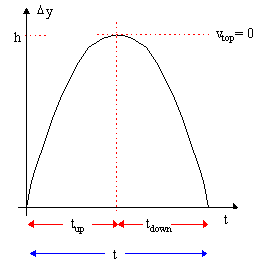
We have lots and lots of information from symmetry.
To find tair, choose the kinematics equation that has
t and the known quantities v0, vf, and a,
that is vf = v0+ atair. Solving
yields tair = (vf - v0)/a =
(-v0-v0)/(-g) = 2v0/g = 2.4465
seconds. Hence tup = tdown = 1.2232 s.
To find h, choose the kinematics equation that has
Δy (h is a displacement) and the known quantities v0,
vtop, and a, that is 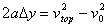 . Upon
rearrangement, this yields h = Δy = (v0)2/g
= 7.34 m.
. Upon
rearrangement, this yields h = Δy = (v0)2/g
= 7.34 m.
To solve this problem, we list the list the given information and what we are looking for:
| v0 = ? | velocity as it leaves the hand |
| vtop = 0 m/s | since it turns around |
| vf = -v0 | symmetry says it must have this value when it returns to the same height |
| a = -9.81 m/s | only gravity is acting |
| Δy = 0 | since it returns to the same height |
| tair = 3.20 s | the time it takes for the entire trip |
| tup = tdown = ½tair = 1.60 s | symmetry requires this |
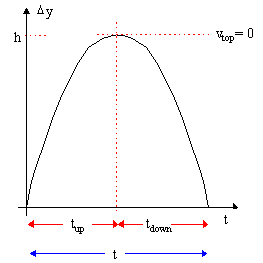
We have lots and lots of information from symmetry.
To find v0, choose the kinematics equation that has
v0 and the known quantities, vf = -v0
, tair and a, that is vf = v0+
atair. Eliminating vf yields -v0 =
v0 - gtair. Rearranging gives v0 =
gtair/2 = 15.7 m/s.
To find h, choose the kinematics equation that has
Δy (h is a displacement) and the known quantities v0,
vtop, and a, that is 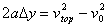 . Upon
rearrangement, this yields h = Δy = (v0)2/g
= 12.6 m.
. Upon
rearrangement, this yields h = Δy = (v0)2/g
= 12.6 m.
To solve this problem, we list the list the given
information
| Ball #1 | Ball #2 |
|---|---|
| v0 1 = 15.0 m/s | v0 2 = 12.0 m/s |
| a1 = -9.81 m/s2 | a2 = -9.81 m/s2 |
| Δy1 = ? | Δy2 = ? |
| t1 = ? | t2 = ? |
This is an example of a two-body constrained kinematics
problem. We need a sketch to get the constraints. For the sketch,
recall the shape of the d versus t curve for an object thrown
up into the air - a parabola.
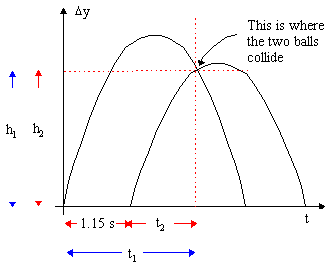
Looking at the sketch, we see that our constraints
are:
To solve the problem, we must find the kinematics
equation that contains the known quantities, v0 and
a = -g, and the unknown quantities, Δy and t. Examining our equations
we see that we can use Δy = v0t - ½gt2.
We substitute this equation into both sides of equation (1).
This yields,
We then use equation (2) to replace t1
by t2 + 1.15,
This reduces to
Upon rearrangement this becomes
Thus t2 = 1.2997 s, and t1 = 2.4497 s. Now that we have the time that each ball is in the air, we can now find h
So the balls collide when they are 7.31 m in the
air.
You are trapped on the top of a burning building. Death is imminent and help is nowhere in sight. There is a safe building 6.50 m away and 3.00 m lower. You decide to try and make it across. You run horizontally off your building at 8.10 m/s. Do you make it across? If you don't, how much faster must you be going?
First we sketch the situation and possible outcomes.
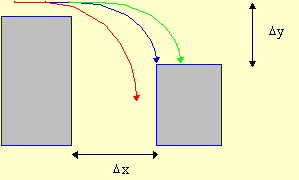
While you are jumping, you are a projectile. We solve projectile motion problems by considering the x and y components separately, keeping in mind that the time in air is common. We write out the i and j information in separate columns including the information that we can infer or that we are supposed to know like the fact that running horizontally implies that voy = 0..
|
|
|
||
| Δxsafe = 6.50 m | Δysafe = -3.00 m | minus indicates down | |
| ax = 0 | No x component for projectiles | ay = -g = -9.81 m/s2 | gravity acts down |
| v0x = 8.10 m/s | v0y = 0 m/s | horizontal takeoff means no vertical component |
|
| tair = ? | common | tair = ? |
This is the time it would take you to cross a horizontal distance of 6.50 m. You must be in the air for at least this long if you are to safely make it across to the next building.
On the other hand, looking at the y information, we see that we also have enough data to find tair. The kinematics equation that has all four quantities is Δy = v0yt + ½ayt2. We know v0y = 0 since you ran off the roof horizontally and that ay = -g, thus this equation becomes Δy = -½gt2. Solving for t, we get
This is the time it takes you to fall a vertical distance of 3.00 m. If you do reach the other building, then this is how long you were in the air.
Since the time it takes to cross the horizontal distance is less than the time you have, you have don't make it across.
To make it across safely you of course would need to run off the roof faster. Since ax = 0 for projectiles, the kinematics equation become Δx = v0xt where t is now the 0.7821 s. Solving for v0x, we get ,
If you were able to run at 8.31 m/s you would safely make it to the other building.
A stunt motorcyclist is trying to jump over fifteen buses set side to side. Each bus is 2.50 m wide and a 30.0° ramp has been installed on either side of the line of buses. What is the minimum speed at which she must travel to safely reach the other side. How long will she be in the air?
First we sketch the situation and possible outcomes.
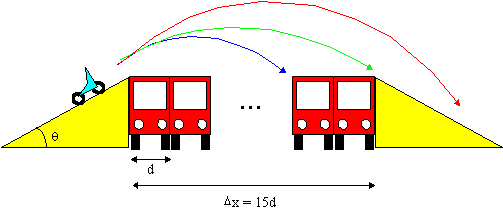
While the motorcyclist is jumping, she is a projectile. We solve projectile motion problems by considering the x and y components separately, keeping in mind that the time in air is common. We write out the i and j information in separate columns including the information that we can infer or that we are supposed to know. We see from the sketch that if the motorcyclist is successful, then this is an example of level-to-level flight and Δy = 0. Note that the initial velocity is broken into components.
|
|
|
||
| Δxsafe = 15×2.50 m = 37.5 m | Δysafe = 0 | level to level flight | |
| ax = 0 | No x component
for projectiles |
ay = -g = -9.81 m/s2 | gravity acts down |
| v0x = v0 cosθ | v0 is unknown | v0y = v0 sinθ | |
| tair = ? | common | tair = ? | common |
We substitute in known quantities to get
We can divide the second equation by t and we get
We rewrite the first equation as t = Δx / v0 cosθ, which we substitute into the second equation to get v0 sin= ½g[Δx / v0 cosθ]. Getting v0 by itself we have v0 = {g/(2sinθ cosθ)}½. Plugging in the appropriate numbers, we get v0 = 20.61 m/s = 74.2 km/h. Since is the speed that the motorcyclist must have on liftoff to successfully reach the other ramp.
We can substitute this value into t = Δx / v0 cos to find the time in air to be 2.10 s.
A boy throws a rock with speed v = 18.3 m/s at an angle of θ = 57.0° over a building. The rock lands on the roof 22.0 m in the x direction from the boy. How long was the rock in the air? How much taller, height h, is the building than the boy? Ignore air resistance.
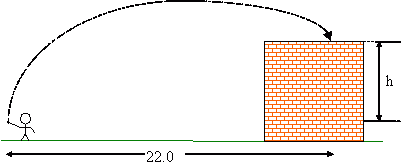
The rock is a projectile. We solve projectile motion problems by considering the x and y components separately, keeping in mind that the time in air is common. We write out the i and j information in separate columns including the information that we can infer or that we are supposed to know. We see from the sketch that h = Δy, the vertical displacement. Note that the initial velocity is broken into components.
|
|
|
||
| Δx = 22.0 m | Δy = h | ||
| ax = 0 | No x component for projectiles |
ay = -g = -9.81 m/s2 | gravity acts down |
| v0x = v0cos(θ) = 18.3 × cos(57º) = 9.9669 m/s |
v0y = v0sin(θ) = 18.3 × sin(57º) = 15.3477 m/s |
||
| tair = ? | common | tair = ? | common |
Looking at the y information, we see that we now have enough data to find h. The kinematics equation that has all four quantities is Δy = v0yt + ½ayt2. Since Δy = h and ay = -g, this equation become h = v0yt - ½gt2. Substituting in the appropriate numbers reveals that h = 9.98 m. The building is 10.0 m taller that the boy where we have assumed that the ball left the boy's hand at head height which is a reasonable assumption.
A tile, initially at rest, slides down a roof for a distance of 3.75 m before falling off the roof. The height of the building from ground to eave is 8.40 m. The acceleration of the tile as it slides is 2.10 m/s2.
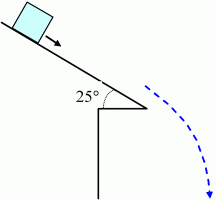
When the tile slides down the roof, it travels in a straight line. That is a 1D kinematics problem. When it leaves the roof, it becomes a projectile problem.
(a) We solve the 1D problem first. We write down all the given data and unknowns:
| Δx = 3.75 m | |
| v0 = 0 | starts from rest |
| a = 2.10 m/s2 | |
| vf | need this for the second part |
This is the speed that the tile leaves the roof and is the initial velocity for the second part of the problem.
(b) The vertical component of the velocity of the tile as it leaves the roof is v0x = -vfsin(25°) = -1.6772 m/s. Note that the minus sign indicates that the tile is moving downwards.
(c) The horizontal component of the velocity of the tile as it leaves the roof is v0x = vfcos(25°) = 3.5968 m/s.
(d) The tile is now a projectile. We solve projectile motion problems by considering the x and y components separately, keeping in mind that the time in air is common. We write out the i and j information in separate columns including the information that we can infer or that we are supposed to know. We see from the sketch that Δy is the vertical distance that the tile falls. Note that the initial velocity is broken into components.
|
|
|
||
| Δx = ? | Δy = -8.40 m | minus means down | |
| ax = 0 | No x component for projectiles |
ay = -g = -9.81 m/s2 | gravity acts down |
| v0x = 3.5968 m/s | v0y = -1.6772 m/s | ||
| tair = ? | common | tair = ? | common |
The two solution to this quadratic are t = 1.149 s and t = -1.491 s. We take the positive solution as that is the solution for times after the tile left the roof.
(e) Looking at the x information, we see that we now have enough data to find Δx. The kinematics equation that has all four quantities is Δx = v0xt + ½axt2. Since ax = 0 for a projectile, this equation become Δx = v0xt. Substituting in the appropriate numbers, we get Δx = v0xt = 3.5968 m/s × 1.149 s = 4.13 m. The tile land 4.13 m from the eave of the roof.
A boy is on the side of a hill. The hill makes a 15° incline with respect to horizontal. The boy throws a rock up the side of the hill. The boy throws the rock at 45° with respect to horizontal and the rock lands 30 m away up the hill. Find how fast the boy threw the rock. What angle does the rock make with horizontal before it lands? Ignore the boy's height.
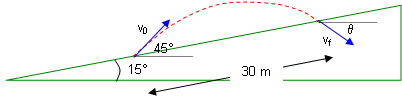
We know
| v0 = i v0cos(45°) + j v0 sin(45°) |
| vf = i vf cos(θ) – j vf sin(θ) |
| a = – j g = – j 9.81 m/s2 |
| Δr
= i 30 cos(15°) + j
30 sin(15°) m = i 28.978 + j 7.765 m |
Applying our kinematic equations to the situation:
| vf cos(θ) = v0 cos(45°) | (1) |
| 28.978 = v0 cos(45°) t | (2) |
| 7.765 = v0 sin(45°)t – ½gt2 | (3) |
| –vf sin(θ) = v0 sin(45°) – gt | (4) |
| 2(9.81)(7.765) = [–vf sin(θ)]2 – [v0 sin(45°)]2 | (5) |
Examining the equations, we find that we can eliminate v0t from equation (3) using equation (2). This yields
7.765 = [28.978/cos(45°)] sin(45°) – ½gt2 .
This can be simplified and solved for t. We find t = 2.0796 s. Knowing t, equation (2) can be solved to yield v0 = 19.706 m/s. With v0 and t, equations (1) and (4) become vf cos(θ) = 13.934 and vf sin(θ) = 6.467. The ratio of these two equations yields tan(θ) = 0.4641 or θ = 24.9°. Also vf = 15.36 m/s.
![[Return to Top of Page]](../../top.gif)
(a) What minimum velocity, expressed in ij
notation, will allow the ball to clear the roof?
(b) At what angle and speed do you throw the ball?
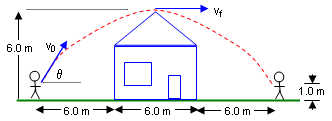
The main point of interest is the rooftop. To just clear the roof, requires that the roof be at the top of the parabola. We know
| v0 = i v0 cos(θ) + j v0 sin(θ) |
| vf = i vf + j 0 |
| a = – j g = – j 9.81 m/s2 |
| Δr = i 9 + j 5 m |
Applying our kinematic equations to the situation:
| vf = v0 cos(θ) | (1) |
| 9 = v0 cos(θ) t | (2) |
| 5 = v0 sin(θ)t – ½gt2 | (3) |
| 0 = v0 sin(θ) – gt | (4) |
| 2(–9.81)(5) = –[v0 sin(θ)]2 | (5) |
Equation (5) allows us to find the y component of the initial velocity v0y = v0 sin(θ) = 9.905 m/s. We can use this result to find t from equation 4, t = 1.0096 s. Knowing t we can use equation (2) to find the x component of the initial velocity v0x = v0 cos(θ) = 8.914 m/s. Thus the initial velocity is
v0 = i 8.914 + j 9.905 m/s .
The angle θ can be found from the ratio [v0 sin(θ)] / [v0 cos(θ)] = 9.905/8.914 or, more simply, tan(θ) = 1.111 which yields θ = 48.0°.
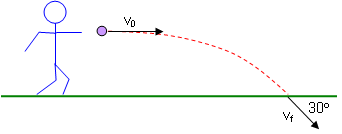
We know
| v0 = i v0 + j 0 |
| vf = i vf cos(30°) – j vf sin(30°) |
| a = – j g = – j 9.81 m/s2 |
| Δr = i Δx – j 1.10 m |
Applying our kinematic equations to the situation:
| v0 = vf cos(30°) | (1) |
| Δx = v0 t | (2) |
| –1.10 = –½gt2 | (3) |
| – vf sin(30°) = –gt | (4) |
| 2(–9.81)(-1.10) = [–vf sin(30°)]2 | (5) |
To determine v0, we need to know vf or Δx in equation (1) or (2). We can use equation (5) to find vf = 9.291 m/s. Thus, from equation (1), v0 = 8.046 m/s.
We know that centripetal acceleration is given by the formula ac = v2/R where R is the distance from the earth to the sun which is given and v is the speed of the earth which is not directly given. However, since the earth travels in an almost perfect circle around the sun, we can find the speed from v = d/t = 2πR/T. The time T is one year which we must convert to seconds.
T = 365 days × 24 hours/day × 3600 seconds/ hour = 31,536,000 s
The speed is thus
v = 2πR/T = 2π(1.50 × 10¹¹ m)/(31,536,000 s) = 29,885.8 m/s
The centripetal acceleration is thus ac = v2/R = (29,885.8 m/s)2/(1.50 × 1011 m) = 0.00595 m/s2. This is tiny compared to g = 9.81 m/s2 and is not usually noticeable.