[Return to Physics Homepage]     [Return to Mike Coombes' Homepage]     [Return to List of Handouts]     [Return to Sample Tests]


Test #2

PHYSICS 1101

21 October 1997


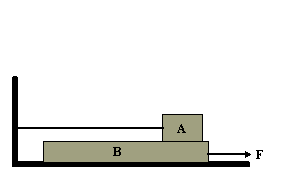
  1. In the diagram below are two blocks. Block A sitting on top of block B has a mass mA = 10.0 kg and is attached to the wall by massless string. Block B, mass mB = 35.0 kg, is pulled by a force F = 75.0 N. The surface under block B is frictionless. The coefficients of friction for block A and B are μs = 0.34 and μk = 0.17.
    (a) Determine the acceleration of block B.
    (b) Determine the tension in the string.

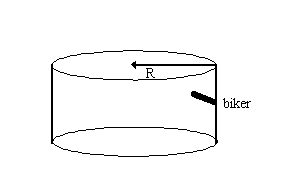
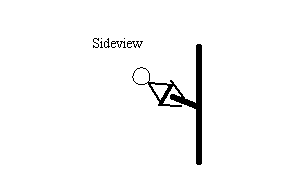
  2. A motorcyclist is riding his motorcycle on a Wall of Death, a cylinder of radius 19.0 m. If the coefficient of static friction between the wheels and the wall is μ = 0.85, determine the minimum speed necessary to stay in contact with the wall. Treat the motorcyclist and motorcycle as one object.

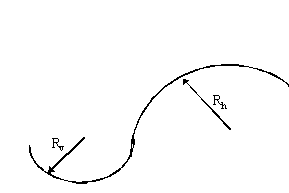
  3. The diagram below shows the path a rollercoaster takes as it passes through a semicircular valley, Rv = 15.0 m, and over a semicircular hill, Rh = 40.0 m. The rollercoaster maintains a constant speed throughout the journey. A passenger notices that he feels that he weighs 4 times heavier at the bottom of the valley than at the crest of the hill (Hint - what forces are we talking about here). Determine the speed of the rollercoaster.

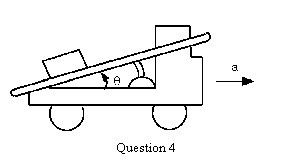
  4. A baggage loading truck at an airport has a ramp that makes a θ = 15.0° angle to the horizontal as shown in the diagram below. The driver wishes to move the truck with a package on the ramp. The coefficient of static friction between the package and the ramp is μs = 0.500 .
    (a) Which way does friction act?
    (b) Which way should you choose your x and y axes?
    (c) Find the maximum forward acceleration that the truck can have if the package is not to slip down the ramp.

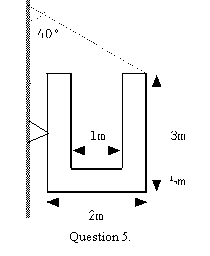
  5. A uniform 'U'-shaped sign is attached to a wall by a hinge and a cable as shown in the diagram below. The sign has a mass of 24.5 kg. The hinge is in the middle of the left side.
    (a) Find the tension in the cable.
    (b) Find the horizontal and vertical components of the hinge force.

  6. Mars has two moons, Phobos and Deimos. The centre of Phobos is 9.408 × 10⁶ m away from the centre of Mars. The centre of Deimos is 2.3457 × 10⁷ m away from the centre of Mars. Phobos takes 7 hours and 39 minutes to circle Mars. Assuming that the orbits are circular.
    (a) Determine the mass of Mars.
    (b) How long does it take Deimos to circle Mars?
    (c) What would be the speed of a spaceship in a circular orbit of Mars at 5.2 × 10⁵ km from the centre of Mars.
    (d) What is the acceleration due to gravity on Mars, if the radius of Mars is 3393 km?

Formulas

Error Propagation

Adding or Subtracting Δ(A+B-C)= ΔA + ΔB + ΔC
Multiplying or Dividing Δ(AB/C)= (AB/C)(ΔA/A + ΔB/B + ΔC/C)
Powers and Roots Δ(Az) = zAz-1ΔA
Special Fuctions sin(θ±Δθ) = sin(θ)±Δθ cos(θ)
cos(θ±Δθ) = cos(θ)±Δθ sin(θ)
tan(θ±Δθ) = tan(θ)±Δθ /cos2(θ)
e(x±Δx) = ex±Δxex
ln(x±Δx) = ln(x)±Δx/x
Note: Δθ must be stated in radians!

Kinematics

vaverage = Δx/Δt ωaverage = Δθ/Δt
vaverage = (vf+v0)/2 ωaverage = (ωf+ ω0)/2
aaverage = Δv/Δt αaverage = Δω/Δt
Δx = vaveraget Δθ = ωaveraget
Δx = v0t + ½at2 Δθ = ω0t + ½αt2
v = v0 + at ω = ω0 + αt
v2 = (v0)2 + 2aΔx ω2 = (ω0)2 + 2αΔθ

Translation <-> Rotation

s = Rθ vtan = Rω atan = Rα ac = v2/R

Newton's Laws

ΣFx = max ΣFy = may fmax static = μsN fkinetic = μkN
F = Gm1m1/R2 g(R) = GMplanet/R2 v = [GMplanet/R]½ T2 = 4π2R2/ GMcentral
G = 6.672 × 10⁻¹¹ N-m2/kg2 g = 9.81 m/s2

Rolling

vlinear = vtangential

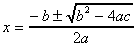
Quadratic Formula

if ax2+bx+c = 0, then

[Return to Physics Homepage]     [Return to Mike Coombes' Homepage]     [Return to List of Handouts]     [Return to Sample Tests]

Questions? mike.coombes@kpu.ca

[Return to Kwantlen Homepage]