[Return to Physics Homepage]     [Return to Mike Coombes' Homepage]     [Return to List of Handouts]     [Return to Sample Tests]


Test #1

PHYSICS 1101

30 September 1997


  1. A ball is thrown into the air with an initial speed of v0 at an angle = 27.0 ± 0.3°. The ball reaches a height h = 6.75 ± 0.05 m. The value of gravitational constant is g = 9.807 ± 0.003 m/s2. The initial speed can be determine from the formula

    .

    Determine v0. Show all work! Show the unrounded values, then the significant digits!
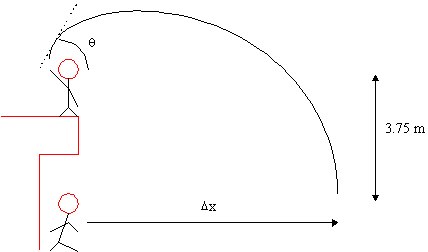
  2. Two boys are playing in the snow in the diagram below. One boy is standing on the edge of the roof while the other is 3.75 m underneath the first. The boy on the ground runs forward at 5.20 m/s. The boy on the roof can throw a snowball at 8.50 m/s. (a) At what angle should the boy on the roof throw the snowball so that it hits the running boy on the top of his head?
    (b) What distance x did the boy get to?
    (c) How long was the snowball in the air?

    .

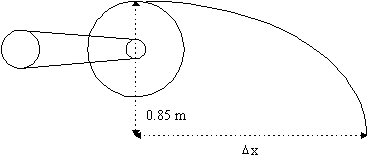
  3. A student is repairing his bicycle. The diagram below shows the gears, chains and back wheel which is upside down. The pedal gear has a radius of 12.0 cm and is connected by a non-slipping chain to the back gear which has a radius of 4.00 cm. The back wheel has a radius of 34.0 cm.
    (a) The student rotates the pedals at 70.0 times per minute. What is the angular velocity of the back wheel?
    (b) A pebble, stuck in the back wheel, comes loose and flies horizontally off the back of the wheel. What distance x does it travel? The top of the wheel is 85.0 cm off the ground.

    .

Formulas

Error Propagation

Adding or Subtracting Δ(A+B-C)= ΔA + ΔB + ΔC
Multiplying or Dividing Δ(AB/C)= (AB/C)(ΔA/A + ΔB/B + ΔC/C)
Powers and Roots Δ(Az) = zAz-1ΔA
Special Fuctions sin(θ±Δθ) = sin(θ)±Δθ cos(θ)
cos(θ±Δθ) = cos(θ)±Δθ sin(θ)
tan(θ±Δθ) = tan(θ)±Δθ /cos2(θ)
e(x±Δx) = ex±Δxex
ln(x±Δx) = ln(x)±Δx/x
Note: Δθ must be stated in radians!

Kinematics

vaverage = Δx/Δt ωaverage = Δθ/Δt
vaverage = (vf+v0)/2 ωaverage = (ωf+ ω0)/2
aaverage = Δv/Δt αaverage = Δω/Δt
Δx = vaveraget Δθ = ωaveraget
Δx = v0t + ½at2 Δθ = ω0t + ½αt2
v = v0 + at ω = ω0 + αt
v2 = (v0)2 + 2aΔx ω2 = (ω0)2 + 2αΔθ

Translation <-> Rotation

s = Rθ vtan = Rω atan = Rα

Rolling

vlinear = vtangential

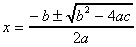
Quadratic Formula

if ax2+bx+c = 0, then

[Return to Physics Homepage]     [Return to Mike Coombes' Homepage]     [Return to List of Handouts]     [Return to Sample Tests]

Questions? mike.coombes@kpu.ca

[Return to Kwantlen Homepage]