![[Return to Physics Homepage]](../physics.gif)
![[Return to Mike Coombes' Homepage]](../coombes.gif)
![[Return to List of Handouts]](../handouts.gif)
![[Return to Sample Tests]](../tests.gif)
Final Examination
PHYSICS 1101
17 December 1997
- (a) A block of ice of mass 0.365 kg at -15.0° C
is placed in a 700 W microwave. The microwave is turned on.
The ice warms, then melts to water, and then the ice water warms
to 60.0° . How long does this take? Thermodynamic data for ice
and water can be found in the sheet of equations. Assume that
the ice/water absorbed all the microwave energy. Hint - recall
that power is energy over time.
(b) A thin rod made of steel is exactly 22.175 cm
long at 15.0° C. A thin rod of aluminum is exactly 21.950 cm at
15.0° C. At what temperature would the rods be exactly the same
length? The coefficients of linear expansion are
αsteel
= 11 × 10-6/°C and
αaluminum
= 23 × 10-6/°C.
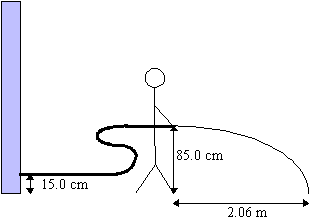
- A Physics 1101 student is watering his lawn using
a hose, which has a uniform diameter, as is shown in the diagram
below. The student is holding the hose horizontally and the water
lands 2.06 m away. The student, slightly bored, turns his chore
into a real life fluid physics problem. He treats the water as
a projectile and figures out the speed of the water as it leaves
the hose. What is that speed? Knowing that the hose has the
same cross-sectional area throughout, he determines the speed
that the water enters the hose at the house. What is that speed?
Knowing the speed of the water entering and leaving the hose,
knowing that water has a density of 1000 kg/m3, and
knowing that atmospheric pressure is 1.01 × 10⁵ Pa,
he determines the water pressure at the house. What is that
pressure?
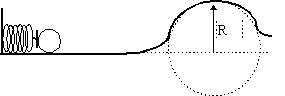
- As shown in the diagram below, a ball bearing
of mass 150 g and unknown radius is pressed 15.0 cm into a spring
which has a spring constant of K = 100 N/m. The ball bearing
is released and rolls without slipping to the top of a semicircular
hill. At the top of the hill it almost loses contact with the
surface. How high is the hill?
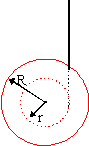
- A person holds the string of a yo-yo motionless
and with constant tension as he lets the yo-yo drop as shown in
the diagram below. The yo-yo does NOT slip as it falls. Determine
the angular acceleration of the yo-yo about it's centre of mass,
the linear acceleration of the yo-yo, and the tension in the string.
The yo-yo has a moment of inertia of I = 2.50 × 10⁻⁵
kg-m2, an inner radius r = 1.75 cm, an outer radius
R = 2.65 cm, and a mass M = 125 g.
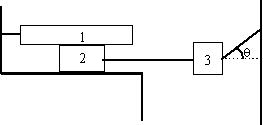
- The diagram below shows an arrangement of three
blocks. Block 1 has a mass of 15.0 kg and is tied to a wall
by a horizontal string. Block 2 has a mass of 8.0 kg and is connected
to Block 3 by a string. Block 3 is also tied to a wall by a string
that makes an angle θ = 38.0° with
the horizontal. The tabletop is
frictionless but there is friction between blocks 1 and 2. The
coefficient of static friction between the two blocks is
μ = 0.25.
The three blocks are motionless but a slight nudge would make
block 2 slide. Find the tension in each string and the mass of
Block 3. Be careful with normal forces and reaction forces.
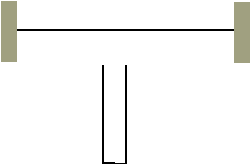
- The wire shown below has a length of 2.00 m, a
mass of 20.0 g, and is held under a tension of 100 N. When it
is made to vibrate in the third harmonic, it resonates with sound
in the tube. Find the two smallest lengths of the tube. Take
the speed of sound in air to be 340 m/s. Sketch the standing
waves on the string and in the tube.
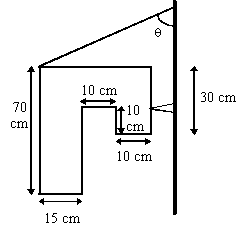
- The sign in the diagram below is uniform and has
a mass of 31.0 kg. The wire makes an angle
θ = 60.0° with the wall.
(a) Find the tension in the wire.
(b) Find the horizontal and vertical components of
the hinge force.
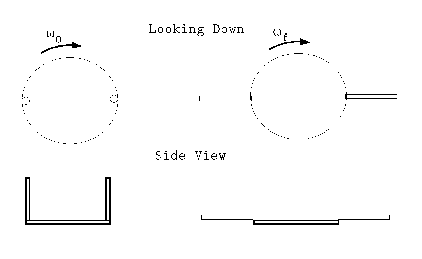
- Two rods/cylinders are standing upright on the
edge of a solid disk. The system is rotating at 10.0 rad/s.
Each rod has a radius of 2.00 cm, a length of 0.900 m, and a mass
of 2.50 kg. The disk has a radius of 1.00 m and a mass of 14.0
kg. The rods fall outwards due to forces which are totally internal.
(a) What is the initial moment of inertia about the
axis of rotation?
(b) What is the final moment of inertia about the
axis of rotation?
(c) What is the final rotational velocity of the
system?
- (a) Two cars are separated by 75 km of straight
highway. They both head toward each other at the same time. Car
A travels at a constant 45 km/h and car B travels at a constant
65 km/h. How long after they start do they pass one another?
How far from car A's starting point do they pass one another?
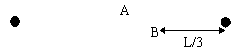
(b) Two identical incoherent spherical sound sources
of the same power are distance L apart as shown in the diagram
below. The sound level at point A, halfway between the speakers,
is 50.0 dB. What is the sound level at point B, L/3 from one
of the speakers?
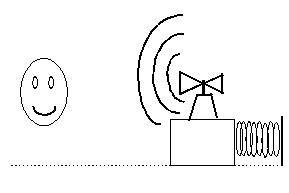
- A siren with a frequency fs = 2000
Hz is attached to a block. The siren and block together have
a mass of 2.00 kg. The block is attached to a spring of unknown
spring constant K. The spring is compressed an unknown distance
and then released. The siren and block oscillate back and forth.
A listener hears the source as emitting a varying frequency since
the siren is moving. The highest frequency that the listener
hears is 2060 Hz. The listener also determines that he hears
this highest frequency repeat every 1.50 seconds. The speed of
sound in air is 343 m/s.
(a) How fast is the block moving when the listener
hears the highest frequency?
(b) Where in its motion is the block when the listener
hears the highest frequency?
(c) What is the lowest frequency that the listener
would hear?
(d) Where in its motion is the block when the listener
hears the lowest frequency?
(e) What is the period and angular frequency of the
block?
(f) What is the amplitude of the displacement of
the block?
(g) What is the spring constant of the spring?
Formulas
Error Propagation
| Adding or Subtracting |
Δ(A+B-C)= ΔA
+ ΔB + ΔC |
| Multiplying or Dividing |
Δ(AB/C)= (AB/C)(ΔA/A
+ ΔB/B + ΔC/C) |
| Powers and Roots |
Δ(Az)
= zAz-1ΔA |
| Special Fuctions |
sin(θ±Δθ)
= sin(θ)±Δθ
cos(θ)
cos(θ±Δθ)
= cos(θ)±Δθ
sin(θ)
tan(θ±Δθ)
= tan(θ)±Δθ
/cos2(θ)
e(x±Δx)
= ex±Δxex
ln(x±Δx)
= ln(x)±Δx/x
|
|
Note: Δθ must be stated in radians! |
Kinematics
| vaverage
= Δx/Δt |
ωaverage
= Δθ/Δt |
| vaverage = (vf+v0)/2 |
ωaverage
= (ωf+
ω0)/2
|
| aaverage
= Δv/Δt |
αaverage
= Δω/Δt |
| Δx = vaveraget |
Δθ =
ωaveraget |
| Δx = v0t + ½at2 |
Δθ =
ω0t
+ ½αt2 |
| v = v0 + at |
ω
= ω0
+ αt |
| v2 = (v0)2
+ 2aΔx |
ω2 =
(ω0)2
+ 2αΔθ |
Translation <-> Rotation
| s = Rθ |
vtan = Rω |
atan = Rα |
ac = v2/R |
Newton's Laws
| ΣFx = max |
ΣFy = may |
fmax static = μsN |
fkinetic = μkN |
| F = Gm1m1/R2 |
g(R) = GMplanet/R2 |
v = [GMplanet/R]½ |
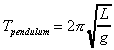
T2 = 4π2R2/
GMcentral |
G = 6.672 × 10⁻¹¹ N-m2/kg2 |
g = 9.81 m/s2 |
Rolling
vlinear = vtangential
Torque
| τ
= Iα |
τ = r × F |
τz = xFy
- yFx |
Moment of Inertia
| Itotal = I1 + I2 +
I3 ... |
I = Icm + Md2 |
Work and Energy
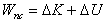 |
Klinear = ½mv2 |
Krotational
= ½Iω2 |
| Ugravity = mgh |
Uspring = ½Kx2 |
|
Collisions
| p = mv |
 |
Pf = Pi |
| v1f - v1f
= -(v1i - v2i) |
I = Δp
= FaverageΔt |
Angular Momentum
| L = r × p |
Lz = xpy
- ypx = rpsinφ |
Llinear = bmv |
| Lorbital
= r2mω |
LA
= IAωA |
Ltotal = L1 + L2 +
L3 ... |
| Lfinal = Linitial |
Simple Harmonic Motion
Waves
Standing Waves
If the string is fixed at both ends or air column
is open at both ends
Use 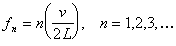
Use 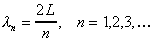
If the string or air column has one open end and
one fixed end
Use 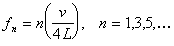
Use 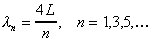
Sound Level / Decibels / Sound Intensity
| ITotal = I1 + I2 +
I3 ... |
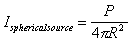 |
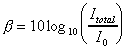 |
| ITotal = I0
× 10(β/10) |
I0 = 1 × 10-12 W/m2 |
Doppler Shift
Use 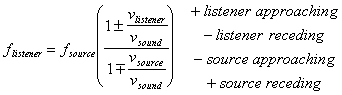
Interference
Constructive interference (maximum amplitude) when
Δx
= nλ, n = 1, 2, 3, ...
Destructive interference (zero or minimum amplitude) when
Δx
= nλ/2,
n = 1, 3, 5, ...
Fluids
 |
 |
P2 = P2 + ρgh |
| Aoutvout = Ainvin |
 |
ρwater = 1000 kg/m3 |
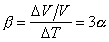
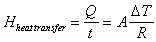
Heat
 |
 |
εblackbody = 1 |
| Q = mcΔT |
Qphase change = mL |
cice = 2220 J/kg-K |
| cwater = 4190 J/kg-K |
 |
 |
 |
 |
Rseries = R1 + R2 +
R3 ... |
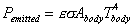 |
 |
Σ = 5.67 × 10⁻⁸
W/m2-K4 |
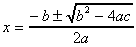
Quadratic Formula
if ax2+bx+c = 0, then
Questions?
mike.coombes@kpu.ca
![[Return to Kwantlen Homepage]](http://www.kpu.ca/images/return_button.gif)