![[Return to Physics Homepage]](./../../physics.gif)
![[Return to Mike Coombes' Homepage]](./../../coombes.gif)
![[Return to List of Handouts]](./../../handouts.gif)
![[Return to Problem Sets]](./../../problems.gif)
![[Return to List of Solutions]](./../../solutions.gif)
Physics 1101 In-Class Problems: Torque & Static Equilibrium Revised
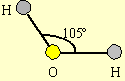
- The distance between the oxygen molecule and each of the hydrogen
atoms in a water (H2O) molecule is 0.0958 nm; the angle
between the two oxygen-hydrogen bonds is 105°.
Treating the atoms as particles, find the centre of mass.
- Where is the centre of mass of a uniform cubic box of side
length L which has no lid?
- Two uniform squares of sheet metal of dimension L ×
L are joined at a right angle along one edge. One of the squares
has twice the mass of the other. Find the centre of mass.
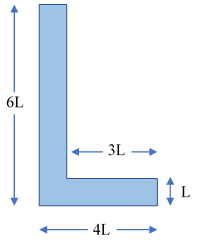
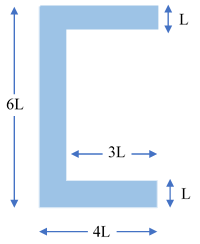
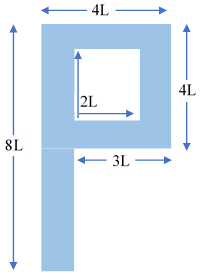
- Find the centre of mass of the following signs from an origin at the lower
left-hand corner of each sign. The signs are uniform and the dimensions are given.
- An L-shaped object of uniform density is hung
over a nail so that it is free to pivot. What angle, θ,
does the long side make with the vertical? The long side of the
L-shaped object is twice as long as the short side?
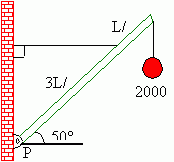
- A uniform 400 N boom is supported as shown in
the figure below. Find the tension in the tie rope and the force
exerted on the boon by the pin at P.
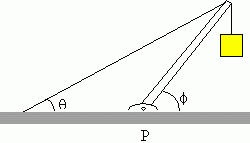
- In the figure below, a mass of 500 kg is held
motionless in the air by a 120-kg boom and a rope. Find the tension
in the rope. Find the force exerted on the boom by the pin at
P. The angles are θ
= 30.0°
and φ =
45.0°.
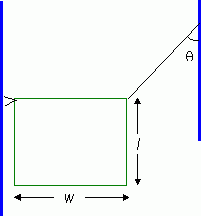
- A rectangular sign of mass 50.0 kg and width
w = 5.00 m and l = length 4.00 m is hanging from
a hinge and a rope as shown in the figure below. The rope makes and angle
θ = 65.0°
with the right wall.
(a) Find the tension in the rope.
(b) Find the horizontal and vertical components
of the hinge force.
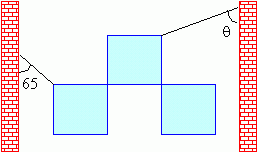
- Find the centre of mass of the object shown below.
Determine the tension in the strings and the unknown angle θ.
Each square has a side of length 32.0 cm. The object has a mass
of 125 g.
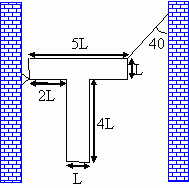
- Find the centre of mass of the object shown below. The sign has a mass of 20.0 kg. The hinge is
located at the bottom of the left side.
Determine the tension in the rope and the horizontal and vertical
components of the hinge force. The length, l,
is 12 cm.
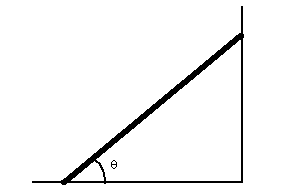
- A ladder is propped against a wall making an
angle with the floor. The wall is frictionless but the coefficients
of friction for the floor are μs and
μk respectively.
Obtain an expression for the smallest that can be if the ladder
is not to slip. Recall that tanθ
= sinθ/cosθ.
Questions?
mike.coombes@kpu.ca
![[Return to Kwantlen Homepage]](http://www.kpu.ca/images/return_button.gif)