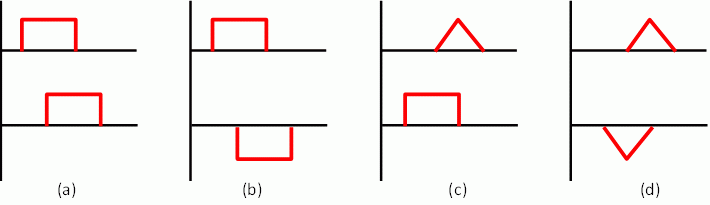
Sketch the superposition of the following wave pulses.
The waves on a certain string move at 50.0 m/s. The string is
7.5 m long. If both ends are fixed, what are the first five resonance
or standing wave frequencies? If one end is free, what are the first
five frequencies? Is there any way of telling that a string is fixed
or free at one end by looking at a sequence of resonance frequencies?
A wire of length 4.35 m and mass 137 g is under
a tension of 125 N. A standing wave has formed which has seven
nodes including the endpoints. What is the frequency of this wave?
Which harmonic is it? What is the fundamental frequency? The maximum
amplitude at the antinodes is 0.0075 m, write an equation for
this standing wave.
A string fixed at one end only is vibrating in its ninth harmonic mode.
Sketch the wave. The speed of a wave on the string is v = 25.8 m/s and the
string has a length of 8.25 m. What is the frequency of the wave? What is
the wavelength of the wave? What is the fundamental frequency?
Three successive resonance frequencies for a certain
string are 175, 245, and 315 Hz. (a) Find the ratio of these three
modes. (b) How can you tell that this sting has an antinode at
one end? (c) What is the fundamental frequency? (d) Which harmonics
are these resonance frequencies? (e) If the speed of transverse
waves on this string is 125 m/s, find the length of the string?
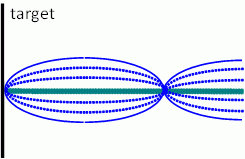
While watching an archery show you recorded
earlier, you notice that when the 1.05 m arrows hit a target they vibrate with
the following pattern. Using frame
advance on your PVR you deduce that the arrow vibrates 110 times per second. What is the speed of the waves travelling
through the arrow?
The human ear canal is approximately a cylindrical tube of length 2.5 cm. Find the fundamental resonant frequency?
Having no ruler at hand, you decide to determine the length of a hollow
open-ended tube by holding one end next to a sound source and varying the
frequency of the sound. The lowest frequency that causes resonance in the
tube is f = 420 Hz. Assuming that the speed of sound is 343 m/s, what is
the length of the tube? Sketch the standing wave.
A narrow hollow tube of length L = 3.50 m is open at both ends and sits on two sawhorses. A wind is blowing and the tube is "moaning". What is the lowest possible frequency for the sound produced? Sketch the standing wave. Take the speed of sound to be 340 m/s.
The beat frequency between an unknown tuning fork and a 500
Hz tuning fork is 12 Hz. Compared with a 504 Hz tuning fork, the
beat frequency is 16 Hz. What is the frequency of the unknown
tuning fork?
![[Return to Physics Homepage]](./../../physics.gif)
![[Return to Mike Coombes' Homepage]](./../../coombes.gif)
![[Return to List of Handouts]](./../../handouts.gif)
![[Return to Problem Sets]](./../../problems.gif)
![[Return to List of Solutions]](./../../solutions.gif)

![[Return to Kwantlen Homepage]](http://www.kpu.ca/images/return_button.gif)