- Initially, a ball has an angular velocity of
5.0 rad/s counterclockwise. Some time later, after rotating through
a total angle of 5.5 radians, the ball has an angular velocity
of 1.5 rad/s clockwise.
(a) What is the angular acceleration? What is the
average angular velocity? How much time did this take?
(b) At some point the angular velocity of the ball
had to have been zero. At what angle from it's initial orientation
did this occur and how long did it take?
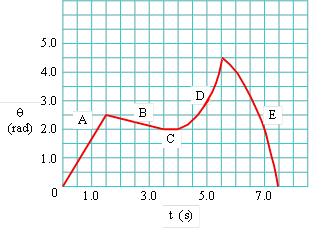
- From the angle versus time graph given to the
side, determine the average angular velocity in each segment A to E. Is the
angular acceleration in each segment zero, negative, or positive? What is the
average angular velocity over the entire time interval?
-
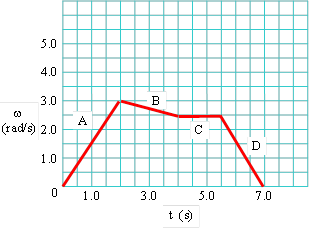
From the angular velocity versus time graph below, determine the angular acceleration in each segment. What is the average angular velocity in each segment? What is the angular displacement in each segment? What is the average angular velocity over the entire time interval?
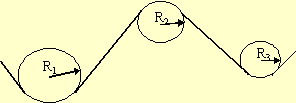
- In the diagram below, a rope is threaded around
three pulleys of radii, R1 = 0.30 m, R2
= 0.20 m, and R3 = 0.10 m. There is no slippage.
(a) If the rope moves with constant speed v = 5.0
m/s, what is the angular velocity of each pulley?
What is the frequency and period of each pulley?
(b) The rope accelerates from 5.0 m/s to 10.0 m/s
in 10.0 s, what is the average angular velocity of each pulley
for this time? What is the average angular acceleration of each
pulley? How many revolutions does each pulley turn in that 10.0
s?
- Two rotating disks, each with a visible dot,
are show at the same instant in time in the figure below. The
disk on the left has zero initial angular velocity and an angular
acceleration of a = 12.0 rad/s2.
The disk on the right has a constant
angular velocity of w
= 18.0 rad/s. When will the two disks have turned through the same total angle?
How many revolutions
will this have taken for each disk? If the disks had different
radii, would there be any change to your answers?

- A ball is thrown into the air at an angle of
25°
to the horizontal with a velocity of 11.0 m/s. As the ball leave
the pitcher's hand it has an angular velocity of 35.0 rad/s. How
many revolutions does the ball make before it returns to the same
level? Note that the x, y, and rotational motions are all completely
independent. Also note that the linear velocity given is not the
velocity in the equation v = wR.
- A motorcycle has tires with a diameter of 44.0
cm. Cruising down the highway, they are rotating at 1150 rpm (revolutions
per minute). What is the angular velocity in radians per second?
What is the frequency and period of the tires? What is the tangential
velocity of the edges of the tires (and hence the linear velocity
of the motorcycle) in m/s and km/h?
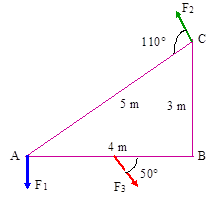
- In the diagram below, three forces are applied
to a 3-4-5 triangle. The forces are F1 = 91.7 N, F2
= 150 N, and F3 = 67.7 N. F3 is applied
at the middle of side AB. (a) Find the net torque about point
A. (b) Find the net torque about point B. (c) Find the net torque
about point C.
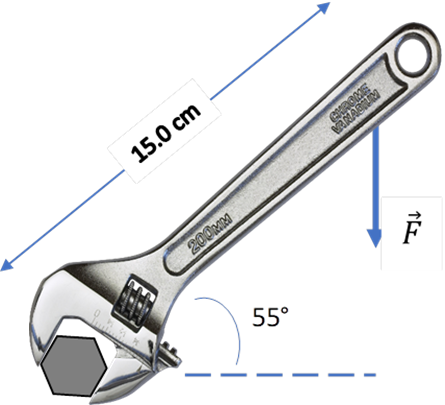
- Metal nuts on machinery bolts often have a recommended torque to which they should be tigtened by a wrench. If the nuts are not tightened enough, they may work loose. If tightened too much they may strip the bolt and be impossible to remove. In the diagram below, what maximum force F can you apply to tighten the bolt to 300 m-N?
![[Return to Physics Homepage]](./../../physics.gif)
![[Return to Mike Coombes' Homepage]](./../../coombes.gif)
![[Return to List of Handouts]](./../../handouts.gif)
![[Return to Problem Sets]](./../../problems.gif)
![[Return to List of Solutions]](./../../solutions.gif)
Questions?
mikec@kwantlen.bc.ca
![[Return to Kwantlen Homepage]](http://www.kwantlen.bc.ca/images/return_button.gif)