![[Return to Physics Homepage]](./../../physics.gif)
![[Return to Mike Coombes' Homepage]](./../../coombes.gif)
![[Return to List of Handouts]](./../../handouts.gif)
![[Return to Problem Sets]](./../../problems.gif)
![[Return to List of Solutions]](./../../solutions.gif)
| Physics 1101 | Work & Energy |
Work
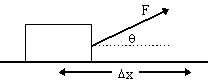
In the diagram below, calculate the work done if:
(a) F = 15.0 N, θ = 15°,
and Δx = 2.50 m,
(b) F = 25.0 N, θ = 75°,
and Δx = 12.0 m,
(c) F = 10.0 N, θ = 135°,
and Δx = 5.50 m,
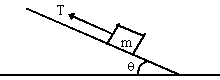
In the diagram below, a rope with tension T = 150 N pulls a 15.0-kg block 3.0 m up an incline (θ = 25.0°). The coefficient of kinetic friction is μk = 0.20. Find the work done by each force acting on the block.
A 50.0-N force is applied horizontally to a 12.0-kg block which is initially at rest. After traveling 6.45 m, the speed of the block is 5.90 m/s. What is the coefficient of kinetic friction?
Determine the work done by the following. Determine the angles
between the forces and the displacements. The forces are in Newtons
and the displacements are in metres:
(a) F = <1, 2, 3> and Δr
= <4, 5, 6>
(b) F = <1, 2, 3> and Δr
= <4, 5, -6>
(c) F = <4, 2, 4> and Δr
= <2, -8, 2>
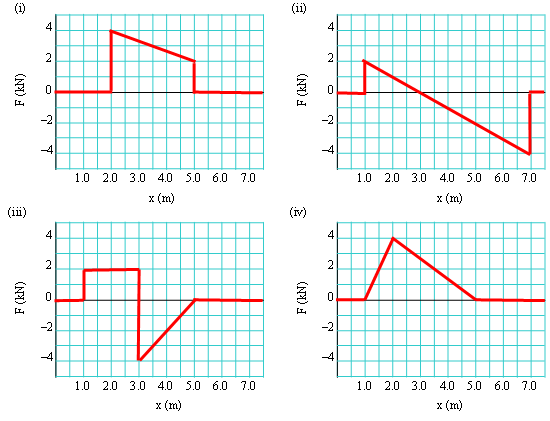
The diagrams below are graphs of Force in kiloNewtons versus distance in metres for the motion of a 50-kg block moving to the right at 10.0 m/s. What is the work acting on the block in each case?
Work-Energy
What is the work done by friction in slowing a 10.5-kg block
traveling at 5.85 m/s to a complete stop in a distance of 9.65
m? What is the kinetic coefficient of friction?
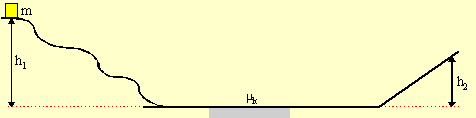
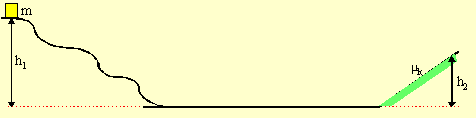
In the diagram below, a 5.00-kg block slides from rest at a height of h1 = 1.75 m down to a horizontal surface where it passes over a 2.00 m rough patch. The rough patch has a coefficient of kinetic friction μk = 0.25. What height, h2, does the block reach on the incline?
In the diagram below, a 5.00-kg block slides from rest at a height of h1 = 1.75 m down to a smooth horizontal surface until it encounters a rough incline. The incline has a coefficient of kinetic friction μk = 0.25. What height, h2, does the block reach on the θ = 30.0° incline?
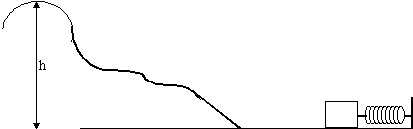
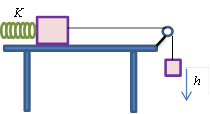
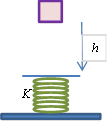
In the diagram below, the spring has a force constant of 5000 N/m, the block has a mass of 6.20 kg, and the height h of the hill is 5.25 m. Determine the compression of the spring such that the block just makes it to the top of the hill. Assume that there are no non-conservative forces involved.
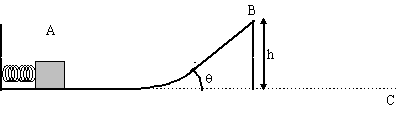
Suppose that there is friction in the previous problem and that the compression must in fact be 0.425 m for the block to just reach the top of the hill. What work is done by the frictional force?
Power
What power is required to pull a 5.0 kg block at a steady speed of 1.25 m/s? The coefficient of friction is 0.30.
An engine with an output of 7500 W is propelling a boat at 12 km/h. What force is the engine exerting on the boat? What force and how much power is water resistance exerting on the speedboat?
Efficiency
A 3.0 hp engine is 35% efficient as it pulls a block at constant speed up a 12.0 m 30.0° incline. How long does this take? Ignore friction. The mass of the block is 245 kg. Note 1 hp = 746 Watts. During that time, how much energy is expended as heat?
An engine that is 27% efficient does 100 kJ of work. How much energy does it emit as heat?
An engine that is 27% efficient wastes 650 kJ of energy as heat. How much mechanical work did it do?
A website gives the energy content of 1 litre of gasoline as 8.9 kWh (kiloWatt-hours). What is the energy content of that gasoline in Joules? If a 22% efficient gasoline engine consume 2.0ℓ of gasoline to lift a 1000-kg load height h, what is h?
Work, Heat, and Energy
If a typical 70-kg person consumes energy at a rate of 100 W, and a typical candy bar has a food energy of 450 KJ, how many candy bars per day must the person consume if that is all he eats?
Worker A lift a 25.0 kg box 0.95 m to a conveyor belt that carries the
box to worker B who lowers the box to the floor. The workers move 415 boxes in an
hour this way. Worker A is 22% efficient. Worker B is 26% efficient. Ignore work done by bending and twisting.
(a) What is the work done by worker A? What is the mechanical power output of worker A during this hour?
(b) How much total energy does worker A expend during this time? What is his total power input during this time?
(c) How much heat energy does worker A expend during this time? What is power is he expending as heat input during this time?
(d) Even though worker B is lowering the box (and not just dropping it), he must use energy to generate the force of his muscles to keep the box from falling? Compare the force worker B exerts on the box compared to worker A? Now look at the work definition W=Fdcosθ. How does this formula compare in the two cases? People are not springs, they do not get energy back from doing negative work. To do negative work, we assume people use just about the same amount of food energy as when doing positive work.
(e) What is the work done by worker B? What is the mechanical power output of worker B during this hour?
(f) How much total energy does worker B expend during this time? What is his total power input during this time?
(g) How much heat energy does worker B expend during this time? What is power is he expending as heat input during this time?

A 60-kg athlete has a basic metabolic rate of 80 W.
While on a stair climber for 40 minutes, measurements show she is consuming energy at 820 W.
Assume an efficiency of 25%.
(a) What is her mechanical power and mechanical work?
(b) How "high" does she climb?
(c) How much power is going into heat? How much heat does she produce?
(d) To maintain
a correct internal body temperature, she sweats. How much excess energy must she
get rid of by sweating during her session?
The text says that a 68-kg runner, running at a constant 15 km/h is consuming
energy at a rate of 1150 W. It appears that the runner is not doing any work since
there is no change in his kinetic energy. However, the air exerts a wind resistance
or drag on him that he has to overcome. You may have noticed that on a
windy day walking running into the
wind is harder than usual, and having the wind at your back makes walking or running easier.
(a) If the runner is 25% efficient, what is the drag force?
(b) If the person at rest uses 100 W, how much excess power does he need to get rid
of by sweating.
A 75-kg person is pulling and pressing a stiff horizontal spring with constant
K = 10,000 N/m. He pushes it in 15 cm from equilibrium and pulls it out 15 cm from
equilibrium on each repetition. Remember, people have to do work pushing or pulling!
He does 140 repetitions in 20 minutes. He is 25%
efficient.
(a) What is his mechanical work and power for the session?
(b) What is the total energy and power his body uses for this session?
(c) What is the total heat and power expended as heat for this session?
(d) If at rest, he uses 110 W, what excess heat power must he get rid of by sweating?
A person has many heavy 10.0-kg medicine balls on a table that is chest high.
One after the other, he pushes the medicine balls from rest to 10.0 m/s. He pushes 100 balls in 8.0 minutes. He is 23% efficient.
(a) What is the work done by the person? What is the mechanical power output of the person during this time?
(b) How much total energy does the person expend during this time? What is his total power input during this time?
(c) How much heat energy does the person expend during this time? What is power is he expending as heat input during this time?
If the 70-kg person in question 22 consumes an extra two 450 KJ candy bars a day, how far must he walk to “burn off” the extra calories? Assume the person requires 60 kcal to walk one kilometre. If he were to climb stairs, what height would he reach? Assume that the person is 25% efficient in converting food energy into mechanical energy.
A typical 70-kg person has a basic metabolic rate of 100 W. He is planning a weeklong biking trip and wants to know how much food to pack in the form of 450 KJ candy bars. He expects to ride 8 hours per day for that week. He uses Google and finds the metabolic rate of a person while biking is 1.0 Kcal/(s-kg). How many bars does he pack?
Energy in Food
A person consumes an extra two 450 KJ candy bars a day over his basic caloric requirements without exercising for a year and the excess energy is stored as body fat. The energy content of body fat is 9.3 kcal/g. How much mass will the person gain?
A 200-ml glass of wine is 12% alcohol by volume. Ignoring other food contributions, how many Kcal does it have? Note 1 ml = 1 g. m
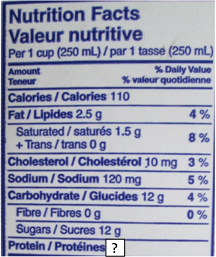
Consider the nutrition facts for the food item in the picture. How many grams of protein are there?
 | Food | Energy in 1 g (kJ) |
| Protein | 17 | |
| Fat | 38 | |
| Carbohydrates | 17 | |
| Ethanol (alcohol) | 29 | |
| Organic acids | 13 | |
| Polyols (sugar alcohols, sweeteners) | 10 | |
| Fibre | 8 | |
| Source: Wikipedia. Note 1 Kcal = 4.19 KJ | ||
Questions? mikec@kwantlen.bc.ca
![[Return to Kwantlen Homepage]](http://www.kwantlen.bc.ca/images/return_button.gif)