![[Return to Physics Homepage]](./../../physics.gif)
![[Return to Mike Coombes' Homepage]](./../../coombes.gif)
![[Return to List of Handouts]](./../../handouts.gif)
![[Return to Problem Sets]](./../../problems.gif)
![[Return to List of Solutions]](./../../solutions.gif)
Linear Collisions
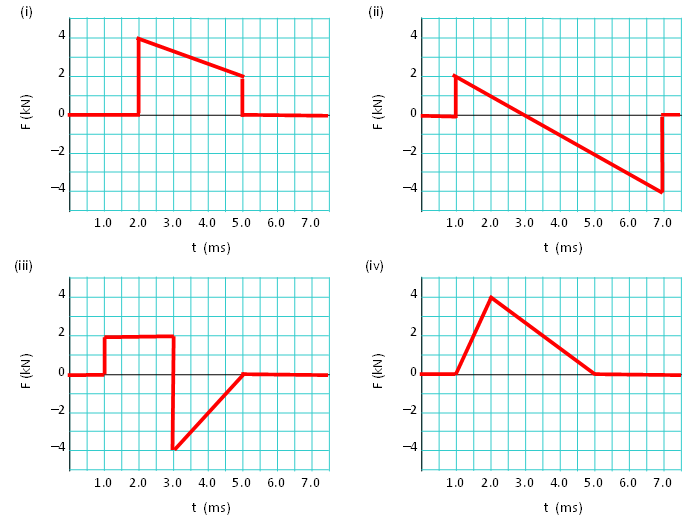
- The diagrams below are graphs of Force in
kiloNewtons versus time in milliseconds for the motion of a 5-kg block moving
to the right at 4.0 m/s.
(a) What is the magnitude and direction of the impulse
acting on the block in each case?
(b) What is the magnitude and direction of the average force
acting on the block in each case?
(c) What is the magnitude and direction of the final velocity
of the block in each case?
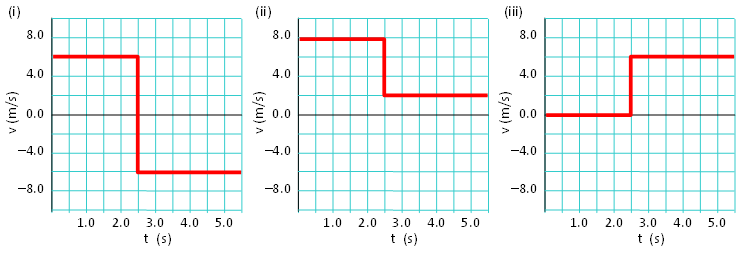
- The diagrams below are the velocity versus time graphs for
the collision of motion of a 4-kg block with a wall. The collision lasts for 20
milliseconds in each case.
(a) What is the magnitude and direction of the impulse
acting on the block in each case?
(b) What is the magnitude and direction of the average force
acting on the block in each case?
- You've been rowdy and obnoxious in a bar and are now in the
process of being thrown out by the scruff of the neck by the bouncer.
The bouncer has hold of you for 5.0 s and you are take from a
seated position to a final speed of 2.75 m/s. If your mass is
70.0 kg, what was your final momentum? What impulse and average
force did the bouncer exert on your person? Assume all motion
is in a straight line.
- A ball of mass 0.500 kg with speed 15.0 m/s collides with a
wall and bounces back with a speed of 10.5 m/s. If the motion
is in a straight line, calculate the initial and final momenta
and impulse. If the ball exerted an average force of 1000 N on
the wall, how long did the collision last?
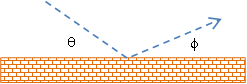
- A ball of mass 0.25 kg glances of a wall as shown in the
diagram. The ball approaches at 15 m/s at θ
= 30° and leaves at 12 m/s at φ = 20°. The
collision lasts for 15 milliseconds.
(a) What are the components of the impulse experienced by
the ball?
(b) What are the components of the average force acting on
the ball?
- Explain why a person wearing a seatbelt in a car accident
is less likely to be seriously hurt than the person who isn't
wearing a seatbelt.
- A lion of mass 120 kg leaps at a hunter with a horizontal velocity
of 12m/s. The hunter has an automatic rifle firing bullets of
mass 15 g with a muzzle speed of 630m/s and he attempts to stop
the lion in midair. How many bullets would the hunter have to
fire into the lion to stop its horizontal motion? Assume the bullets
stick inside the lion.
- On a frictionless surface, a 6.0-kg rock approaches from the
left at 3.5 m/s. It collides elastically with a 9.0-kg rock which
is approaching from the right at 1.7 m/s. Find the final velocities of the rocks.
- If the collision in question #8 had been perfectly inelastic,
what would have been the final velocity of the rocks? How much
kinetic energy would have been lost in the collision?
- A 50.0-kg skater is traveling due east at 3.00 m/s. A 70.0-kg
skater is moving due south at 7.00 m/s. They collide and hold
on to one another after the collision. Determine the magnitude
and direction of their velocity after the collision. Ignore the
effects of friction.
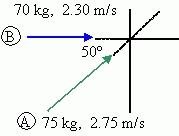
- Football player A tackles and holds onto player B in the diagram below.
- Assuming friction is negligible, what is the velocity of the players just after the collision?
- If the collision lasts for 0.30 seconds, what average force (magnitude and direction) does player A exert on player B?
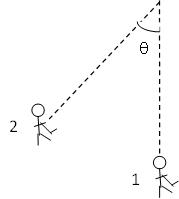
- Two opposing hockey players are racing up the ice for the puck when they collide at point A as shown in the diagram below. The first hockey player has mass 90 kg and a speed of 2.7 m/s while the other has mass 82 kg and speed 3.1 m/s. The angle in the diagram is θ = 32° . After the collision, the players remain locked together (at least until the referee forces them apart). What is the magnitude and direction of the players' velocity just after they collide?
Angular Momentum
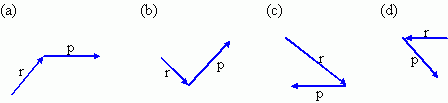
- Determine the direction of the angular momentum for the following
cases:
- Calculate the angular momentum for the following particles. Find
the angle between the position and the momentum vectors.
(a) r= (4, -5, 3) and p = (1, 4, -2)
(b) r = (1, -2, 3) and p = (7, -1, 1)
(c) r = (0, 2, 0) and p = (1, 0, 0)
- Calculate the angular momentum of a phonograph record (LP)
rotating at 331/3 rev/min. An LP has a radius
of 15 cm and a mass of 150 g. A typical phonograph can accelerate
an LP from rest to its final speed in 0.35 s, what average torque
would be exerted on the LP?
- A cylinder of mass 250 kg and radius 2.60 m is rotating at
4.00 rad/s on a frictionless surface when two more identical non-rotating
cylinders fall on top of the first. Because of friction between
the cylinders they will eventually all come to rotate at the same
rate. What is this final angular velocity?
- In a nightmare you dream that you are a hamster running in
an exercise wheel. Typical hamsters are 300 g and can run at speeds
of 3.2 m/s. A typical exercise wheel has a moment of inertia about
its centre of 0.250 kg-m2. How fast should the wheel
have been rotating in your dream? The radius of the wheel is 12.0
cm. Treat the hamster as a point mass. Hint what was the
angular momentum of the system before the hamster started running?
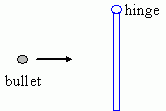
- A door with width L = 1.0 m and mass M = 15 kg is hinged on
one side so that it can rotate freely. A bullet, as shown, is
fired into the exact centre of the door. The bullet has mass 25
g and a speed of 400 m/s. What is the angular velocity of the
door with respect to the hinge just after the bullets embeds itself
in the door? The door may be treated as a thin rectangular sheet.
The bullet may be treated as a point mass.
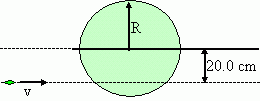
- A 150-g piece of playdough slides across a frictionless table
at v = 5.50 m/s. It collides with a disk of radius R = 35.0 cm
and mass M = 2.50 kg which has a fixed frictionless axle. The
playdough stick to the disk. Treat the playdough as a point mass.
(a) If the disk is not rotating initially, what is its angular velocity
after the collision?
(b) What angular velocity would the disk need to have initially, if
the disk stopped completely after the collision?
- A 22-g bug crawls from the centre to the outside edge of a
150-g disk of radius 15.0 cm. The disk was rotating at 11.0 rad/s.
What will be its final angular velocity? Treat the bug as a point
mass.
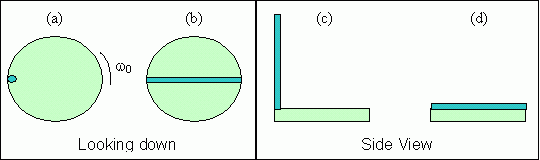
- A cylindrical rod of radius r = 2.00 cm and mass 1.25 kg is
upright on the edge of a rotating disk of mass 10.0 kg and radius
25.0 cm as is shown in diagram (a) below. The system is rotating
at 15.0 rad/s. The rod falls on its side as shown in diagram (b).
Diagrams (c) and (d) present a side view. What is the new angular
velocity of the system? How much work was done in changing the shape
of the object?
Questions?
mike.coombes@kpu.ca
![[Return to Kwantlen Homepage]](http://www.kpu.ca/images/return_button.gif)