![[Return to Physics Home Page]](./../../physics.gif)
![[Return to Mike Coombes' Home Page]](./../../coombes.gif)
![[Return to List of Handouts]](./../../handouts.gif)
![[Return to Problem Sets]](./../../problems.gif)
![[Return to List of Solutions]](./../../solutions.gif)
You are trapped on the top of a burning building. Death is imminent and help is nowhere in sight. There is a safe building 6.50 m away and 3.00 m lower. You decide to try and make it across. You run horizontally off your building at 8.10 m/s. Do you make it across? If you don't, how much faster must you be going?
A stunt motorcyclist is trying to jump over fifteen buses set side to side. Each bus is 2.50 m wide and a 30.0° ramp has been installed on either side of the line of buses. What is the minimum speed at which she must travel to safely reach the other side? How long will she be in the air?
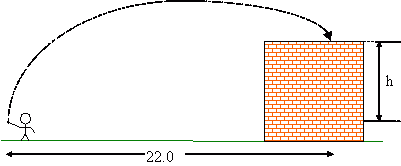
A boy throws a rock with speed v = 18.3 m/s at an angle of θ = 57.0° over a building. The rock lands on the roof 22.0 m in the x direction from the boy. How long was the rock in the air? How much taller, height h, is the building than the boy? Ignore air resistance.
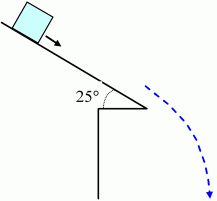
A tile, initially at rest, slides down a roof for a distance of 3.75 m before falling off the roof. The height of the building from ground to eave is 8.40 m. The acceleration of the tile as it slides is 2.10 m/s2.
(a) Determine the speed of the tile just as it leaves the roof.
(b) Determine the vertical component of the velocity just before it leaves the roof.
(c) Determine the horizontal component of the velocity just before it leaves the roof.
(d) Determine how long it takes to hit the ground after leaving the roof.
(e) Determine how far from the edge of the roof that the tile lands.
A boy is on the side of a hill. The hill makes a 15° incline with respect to horizontal. The boy throws a rock up the side of the hill. The boy throws the rock at 45° with respect to horizontal and the rock lands 30 m away up the hill. Find how fast the boy threw the rock. What angle does the rock make with horizontal before it lands? Ignore the boy’s height.
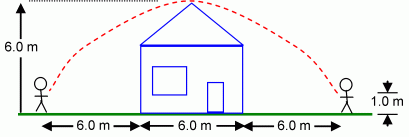
You are 6.0 m from the wall of a house. You want to toss a ball to your friend who is 6.0 m from the opposite wall. The throw and catch each occur 1.0 m above the ground.
(a) What minimum velocity, expressed in ij notation, will allow the ball to clear the roof?
(b) At what angle and speed do you throw the ball?
A boy throws a ball horizontally from a shoulder height of 1.10 m. Just before the ball touches down on the level ground it makes an angle of 30° with the ground. Determine the initial velocity of the ball as it left the boy’s hand.
Questions? mike.coombes@kpu.ca
![[Return to Kwantlen Homepage]](http://www.kpu.ca/images/return_button.gif)