![[Return to Physics Homepage]](../../physics.gif)
![[Return to Mike Coombes' Homepage]](../../coombes.gif)
![[Return to List of Handouts]](../../handouts.gif)
![[Return to Lab Handouts]](../../labs.gif)
(a) Let x = 14.75 ± 0.09. Evaluate F = 3x½.
First the principle value of F is
P(F) = 3(14.75)½ = 11.5217 .
Next, we take the derivative of F with respect to x
dF/dx = 3 / 2x½ .
The uncertainty in F is thus
δF = δx dF/dx = 0.09 × 3 / 2(14.75)½ = 0.0352 .
Keeping one figure in the uncertainty, the result is F = 11.52 ± 0.04.
(b) Let θ = 27.5 ± 0.5°. Evaluate F = sin(θ) - cos(θ).
First the principle value of F is
P(F) = sin(27.5°) - cos(27.5°) = -0.42526 .
Next, we take the derivative of F with respect to θ
dF/dθ = cos(θ) + sin(θ) .
The uncertainty in F is thus
δF = Δθ dF/dθ = (0.5° × π/180°) {cos(27.5)° + sin(27.5°)} = 0.0118 .
Keeping one figure in the uncertainty, the result is F = -0.43 ± 0.01.
(c) Let θ = 27.5 ± 0.5°. Evaluate F = sin(θ) + cos(θ).
First the principle value of F is
P(F) = sin(27.5°) + cos(27.5°) = 1.34876.
Next, we take the derivative of F with respect to
dF/dθ = cos(θ) - sin(θ) .
The uncertainty in F is thus
δF = Δθ dF/dθ = (0.5° × π/180°) |cos(27.5°) - sin(27.5°)| = 0.00371 .
Keeping one figure in the uncertainty, the result is F = 1.349 ± 0.004.
(d) Let t = 2.35 ± 0.06 s. Evaluate F = 5t2 - 3t + 2.
First the principle value of F is
P(F) = 5(2.35)2 -3(2.35) + 2 = 22.5625 .
Next, we take the derivative of F with respect to t
dF/dt = 10t - 3 .
The uncertainty in F is thus
δF = δt dF/dt = 0.06 {10(2.35) - 3} = 1.23 .
Keeping one figure in the uncertainty, the result is F = 23 ± 1.
(e) Let = 0.754 ± 0.004 rad. Evaluate F = [tan(θ)]½.
First the principle value of F is
P(F) = [tan(0.754)]½ = 0.96907 .
Next, we take the derivative of F with respect to t
dF/dθ = ½[tan(θ)]-½ / cos2(θ) .
The uncertainty in F is thus
δF = δt dF/dt = 0.004 × ½ /{ [tan(.754)]½ cos2(.754)} = 0.00388 .
Keeping one figure in the uncertainty, the result is F = 0.969 ± 0.004.
![[Return to Top of Page]](../../top.gif)
(a) 
We need to do two partial derivatives
∂ z/∂ x = ½ (1/z) (2x) = x / z , and
∂ z/∂ y = ½ (1/z) (2y) = y / z .
The uncertainty in z is thus
δz = { [δx x/z]2 + [δy y/z]2 }½ .
(b) R = Acos(θ)
We need to do two partial derivatives
∂ R/∂ A = cos(θ) , and
∂ R/∂q = -Asin(θ) .
The uncertainty in R is thus
δR ={ [δA cos(θ)]]2 + [δθ Asin(θ)]2 }½.
(c) N = N0e-λt
We need to do three partial derivatives
∂ N/∂ N0 = e-λt = N/N0 ,
∂ N/∂l = -tN0 e-λt = -tN , and
∂ N/∂ t = -λN0 e-λt = -λN .
The uncertainty in N is thus
δN = N{ [δN0/N0]2 + [dl t]2 + [δt λ]2 }½.
(d) F = A/B + C/D
We need to do four partial derivatives
∂ F/∂ A = 1/B ,
∂ F/∂ B = -A/B2 ,
∂ F/∂ C = 1/D , and
∂ F/∂ D = -C/D2 .
The uncertainty in F is thus
δF = { [δA/B]2 + [δB A/B2]2 + [δC/D]2 + [δD C/D2]2 }½.
(e) v = v0 + at
We need to do three partial derivatives
∂ v/∂ v0 = 1 ,
∂ v/∂ a = t , and
∂ v/∂ t = a .
The uncertainty in v is thus
δv = { [δv0]2 + [δa t]2 + [δt a]2 }½.
(f) 
We need to do three partial derivatives
∂ t/∂l = -(1/λ2)ln(R0/R) = -t/λ ,
∂ t/∂ R0 = (1 / λR0) , and
∂ t/∂ R = - (1 / λR).
The uncertainty in t is thus
δt = (1/λ){ [t dl]2 + [δR0/R0]2 + [δR/R]2 }½.
(g) d = v0t + ½at2
We need to do three partial derivatives
∂ d/∂ v0 = t ,
∂ d/∂ a = ½t2 , and
∂ d/∂ t = v0 + at .
The uncertainty in d is thus
δd = { [δv0 t]2 + [½δa t2]]2 + [δt (v0 + at)]2 }½ .
(h) X = Rtan2(θ)
We need to do two partial derivatives
∂ X/∂ R = tan2(θ) , and
∂ X/∂q = 2R tan(θ) / cos2(θ) .
The uncertainty in X is thus
δX = { [δR tan2(θ)]2 + [Δθ 2Rtan(θ) / cos2(θ)]2 }½ .
(i) 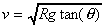
We need to do three partial derivatives
∂ v/∂ R = ½[Rgtan(θ)]-½ gtan(θ) = gtan(θ) / 2v ,
∂ v/∂ g = ½[Rgtan(θ)]-½ Rtan(θ) = Rtan(θ) / 2v, and
∂ v/∂q = ½[Rgtan(θ)]-½ Rg/cos2(θ) = Rg / 2vcos2(θ)
The uncertainty in v is thus
δv = { [δR g]2 + [δg Rtan(θ)]2 + [δθ Rg/cos2(θ)]2 }½ / 2v .
(j) L = mvrsin(φ)
We need to do four partial derivatives
∂ L/∂ m = vrsin(φ) = L/m ,
∂ L/∂ v = mrsin(φ) = L/v ,
∂ L/∂ r = mvsin(φ) = L/r , and
∂ L/∂f = mvrcos(φ) = L/tan(φ) .
The uncertainty in L is thus
δv = L{ [δm/m]2 + [δv/v]2 + [δr/r]2 + [Δθ/tan(θ)]2 }½ .
Questions?mike.coombes@kpu.ca
![[Return to Kwantlen Homepage]](http://www.kpu.ca/images/return_button.gif)