![[Return to Physics Homepage]](./../../physics.gif)
![[Return to Mike Coombes' Homepage]](./../../coombes.gif)
![[Return to List of Handouts]](./../../handouts.gif)
![[Return to Problem Sets]](./../../problems.gif)
![[Return to List of Solutions]](./../../solutions.gif)
|
|
|
|
|
| Questions: | 1 | 2 | 3 | 4 | 5 | 6 | 7 | 8 | 9 | 10 | 11 | 12 | 13 | 14 | 15 | 16 | 17 | 18 | 19 | 20 | 21 | 22 | 23 | 24 | 25 | 26 | 27 |
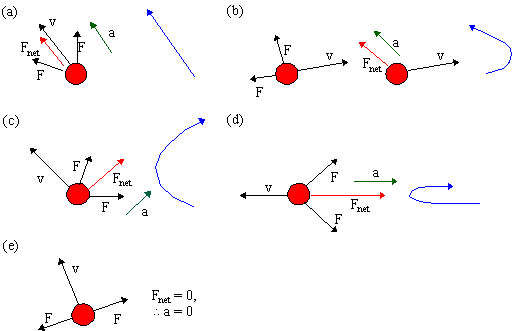
First determine the direction of the net force on the ball. From Newton's Second Law, F = ma, so the direction of the net force and resulting acceleration are in the same direction. As time passes, the direction of the ball will tend to point in the direction of the acceleration.
![[Return to Top of Page]](./../../top.gif)
This involves a 2D vector addition, so it is appropriate to sketch the addition of the forces and then add the components:
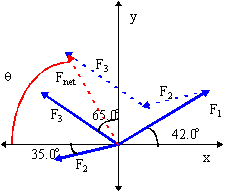
F1 = i[25cos(42.5°)] + j[25sin(42.5°)] = i[18.432] + j[16.890]
F2 = i[-15.5cos(35.0°)] + j[-15.5sin(35.0°)] = i[-12.697] + j[-8.8904]
F3 = i[-20.5sin(65.0°] + j[-20.5cos(65.0°] = i[-18.579] + j[8.664]
Adding the components of the vectors we get
|
Fnet |
= |
i[18.432 + -12.697 + -18.579] + j[16.890 + -8.8904 + 8.664] |
|
= |
i[-12.844] + j[16.663] |
The magnitude of the net force is given by Fnet = [(Fx)2 + (Fy)2]½ = 21.039 N . The angle is determined by trigonometry to be θ = arctan(|Fy/Fx|) = 52.4°. So putting the answer in the same form as that we were given, the net force is Fnet = (21.0 N, 127.6°).
Since a = Fnet/m, a = ([21.0 N
/ 8.75 kg], 127.6°) = (2.40 m/s2, 127.6°).
We are asked to find F4 such that F1 + F2 + F3 + F4 = Fnet + F4 = 0. In other words, we find to find F4=−Fnet. Equal and opposite vectors have the same magnitude but are 180° apart, so F4 = (21.0 N, 127.6° + 180°) = (21.0 N, 307.6°).
(a) To calculate the average acceleration, we make use of the
kinematic data. To solve a kinematics problem, we list the given data
and the unknown. We may reasonably assume that the bullet starts from
rest.
| v0 | = 0 |
| vf | = 500 m/s |
| Δx | = 0.75 m |
| a | = ? |
Examining the variables, we see that we can use the equation 2aΔx = (v)2 − (v0)2, to find the acceleration,

The plus sign indicates that acceleration is in the same direction as the motion of the bullet.
(b) According to Newton's Second Law,
Fbullet = mbulletabullet = (0.100 kg)(1.667 × 10⁵ m/s2) = +1.667 × 10⁴ N ,
where the plus sign indicates that the force is in the same direction as the motion of the bullet.
(c) According to Newton's Third Law, the force on the rifle must be equal but opposite to the force acting on the bullet, Frifle = −Fbullet. Hence we know that the force on the rifle is −1.667× 10⁴ N, where the plus sign indicates that the force is in the opposite direction to the motion of the bullet.
(d) According to Newton's Second Law, Frifle = mriflearifle. We thus find the accelartation of the bullet to be
arifle = Frifle / mrifle = (−1.667 × 10⁴ N) / (7.50 kg) = −2.22 × 10³ m/s2 .
where the minus sign indicates that the acceleration of the
rifle is in the opposite direction to the motion of the bullet.
To find the force we would use Newton's Second Law, F
= ma. We are given the mass but not the acceleration. However
we are given kinematic data and we should be able to use this to find
the acceleration.
| v0 | = 0 |
| vf | = 30 km/h (1000 m / 1 km) (1h / 3600 s) = 8.333 m/s |
| Δx | = 3.50 m |
| a | = ? |

The minus sign indicates that acceleration is in the opposite direction to your motion.
According to Newton's Second Law,
F = ma = (70.0 kg)(−9.92
m/s2) = −694 N ,
where the minus sign indicates that the force is also in the opposite direction to your motion as you slide.
According to Newton's Third Law, the woman must exert 70.0 N on the male skater but in the opposite direction, in other words, −70.0 N, where the minus sign indicates the direction opposite to the direction that the man pushes the woman.
To find the acceleration of the male skater we use Newton's Second Law,
aman = Fwomanonman / mman = −70 N / 80.0 kg = −0.875 m/s2.
The minus sign indicates that the man moves backwards which is what one would expect.
Similarly the acceleration of the female skater is
awoman = Fmanonwoman / mwoman = +70 N / 60.0 kg = +1.17 m/s2.
The plus sign indicates that the woman moves backwards (forward from the man's perspective) which is what one would expect.
To calculate the acceleration of the shell, we make use of the kinematic data. To solve a kinematics problem, we list the given data and the unknown. We may reasonably assume that the shell starts from rest.
| v0 | = 0 |
| vf | = 450 m/s |
| Δx | = 3.75 m |
| a | = ? |
Examining the variables, we see that we can use the equation 2aΔx = (v)2 −
(v0)2, to find the acceleration,

The plus sign indicates that acceleration is in the same direction as the motion of the shell.
We don't have any kinematic data for the artillery piece, but we do know from Newton's Third Law that the force on the cannon must be equal but opposite to the force acting on the shell, Fcannon = −Fshell, and we can calculate Fshell.
According to Newton's Second Law,
Fshell = mshellashell = (10.5 kg)(2.70 × 10⁴ m/s2) = +2.84 105 N ,
where the plus sign indicates that the force is in the same direction as the motion of the shell.
Since Fcannon = mcannonacannon, we rearrange to find
acannon = Fcannon/mcannon
= −Fshell/mcannon
= (−2.84 × 10⁵ N)/(800
kg) = −354 m/s2 .
where the minus sign indicates that the acceleration of the cannon is in the opposite direction to the acceleration of the shell.
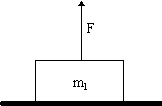
Since this problem deals with forces that suggests we should apply Newton's Second Law. To apply Newton's Second Law we draw a free-body diagram (FBD) for the block. The block has mass, so it has weight. The table top exerts a normal on the block. A given force is also acting on the block. The table top normal is nonzero only if the block remains on the table, so we will assume that the acceleration is zero.
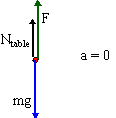
In component form the forces and acceleration vectors are;
F = i0 + jF,
Ntable = i0 – jNtable,
W = i0 – jmg, and
a = i0 + j0.
Since ΣFy = may, we find Ntable + F - mg = 0. We don’t find anything interesting from ΣFx = max. So the equation for the normal force is
Ntable = mg - F .
So the equation for the normal force is
Ntable = mg − F .
Examining the three cases yields,
| F | Ntable | |
| (a) | 100 N | 145 N |
| (b) | 245 N | 0 N |
| (c) | 500 N | −255 N |
Since normal force can never be zero, case (c) is saying that the block has been lifted off the table, so that Ntable = 0, and the block is actually accelerating upwards.
This problem deals with forces and acceleration, which suggests we should apply Newton's Second Law. To apply Newton's Second Law we draw a free-body diagram (FBD). In the diagram we show the givens forces F1 and F2. As well, since the object has mass, it has weight. Since the object touches the table top, there is a normal force from the table top through the object. We assume that the object will accelerate to the right.
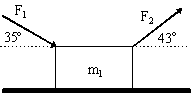
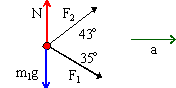
Next we break the forces and acceleration into components;
F1 = iF1cos(35°) – jF1sin(35°),
F2 = iF2cos(43°) – jF2sin(43°),
N = i0 – jN,
W = i0 – jmg, and
a = ia + j0.
We apply Newton’s Second Law separately to the i and j components. Thus ΣFx = max yields
F1cos(35°) + F2cos(43°) = m1a
and ΣFy = may gives
N - m1g - F1sin(35°) + F2sin(43°) = 0
Thus the normal force is:
N = m1g + F1sin(35°) − F2sin(43°) = (20)(9.81) +25sin(35°)− 15sin(43°) = 200.3 N
The acceleration is:
a = [F1cos(35°) + F2cos(43°)]/m1 = [25cos(35°) + 15cos(43°)]/20 = 1.572 m/s2.
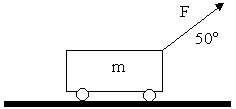
This problem deals with forces and acceleration, which suggests we should apply Newton’s Second Law. To apply Newton’s Second Law we draw a free-body diagram (FBD). In the diagram we show the given force F. As well, since the object has mass, it has weight. Since the object touches the tabletop, there is a normal force from the tabletop through the object. We assume that the object will accelerate to the right.
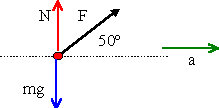
We break the forces and acceleration into components;
F = iFcos(50°) – jFsin(50°),
N = i0 – jN,
W = i0 – jmg, and
a = ia + j0.
We apply Newton’s Second Law separately to the i and j components. Thus ΣFx = max yields
Fcos(50°) = ma
and ΣFy = may gives
N - mg + Fsin(50°) = 0
Thus the normal force is:
N = mg − Fsin(50°) = (0.400)(9.81) − 1.00sin(50°) = 3.16 N
The acceleration is:
a = Fcos(50°)/m = 1.00cos(50°)/0.400 = 1.61 m/s2 .
Since the acceleration is positive, our assumption about its direction was correct. The fact that the normal is positive, i.e. that the object has not lost contact with the tabletop, tells us that there is no acceleration in the y direction.
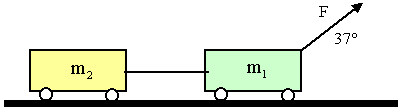
This problem deals with forces and acceleration, which suggests we should apply Newton’s Second Law. To apply Newton’s Second Law we draw a free-body diagram (FBD) for each block. In the diagram for m1 we show the given force F. As well, since the object has mass, it has weight. Since the object touches the tabletop, there is a normal force from the tabletop through the object. There is a string attached to m1 so there is a tension from the heavier block to the lighter. In the diagram for m2 we show the tension of the string acting on it which is the same as on m1 but opposite in direction. It also has weight and is on a surface. Both objects should have the same acceleration since they are connected by a string. We will assume that they will accelerate to the right.
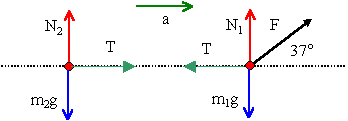
For each block, we break the forces and acceleration into components
|
Left Block |
Right Block |
|
F = iFcos(37°) + jFsin(37°) |
|
|
T = iT + j0 |
T = –iT + j0 |
|
N2
= i0 – jN2 |
N1
= i0 – jN1 |
|
W2 = i0 – jm2g |
W1 = i0 – jm1g |
|
a2 = ia + j0 |
a1 = ia + j0 |
We apply Newton's Second Law separately to the i and j components for each block.
|
Object |
i |
j |
|
|
ΣFx = max |
ΣFy = may |
|
Right Block |
Fcos(37°) - T = m1a |
N1 - m1g + Fsin(37°) = 0 |
|
Left Block |
T = m2a |
N2 - m2g = 0 |
Thus the normal forces are:
N1 = m1g − Fsin(50°) = (1.50)(9.81) − 8.00sin(37°) = 9.90 N ,
and
N2 = m2g = (1.20)(9.81) = 11.77 N .
The fact that both normals are positive indicates that the blocks do not lose contact with the tabletop and are therefore not accelerating in the y direction. This is consistent with our assumption about the acceleration being only in the x direction.
To find the tension T we need to eliminate the acceleration a from the pair of x equations. The second gives
a = T / m2.
We substitute this into the first equation
Fcos(37°) − T = m1 [T / m2] .
We put terms with T on one side and everything else on the other side
Fcos(37°) = m1 [T / m2] + T .
We collect T and find
Fcos(37°) = T [m1/m2 + 1] .
So we have
T = Fcos(37°)/[m1/m2 + 1] = 8.00cos(37°)/[1.50/1.20 + 1] = 2.84 N .
So the tension in the string between the blocks is 2.84 N.
The acceleration of the blocks is
a = T/m2 = 2.84 / 1.20 = 2.37 m/s2 .
This is positive so our assumption about the direction of the acceleration was correct.
The acceleration is:
a = Fcos(50°)/m = 1.00cos(50°)/0.400 = 1.61 m/s2 .
Since the acceleration is positive, our assumption about its direction was correct. The fact that the normal is positive, i.e. that the object has not lost contact with the tabletop, tells us that there is no acceleration in the y direction.
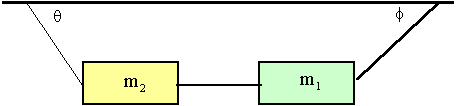
This problem deals with a force, tension, which suggests we should apply Newton’s Second Law. To apply Newton’s Second Law we draw a free-body diagram (FBD) for each block. In the diagram for m1 we show two tension forces, one for each string. As well, since the object has mass, it has weight. In the diagram for m2 we again show two tension forces and its weight. We would not expect the blocks to move so we will assume that there is no acceleration.
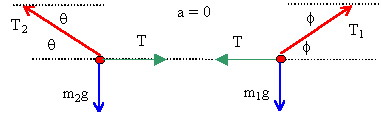
In the free-body diagrams, we also use a little geometry to find more useful angles to work with.
For each block, we break the forces and acceleration into components
|
Left Block |
Right Block |
|
T2 = –iT2cos(θ) + jT2sin(θ) |
T1 = iT1cos(φ) + jT1sin(φ) |
|
T = iT + j0 |
T = –iT + j0 |
|
W2 = i0 – jm2g |
W1 = i0 – jm1g |
|
a2 = i0 + j0 |
a1 = i0 + j0 |
Next we apply Newton’s Second Law separately to the i and j components for each block:
|
Object |
i |
j |
|
|
ΣFx = max |
ΣFy = may |
|
Left Block |
T2 cos(θ) - T = 0 |
T2sin(θ) - m2g = 0 |
|
Right Block |
T1 cos(φ) - T = 0 |
T1sin(φ) - m1g = 0 |
Considering the equations for the left block, we see that
T = T2 cos(θ) .
We don't know T2 however. But we do have another equation with T2 in it and it indicates that
T2 = m2g / sin(θ) .
Hence the tension in the string between the blocks is
T = T2 cos(θ) = m2g cos(θ) / sin(θ) = 3.35(9.81)cos(60º)/sin(60º) = 18.97 N .
From the equations for the right block we see that
m1 = T1sin(φ)/g .
However, we don't know T1. We do have a second equation that tells us that
T1 = T / cos(φ) .
Combining these two results yields
m1 = [T / cos(φ) ] sin(φ )/g = (18.97)sin(45º) / 9.81cos(45º) = 1.93 kg.
The first block has a mass of 1.93 kg.
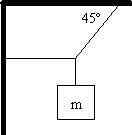
Since this problem deals with forces, the tensions, and we known that the acceleration is zero since nothing is moving, that suggests we should apply Newton's Second Law. To apply Newton's Second Law we draw a free-body diagram (FBD) for the block and the knot. We need a FBD for the knot since this is where the tensions all meet. A knot is massless since we are dealing with massless ropes. The block has mass, so it has weight. Each rope represents a different tension.
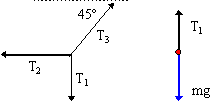
For each object, we break the forces and acceleration into components
|
knot |
block |
|
T3 = iT3 sin (45°) + jT3 cos (45°) |
|
|
T2 = –iT + j0 |
T1 = i0 + jT1 |
|
T1 = i0 – jT1 |
W = i0 – jmg |
|
aknot = i0 + j0 |
ablock = i0 + j0 |
Applying Newton's Second law:
|
knot |
block | |
| ΣFy = may | ΣFy = may | ΣFy = may |
| T2 − T3cos(45°) = 0 | T3sin(45°) − T1 = 0 | T1 − mg = 0 |
From the above we see that T1 = mg = 490.5 N, T3 = T1/sin(45°) = 693.7, and T2 = T3cos(45°) = 490.5 N.
This problem deals with a force, weight, and acceleration. That suggests we should apply Newton's Second Law. To apply Newton's Second Law we draw a free-body diagram (FBD). Since the person has mass, he has weight. Since the person touches the floor of the elevator, there is a normal force from the floor. We will assume that the person will accelerate upwards.
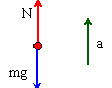
Applying Newton's Second Law yields,
| ΣFy = may |
| N − mg = ma. |
This isn't enough to solve the problem, since we have one equation but two unknowns, N and a.
However, the apparent weight is just N, so the first sentence of the problem is N = (7/8)mg. Now we can find a,
a = (N − mg) / m = [(7/8)mg − mg]/m = −g/8 = −1.23 m/s2 .
The minus sign indicates that, contrary to our initial
assumption, the elevator accelerates downwards at 1.23 m/s2.
This problem deals with a force, tension, and acceleration. That suggests we should apply Newton's Second Law. To apply Newton's Second Law we draw a free-body diagram (FBD) for each object, the person and the elevator. Each has mass, so each has weight. Since the person stands on the elevator, there is a an equal but opposite normal force on each. The rope, and thus the tension, acts directly only on the elevator. Both object have the same acceleration if they remain in contact. We will assume that the acceleration is upwards.
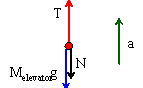
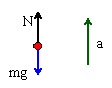
Applying Newton's Second law:
| elevator | passenger |
| ΣFy = may | ΣFy = may |
| T − Mg − N = +Ma | N − mg = ma |
So we have two equation in two unknowns, N and a. First we add
the two equations together to get T − (M+m)g
= (M+m)a. This our equation for the acceleration is a = T / (M+m) − g. The apparent weight, that is the normal force
acting on the passenger, is given by N = mg + ma. When we plug in the
numbers we find:
| acceleration | apparent weight | |
| (a) | 1.91 m/s2 | 938 N |
| (b) | 0 | 785 N |
| (c) | −2.00 m/s2 | 625 N |
The negative acceleration in part (c) indicates that the elevator is actually accelerating downwards.
This problem deals with a force, the scale reading, and acceleration. That suggests we should apply Newton's Second Law. To apply Newton's Second Law we draw a free-body diagram (FBD). Since the person has mass, he has weight. Since the person touches the scale, there is a normal force from the scale. The scale reading is a measure of this normal force. Since there are two cases, we draw an FBD for each case.
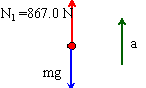
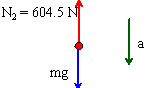
| up | down |
| ΣFy = may | ΣFy = may |
| N2 − mg = +ma | N2 − mg = −ma |
So we have two equation in two unknowns, m and a. First we add the two equations together to get N1 − mg + N2 − mg = 0. This becomes m = (N1 + N2) / 2g = 75.0 kg.
Using the first equation, we get a = (N2 − mg) / m = 1.75 m/s2.
Since this problem deals with forces, the applied force and friction, and we are asked about the acceleration, that suggests we should apply Newton's Second Law. To apply Newton's Second Law we draw a free-body diagram (FBD) for the block. We will set up the axes along the incline. The block has mass, so it has weight. There is a normal for the block from the incline. There is friction but it is not immediately clear if it is static or kinetic.
Let's assume that the block is moving so that there is kinetic friction.
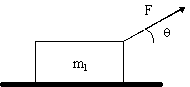
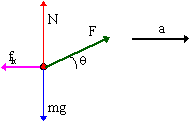
Next we break all the vectors into components:
F = iFcos(θ) + jFsin(θ),
N = i0 + jN,
fk = –ifk + j0
W = i0 – jmg, and
a = ia + j0.
We apply Newton’s Second Law separately to the i and j components. Thus ΣFx = max yields
Fcos(θ) - fk = ma
And ΣFy = may produces
N +Fsin(θ) - mg = 0
By definition, fk = μkN.
From the equation in the second column, we have N = mg −Fsin(θ). Thus fk = μk[mg − Fsin(θ)]. Putting this into the first equation yields
Fcos(θ) − μk[mg − Fsin(θ)] = ma .
Rearranging and solving for a yields,
a = (F/m)[cos(θ) + μksin(θ)]− μkg .
Solving for the three cases:
|
F (N) |
a (m/s2) |
|
| (a) | 25 | −2.11 |
| (b) | 65 | +2.36 |
| (c) | 100 | +6.27 |
Clearly, our answer to part (a) violates our assumption that the friction is kinetic. Hence the friction must have been static and a = 0 for case (a).
(b) If m = 10.0kg, a = 2.5m/s2 x and F = 75 N x, find μk.
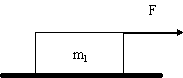
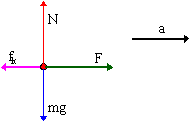
Since this problem deals with forces, friction and F, and acceleration is involved, that suggests we should apply Newton's Second Law. To apply Newton's Second Law we draw a free-body diagram (FBD) for the block. We will set up the axes along the direction of acceleration. The block has mass, so it has weight. There is a normal for the block from the table top. Presumably the block is moving so there is kinetic friction opposed to the motion.
|
i |
j |
| ΣFx = max | ΣFy = may |
| F − fk = ma | N − mg = 0 |
By definition, fk = μkN. From the equation in the second column, we have N = mg. Thus fk = μkmg. Putting this into the first equation yields
F − μkmg = ma .
(a) Solving for the acceleration
a = F/m − μkg = (50.0 N)/(10.0 kg) − 0.3(9.81 m/s2) = 2.06 m/s2 .
(b) Solving for μk
μk = F/mg − a/g = (75 n)/(10.0 kg × 9.81 m/s2)− 2.5/9.81 = 0.51 .
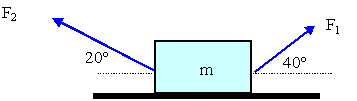
Since the block does not move, we know that we are dealing with static friction. It can either be to the right or to the left in the diagram. To determine which, we must examine the magnitude of each force's x component:
F1x = F1cos(40º) = 36.77 N,
and
F2x = F2cos(20º) = 39.47 N.
Since F2x is bigger, the frictional force must be directed to the right. Note that nothing in the problem says that the object is about to slip, so we are not dealing with fsmax. Considering the forces in the x direction
− F2x + F1x + fs = 0 .
So
fs = F2x − F1x = 39.47 − 36.77 N = 2.70 N .
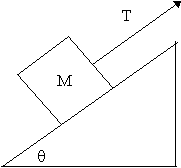
Since this problem deals with forces, weight and friction, and we known that the acceleration is zero since the velocity is constant or zero, that suggests we should apply Newton’s Second Law. To apply Newton’s Second Law we draw a free-body diagram (FBD) for the block. We will set up the axes along the incline. The tension in the rope points along the rope away from the block. The block has mass, so it has weight. There is a normal for the block from the incline. There is friction but it is not immediately clear if it is static or kinetic.
(a) Here the block is moving up the incline, so we have kinetic friction down the incline.
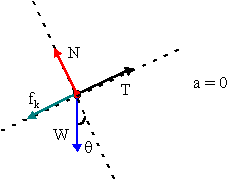 |
Next we break all the vectors into components:
T = iT + j0, |
We apply Newton’s Second Law separately to the i and j components. Thus ΣFx = max yields
T - fk - Wsin(θ) = 0
And ΣFy = may produces
N - Wcos(θ) = 0
By definition, fk = μkN. From the equation in the second column, we have N = Wcos(θ ). Thus fk = μkWcos(θ). Putting this into the first equation yields
T − μkWcos(θ)− Wsin(θ) = 0 .
Rearranging gives an expression for T,
T = W[sin(θ) + μkcos(θ)] = (100 N)[sin(30°)+0.20cos(30°)] = 67.3 N .
(b) Here the block is moving down the incline, so the kinetic friction is up the incline.
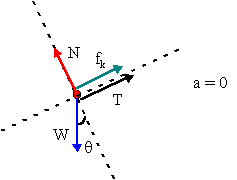
| i | j |
| ΣFx = max | ΣFy = may |
| T + fk − Wsin(θ) = 0 | N − Wcos(θ) = 0 |
By definition, fk = μkN. From the equation in the second column, we have N = Wcos(θ). Thus fk = μkWcos(θ). Putting this into the first equation yields,
T + μkWcos(θ) − Wsin(θ) = 0 .
Rearranging gives an expression for T,
T = W[sin(θ ) − μkcos(θ)] = (100 N)[sin(30°)−0.20cos(30°)] = 32.7 N .
(c) The block doesn’t move, so we must be dealing with static friction. If we pull too hard the block will move up the incline, so the static friction must point down the incline. So we only need to redo (a) with static friction. Nothing will change except the coefficient of friction, so are results will be the same but with μk replaced by μs. Thus our results will be
Tmax = W[sin(θ) + μscos(θ)] = (100 N)[sin(30°)+0.52cos(30°)] = 95.0 N ,
The block doesn’t move, so we must be dealing with static friction. If we don't pull hard enough the block will slide down the incline, so the static friction must point up the incline. So we only need to redo (b) with static friction. Nothing will change except the coefficient of friction, so are results will be the same but with μk replaced by μs. Thus our results will be
Tmin = W[sin(θ)− μscos(θ)] = (100 N)[sin(30°)−0.52cos(30°)] = 5.0 N .
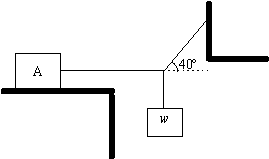
A system in equilibrium does not accelerate, so a = 0. Since this problem deals with forces, friction and weight, and we known that the acceleration is zero, that suggests we should apply Newton's Second Law. To apply Newton's Second Law we draw a free-body diagram (FBD) for each block and the knot. We need a FBD for the knot since this is where the tensions all meet. A knot is massless since we are dealing with massless ropes. Each block has mass, so each has weight. Each rope represents a different tension. Block A is on a table so there is a normal force from the table through A. If there were no friction, Block A would move forward. We deduce that the maximum static friction points left.
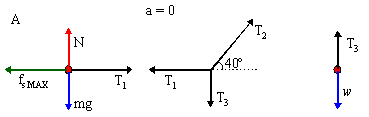
For each object, we break the forces and acceleration into components
|
block A |
knot |
weight |
|
T1 = i0 + jT1 |
T1 = i0 – jT1 |
|
|
f = –ifsMAX + j0 |
T2 = iT2cos(40°) + jT2sin(40°) |
|
|
N = i0 + jN |
T3 = i0 – jT3 |
T3 = i0 + jT3 |
|
WA = i0 – jmg |
|
W = i0 – jw |
|
a = i0 + j0 |
||
Applying Newton’s Second law:
|
Block A |
knot |
w |
||
| i | j | i | j | j |
| ΣFx = max | ΣFy = may | ΣFx = max | ΣFy = may | ΣFy = may |
| T1 − fs MAX = 0 | N − mg = 0 | T2cos(40°) − T1 = 0 | T2sin(40°) − T3 = 0 | T3 − w = 0 |
Besides our equations in the last row above, we also have the definition fs MAX = μN. Our equation in the second column tells us that N = mg = 100 N, so we know fs MAX = μN = 0.40100 N = 40 N. The first equation tells us that T1 = fs MAX = 40 N. The third equation yields, T2 = T1/ cos(40°) = 52.2 N. The fourth equation yields T3 = T2sin(40°) = 33.6 N. The equation in the last column indicates that w = T3 = 33.6 N. So the maximum weight of the hanging block is 33.6 N.
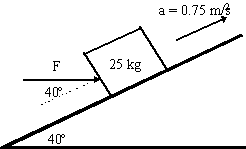
Since this problem deals with forces, F, weight, and friction,
and we are given the acceleration, that suggests we should apply
Newton's Second Law. To apply Newton's Second Law we draw a free-body
diagram (FBD). We are told that there is an applied force F acting
horizontally. Since the block has mass, it has weight. It is on the
incline, so there is a normal. The object is accelerating, so we must
be dealing with kinetic friction which will be opposite to the
direction of motion. Note that we will choose a set of axes such that
one axis points along the incline.
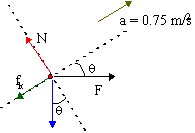 |
Next we break all the vectors into components: F = iF cos(θ) – jF sin(θ), |
We apply Newton’s Second Law separately to the i and j components. Thus ΣFx = max yields
Fcos(θ) - fk - mgsin(θ) = ma
And ΣFy = may produces
N - mgcos(θ) - Fsin(θ) = 0
Since we know fk = μkN, and the second equation says that N = mgcos(θ) + Fsin(θ), we have fk = μk[mgcos(θ) + Fsin(θ)]. Substituting this into the first equation yields,
Fcos(θ) − μk[mgcos(θ) + Fsin(θ)] − mgsin(θ) = ma .
Isolating the term involving μk yields
−μk[mgsin(θ) + Fsin(θ)] = −Fcos(θ) + mgsin(θ) + ma .
So we find that
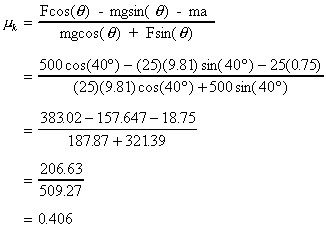
The kinetic coefficient of friction is 0.41 .
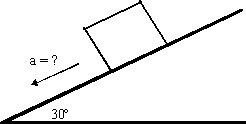
Since this problem deals with a force, friction, and we are asked about the acceleration, that suggests we should apply Newton's Second Law. To apply Newton's Second Law we draw a free-body diagram (FBD). Since the box has mass, it has weight. It is on the incline, so there is a normal. For a moving object, we must be dealing with kinetic friction. Kinetic friction opposes the motion, so it will point up the incline. Note that we should choose a set of axes such that one axis points along the acceleration as this simplifies our equations.
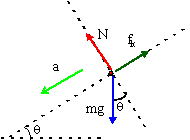 |
Next we break all the vectors into components:
N = i0 + jN, |
We apply Newton’s Second Law separately to the i and j components. Thus ΣFx = max yields
fk - mgsin(θ) = -ma
And ΣFy = may produces
N - mgcos(θ) = 0
Since we know fk = μkN, and the second equation says that N = mgcos(θ), we have fk = μkmgcos(θ). Substituting this into the first equation yields,
μkmgcos(θ) − mgsin(θ) = −ma .
Solving for a yields
a = gsin(θ) − μkmgcos(θ) = (9.81 m/s2)[sin(30°)-0.30cos(30°)] = 2.36 m/s2.
The box accelerates down the incline at 2.36 m/s2.
A 5.0-kg blog is on the a 20° incline. The coefficients of friction
between the block and incline are μs = 0.52 and μk
= 0.38.
(a) Does the block stay in place if the block is gently placed on the incline?
(b) If you gave the block a gentle nudge, would it slide down the incline?
(c) What must be the minimum angle θ of the incline if the block will
always slide down the incline and never stay in place?
To solve these questions, we will draw the free-body diagram of the block and apply Newton’s Laws. The block has mass, so weight mg acts straight down to the bottom of the page. The block is on a surface, so there is a normal force, N, perpendicular to the surface and through the block. Finally, there is friction if the block is to be stationary. It must be fs acting up the incline. Also since the block is stationary, a = 0.
Since the block is on an incline, the problem is simplified if we choose a tilted coordinate system. Also note that the weight mg makes an angle θ to the chosen vertical axis. This is all shown in the diagram below.
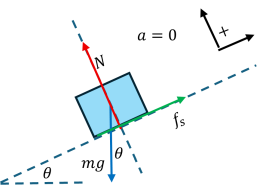
We next determine the equations in the x and y directions.
| N − mgcosθ = 0 | |
| fs − mgsinθ = 0 |
(a) To this question, we must evaluate and compare fs and fsmax = μsN. If fs < fsmax, the block does stay in place.
From the second equation fs = mgsinθ = (5.0)(9.81)sin20° = 16.776 N. And from the first equation, N = mgcosθ = (5.0)(9.81)cos20° = 49.05 N. From this fsmax = μsN = (0.52)(49.05) = 25.506 N. The block does stay in place.
(b) By nudging the block a little, we are allowing kinetic friction fk = μkN to act on the block. If fk > fs, the block would not move. The component of weight down the incline could not overpower fk. Evaluating fk = μkN = (0.38)(49.05) = 18.639 N. The block will not slide down the incline even with a nudge.
(c) As the angle θ increases, the second of our Newton’s Equation indicates that fs increases. But fs cannot exceed fsmax = μsN. If we replace fs with fsmax in the second equation, we should be able to find the critical angle at which the block would be about to slip.
| fsmax − mgsinθ = 0 | |
| μsN − mgsinθ = 0 | |
| μsmgcosθ − mgsinθ = 0 |
mg can be cancelled out of the last equation because it is a common factor. Recalling that tanθ = sinθ / cosθ, the last result can be written as tanθ = μs. We then find θ = arctan(μs) = arctan(0.52) = 27.5°.
A 10.0-kg block is on a tabletop. The coefficients of friction
between the block and tabletop are μs = 0.28 and μk
= 0.18. A string is strung over a massless pulley to a hanging mass of 2.0 kg. But
the hanging block is being held to keep everything motionless.
(a) Does the block on the tabletop move, if the hanging block is released?
(b) How much friction is acting on the block on the tabletop?
(c) What mass of hanging block is needed to just get the blocks to move?
(d) If there is a slight nudge given in (c), what is the acceleration of the blocks?
We start by drawing the free-body diagram of each block. Each block has mass, mg, acting straight down to the bottom of the page. Since the masses are different, we use subscripts to distinguish between them. The string exerts a tension T directed away from each block. The block on the tabletop experiences a Normal force, N, from the tabletop through the block.
We are being asked a what if question about the motion. The approach to take is to assume that there is a static friction, fs, acting to keep the sytem stationary. Friction must act to the left for this to be true. The diagrams are shown below.
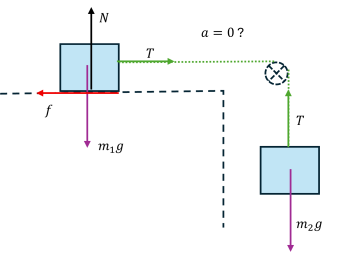
(a) To answer the question, we apply Newton's Law to the diagrams and examine the resulting equations. If the friction fs can equal the tension T without exceeding fsmax, there will be no motion.
The equations we find are:
| N − m1g = 0 | [1] |
| T − fs = 0 | [2] |
| T − m2g = 0 | [3] |
Equations [2] and [3] can be used to eliminate T to yield fs = m2g = (2.0)(9.81) = 19.62 N.
Equation [1] yields, N = m1g = (10.0)(9.81) = 98.1 N. Thus fsmax = μsN = (0.28)(98.1) = 27.468 N. So if the block is released gently, the system does not move.
(b) We found fs = 19.62 N.
(c) To just get the system to move, the hanging mass would need to make the frictional force on the tabletop block reach fsmax. That is:
| fs = m2g |
| fsmax = m2g |
| 27.468 = m2g |
Solving for m2 = (27.468)/(9.81) = 2.494 kg.
(d) The slight nuudge would switch the friction to kinetic friction, fk = μN = (0.18)(98.1) = 17.658 N and the equations would become:
| N − m1g = 0 | [4] |
| T − fk = m1a | [5] |
| T − m2g = −m2a | [6] |
Equation [6] yields T = m2g − m2a. This can then be substituted into equation [5] to yield
m2g − m2a − fk = m1a
This can be rearranged as
m2g − fk = (m1 + m2)a
Solving for a we get a = [m2g − fk]/(m1 + m2) = [(2.494)(9.81) - 17.658] / (10 + 2.494) = 0.545 m/s2.
A 10-kg block is hanging from a spring with spring constant K = 1000 N/m. The spring is attached to the ceiling of an elevator. The elevator is currently moving upwards at 10 m/s and slowing down at 1.0 m/s2. How much is the spring stretched?
The elevator is moving upwards but slowing so the acceleration points downwards.
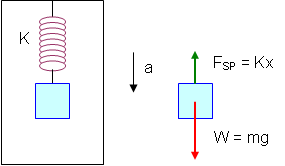
After drawing the free-body diagram, we apply Newton's Second Law and get kx − mg = −ma. Solving for x we find
x = m(g − a)/K = 10(9.81 − 1.0)/1000 = 0.088 m .
The spring is stretched 8.8 cm.
A 10-kg block is sitting on a vertical spring with spring constant K = 1000 N/m. The spring is attached to the floor of an elevator. The elevator is currently moving upwards at 10 m/s and slowing down at 1.0 m/s2. How much is the spring stretched or compressed? Indicate which.
The elevator is moving upwards but slowing so the acceleration points downwards.
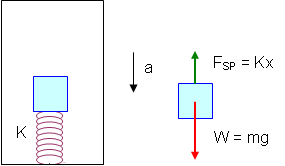
After drawing the free-body diagram, we apply Newton's Second Law and get kx − mg = −ma. Solving for x we find
x = m(g − a)/K = 10(9.81 − 1.0)/1000 = 0.088 m .
The spring is compressed 8.8 cm.
|
|
|
|
|
Questions? mike.coombes@kpu.ca
![[Return to Kwantlen Homepage]](http://www.kpu.ca/images/return_button.gif)