![[Return to Physics Homepage]](./../../physics.gif)
![[Return to Mike Coombes' Homepage]](./../../coombes.gif)
![[Return to List of Handouts]](./../../handouts.gif)
![[Return to Problem Sets]](./../../problems.gif)
![[Return to List of Solutions]](./../../solutions.gif)
Questions: 1 2 3 4 5 6 7 8 9 10 11 12 13

If the impulse is positive, the net area was above the curve and it is directed to the right, if negative to the left.
If the average force is positive it is directed to the right, if negative to the left. The impulse and force have the same direction.
![[Return to Top of Page]](./../../top.gif)

If the impulse is positive it is directed to the right, if negative to the left.
Momentum is defined by p = mv. Taking the direction
of motion as positive, your initial momentum was zero and your
final momentum is
Impulse is defined as the change in momentum
Average force is related to impulse by I = Faveraget,
so
This is the average force exerted on you and is in the same direction
as your motion.
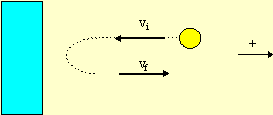
Momentum is defined by p = mv. Taking the right
as positive, the initial momentum of the ball is
The final momentum is
Impulse is defined as the change in momentum
Average force is related to impulse by I = Faveraget,
and the wall would exert this force on the ball to the right.
Therefore
The ball is in contact with the wall for approximately 13 milliseconds.
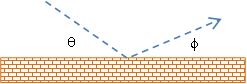
Working with vectors first,
pinitial = mvinitial = (0.25 kg)[i(15.0 m/s)cos(30°) − j(15.0 m/s)sin(30°)] = {i3.2476 − i1.875} N-s.
pfinal = mvfinal = (0.25 kg)[i(12.0 m/s)cos(20°) + j(12.0 m/s)sin(20°)] = {i2.8191 + i1.0261} N-s.
So I = {i2.8191 + i1.0261} N-s − {i3.2476 − i1.875} N-s = {−i0.4285 + i2.9011} N-s.
Working with the separate components
Ix = mvfx − mvix = (0.25) × (12cos20° − 15cos30°) = −0.4285 N-s
Iy = mvfy − mviy = (0.25) × (12sin20° − (−15sin30°)) = +2.9011 N-s
or I = −i0.4285 + j2.9011 N-s.
so Fave = (−i0.4285 + j2.9011 N-s) / (15 ms) = −i28.6 + j193.4 N.
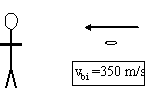
We have a totally inelastic collision, so momentum is conserved.
For this particular problem
Since we are told vpi = 0,
So the constable is knocked backwards at 0.50 m/s.
As is suggested by the word momentum in this question, this is
an explosion in which momentum is conserved.
Recall that momemtum is defined as p = mv. The above equation can be rewritten as
Momentum is a vector quantity so we will need to deal with either the vectors in ij notation or by components (i.e. doing the equation first in x and then in y).
Let's start with writing our vectors in ij notation.
Pman = mmanvman = (70 kg){−i(3 m/s)sin(25°) + i(3 m/s)cos(25°)} = (70){−i1.2679 + i2.7189} N-s = {−i88.750 + i190.325} N-s
Pwoman = mwomanvwoman = (55 kg){−i(3.25 m/s)cos(40°) − i(3.25 m/s)sin(40°)} = (55){−i2.4896 − i2.0892} N-s = {−i136.930 − i114.898} N-s
Thus we find
Dividing through by the mass of the sled, 7.50 kg, we find
This is vsled = 31.73 m/s at 18.48° South of East.
Next we solve by components. First we calculate the magnitude of the momentum of
the man and the woman, using p = mv:
Examining equation (1), we see that Psled
= -(Pman + Pwoman), so we need
to do a vector addition as shown in the diagram below.
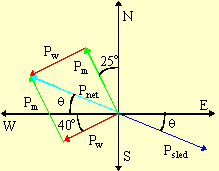
So we find Pnet by components
| Pman x | = -210sin(25°)
= -88.750 |
Pman y | = 210cos(25°)
= 190.325 |
| Pwoman x | = -178.75cos(40°)
= -136.930 |
Pwoman y | = -178.75sin(40°)
= -114.898 |
| Pnet x | = -225.68 | Pnet y | = 75.426 |
| Psled x | = +225.68 | Psled y | = -75.426 |
Using the Pythagorean formula,
Using trigonometry,
So the final momentum of the sled is 238 kg-m/s at 18.5°
south of east.
To find the final velocity of the sled recall that p = mv.
This is a vector equation, so p and v must point in the same
direction. The magnitude of the velocity of the sled is thus
So the velocity of the sled just after both people jump off the sled is 31.7 m/s at 18.5 south of east.
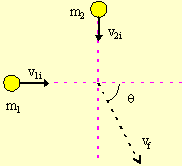
In any kind of collision, momentum is conserved so
Now momentum and velocity are vector quantities and the i and j components must be handled correctly. Either write the vector quantities in ij notation or consider the x components separately from the y components.
First solving using ij notation. Note that we have
p1v1 = (50 kg){i3 m/s} = i150 N-s, and
p2v2 = (70 kg){−j7 m/s} = −j490 N-s.
Thus (m1 + m2)vf = (120 kg)vf = {i150 − j490} N-s
Dividing through by the total mass we find, vf = {i1.25 − j4.0833} m/s
Using Pythagoras' Theorem and trigonometry vf = 4.27 at 72.98° South of East.
Now solving by considering the x and y components separately.
So we can rearrange these equations to find the components of
the final velocity
Using the given values, we find
To find the magnitude and direction of the final velocity, we use the Pythagorean Theorem and trigonometry,
The final velocity of the pair is 4.27 m/s at 73.0° south
of east.
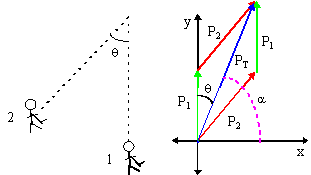
In any kind of collision, momentum is conserved so
Now momentum and velocity are vector quantities and the i and j components must be handled correctly. Either write the vector quantities in ij notation or consider the x components separately from the y components.
First solving using ij notation. Note that we have
p1v1 = (90 kg){j2.7 m/s} = j243 N-s, and
p2v2 = (82 kg){i3.1sin(32°) + j3.1cos(32°)} m/s = {i134.705 + j215.574} N-s.
Thus (m1 + m2)vf = (172 kg)vf = {i134.705 + j458.574} N-s
Dividing through by the total mass we find, vf = {i0.7832 + j2.6661} m/s
Using Pythagoras' Theorem and trigonometry vf = 2.78 m/s at 73.63° above the positive x axis.
Alternately, we work with the x and y components of our equation. First we calculate the magnitude of each player's momentum using
p = mv,
Then we find the total momentum PT by the component method,
| P1x | = 0 | P1y | = 243 |
| P2x | = 254.2sin(32°)
= 134.705 |
P2y | = 254.2cos(32°)
= 215.574 |
| PTx | = 134.705 | PTy | = 458.574 |
Using the Pythagorean formula we find,
Using trigonometry, we find the angle from
So the total momentum of the two players is PT = (478,73.6°).
Now PT = (m1 + m2)vf,
so the final velocity must be in the same direction as the total
momentum. The magnitude of the velocity is
So the final velocity of the two players just after the collision is vf = (2.78 m/s, 73.6°).
(a) In an elastic collision, both momentum and kinetic energy is conserved. Thus we have the equations;
| m1v1f + m2v2f = m1v1i + m2v2i , | (1) |
| v1f - v2f = -(v1i - v2i) . | (2) |
Since v2i = 0, the two equations can be combine to yield
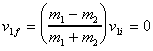
and

So after the collision, the first rock comes to a complete halt
and the second rock takes off with the velocity of the first rock
before the collision.
(b) In a totally inelastic collision, the two rocks stick together so that conservation of momentum becomes
since v2i = 0,
(c) We find the kinetic energy lost in the inelastic collision
by examining the energies just before and after the collision:
So the change in energy is E = Kf - Ki =
-18.4 J. Thus 18.4 J of energy was lost in the collision.
(a) In an elastic collision, both momentum and kinetic energy is conserved. Thus we have the equations;
| m1v1f + m2v2f = m1v1i + m2v2i , | (1) |
| v1f - v2f = -(v1i - v2i) . | (2) |
Since v2i = 0, the two equations can be combine to yield

and

So after the collision, the first rock moves backward at 0.40
m/s and the second rock takes off with a forward velocity of 1.60
m/s.
(b) In a totally inelastic collision, the two rocks stick together
so that conservation of momentum becomes
since v2i = 0,
(c) We find the kinetic energy lost in the inelastic collision
by examining the energies just before and after the collision:
So the change in energy is E = Kf - Ki =
-5.2 J. Thus 5.2 J of energy was lost in the collision.
(a) We have a totally inelastic collision, so
since vsled = 0,
(b) This portion of the question involves a force and a distance suggesting the use of Work-Energy methods.
Since there is friction, WNC = Wfriction
is not zero. We need a free body diagram to find fk.
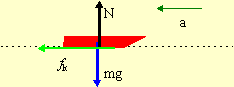
Using Newton's Second Law,
| Fx = max | Fy = may |
| -fk = -ma | N - mg = 0 |
The equation in the second column tells us that N = mg. Since
fk = μkN,
we have fk = μkmg.
So the work done by friction is
As well, we know that
Combing these two results yields,
Solving for μk
The coefficient of kinetic friction was 0.017.
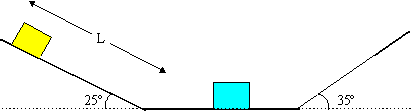
We have a change in height and speed in the first part of the
problem, so that suggests that we have a Work-Energy problem.
In the second part of the problem, there is a collision which
suggest that we use conservation of momentum. In the final portion,
there is a change in height and speed again, so this suggests
that we have a Work-Energy problem.
(i) Since there is no friction, WNC = 0. Hence Ef
= Ei or
The height h is related to L by h = Lsin(25°). Substituting
in this relation, and rearranging to get v by itself yields,
This is the velocity of the first block just before the collision.
This velocity will be the initial velocity for part (ii).
(ii) In an elastic collision, both momentum and kinetic energy is conserved. Thus we have the equations;
| m1v1f + m2v2f = m1v1i + m2v2i , | (1) |
| v1f - v2f = -(v1i - v2i) . | (2) |
Since v2i = 0, the two equations can be combine to yield

and

So the first block will bounce backwards and return up the incline
it came down. The second block will move up the incline on the
right.
(iii) Applying conservation of energy for the first block
Solving for L1, we find
Similarly, the second block moves up its incline a distance
So the first block moves 0.28 m up the left incline after the collision while the second block moves 0.82 m up the right incline.
Questions? mike.coombes@kpu.ca
![[Return to Kwantlen Homepage]](http://www.kpu.ca/images/return_button.gif)