![[Return to Physics Homepage]](./../../physics.gif)
![[Return to Mike Coombes' Homepage]](./../../coombes.gif)
![[Return to List of Handouts]](./../../handouts.gif)
![[Return to Problem Sets]](./../../problems.gif)
![[Return to List of Solutions]](./../../solutions.gif)
|
|
|
|
|
| Questions: | 1 | 2 | 3 | 4 | 5 | 6 | 7 | 8 | 9 | 10 | 11 | 12 | 13 | 14 | 15 | 16 | 17 | 18 | 19 |
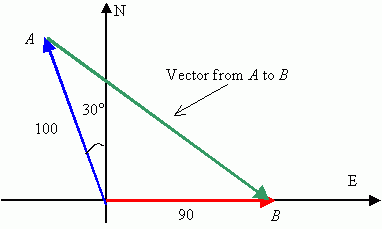
Since the velocities are constant the displacement and distance are equal in magnitude. The distance vehicle A travels is DA = 50 km/h × 2 h = 100 km. The distance vehicle B travels is DB = 45 km/h × 2 h = 90 km. Next we sketch the displacement vectors
Examining the sketch we can see that the vector from A to B is
DAB = i[100sin(30°) + 90] - j[100cos(30°)] = i[140] - j[86.60] .
Using the Pythagorean Theorem, the distance is
DAB = [(140)2 + (86.60)2]½ = 164.6 km.
The angle can be found using trigonometry,
θ = arctan(86.60/140) = 31.7° .
So the direction was 31.7° south of east.
![[Return to Top of Page]](../../top.gif)
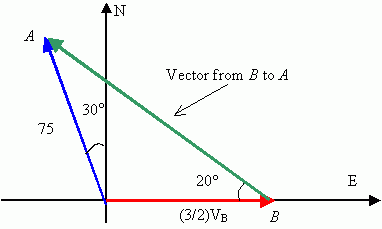
Examining the sketch we can see that the vector from A to B is
DAB = i[–190cos(20°)] + j[190sin(20°)] = i[–178.54] + j[64.98] .
At the same time the x component of DAB must also equal the x components of the other two vectors. That is
178.54 = (3/2)VB + 75sin(30°).
Solving for VB we find, VB = 94 km/h.
Since the velocities are constant the displacement and distance are equal in magnitude. The distance vehicle A travels is DA = VA × 1 h = VA. The distance vehicle B travels is DB = 50 km/h × 1 h = 50 km. Next we sketch the displacement vectors
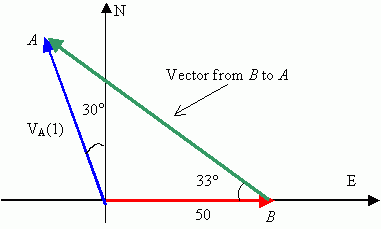
Examining the sketch we can see that the vector from A to B is
DAB = i[–95.4os(33°)] + j[95.4sin(33°)] = i[–80.01] + j[51.96] .
At the same time the y component of DAB must also equal the y component of DA. That is
51.96 = VAcos(30°).
Solvingfor VA we find, VA = 60 km/h.
The observer on the riverbank sees the combination of the boat's velocity relative to the water plus the velocity of the river relative to the shore where the observer is
vbank = vboat + vcurrent.
Thus we are dealing with a simple vector addition.
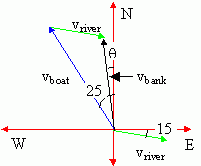
Our given vectors are
vboat = i[-25sin(25°)] + j[25cos(25°)] = i[-10.5655] + j[22.6577]
and
vcurrent = i[8cos(15°)] + j[-8sin(15°)] = i[7.7274] + j[-2.0706] .
Thus
vbank = i[-10.5655 + 7.7274] + j[22.6577 + -2.0706] = i[-2.8381] + j[20.5871]
Using the Pythagorean Theorem and trigonometry, vbank = [(-2.8381)2+(20.5871)2]½ = 20.8 km/h and θ = arctan(2.8381/20.5871) = 7.8°. So the velocity of the boat relative to the observer is 20.8 km/h at 7.8° west of north.
Radar gives the sum of the velocities of the ship and the current
vradar = vship + vcurrent ,
so to find the current we need
vcurrent = vradar - vship.
Thus to find the current we need to do a simple vector subtraction.
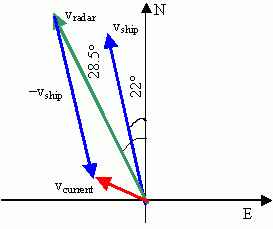
Our given vectors are
vradar = i[-13.2sin(28.5°)] + j[13.2cos(28.5°)] = i[-6.2985] + j[11.6004]
and
vship = i[-12sin(22°)] + j[12cos(22°)] = i[-4.4953] + j[11.1262] .
Thus
vcurrent = i[-6.2985 - -4.4953] + j[11.6004 - 11.1262] = i[-1.8032] + j[0.4742] .
We use the Pythagorean Theorem to get the magnitude,
vcurrent = [(-1.8032)2 + (-0.4742)2]½ = 1.86 knots.
The angle is θ = arctan(0.4272/1.8032) = 14.7°. And thus the direction is 14.7° north of east.
The airplane moves relative to the air but the air is moving. An observer on the ground sees the vector sum of the two velocities vground = vplane + vair. So we have a simple vector addition.
(a)
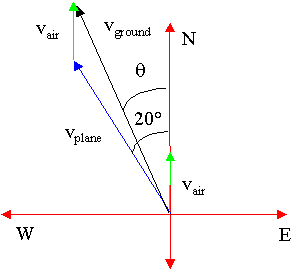
Our given vectors are
vplane = i[-420sin(20°)] + j[420cos(20°)] = i[-143.6] + j[394.7]
and
vair = i[0] + j[25] .
Thus
vground = i[-143.6 + 0] + j[394.7 + 25] = i[-143.6] + j[419.7] .
Using the Pythagorean Theorem and trigonometry, vPG = [(-143.6)2+(419.7)2]½ = 443.6 km/h and θ = arctan(143.6/419.7) = 18.9°. So the velocity of the plane relative to the ground is 444 km/h at 18.9° west of north.
(b)
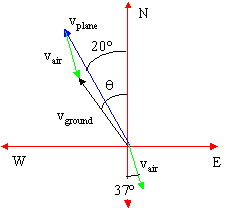
Our given vectors are
vplane = i[-420sin(20°)] + j[420cos(20°)] = i[-143.6] + j[394.7]
and
vair = i[0] + j[25] .
Thus
vground = i[-143.6 + 0] + j[394.7 + 25] = i[-143.6] + j[419.7] .
Using the Pythagorean Theorem and trigonometry, vPG = [(-143.6)2+(419.7)2]½ = 443.6 km/h and θ = arctan(143.6/419.7) = 18.9°. So the velocity of the plane relative to the ground is 444 km/h at 18.9° west of north.
Actual ground velocity is the velocity the people in the town would say the pilot had - not the 240 km/h that the pilot saw on her speedometer. Let's start with a sketch of the given information
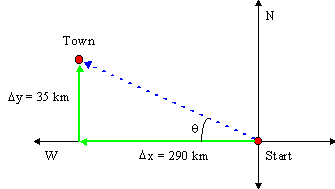
Since we can assume that the pilot's velocity is constant,
VGx = Δx / t = -290 km / 1 h = -290 km/h
VGy = Δy / t = 35 km / 1 h = 35 km/h
So the velocity of the plane is VG = i[-290] + j[35].
We convert to polar coordinate form:
VG = [(VGx)2 + (VGy)2]½ = [(-290)2 + (35)2]½ = 292.1 km/h
θ = arctan(VGy/VGx) = arctan(35/290) = 6.88°
So the velocity of the plane relative to the ground is 292.1 km/h at 6.88° north of west.
(b) Determine the magnitude and direction of the wind's velocity.
We have the plane's actual velocity to the ground and the plane's velocity relative to the air (the airspeed). Since they are different the air must have added to the motion of the plane, as sketched below.
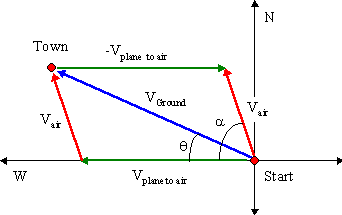
So we have a little vector subtraction problem, Vair = VG - VPA. We break our vectors into components as always and subtract. We already have VG and the problem tells us that she heads west at 240 km/h so VPA = i[-240] + j[0] . Thus we find
Vair = i[-290 - -240] + j[35 - 0] = i[-50] + j[35] .
We convert to polar coordinate form:
Vair = [(Vairx)2 + (Vairy)2]½ = [(-50)2 + (35)2]½ = 61.03 km/h
α = arctan(Vairy/Vairx) = arctan(35/50) = 34.99°
So the velocity of the plane relative to the ground is 61.0 km/h at 35.0° north of west.
The net velocity of the boat is vnet = i[2] + j[4]. Since the velocities are constant, the displacement of the boat is given by Δr = vnett = i[2t] + j[4t], where we don't know how long t it takes to get across. We can sketch the situation
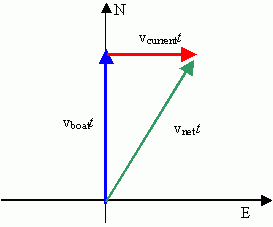
We can also express the landing spot as Δr = i[dunknown] + j[100]. But these two expressions must be equal, so 4t = 100 or it takes 25 seconds to cross and thus dunknown = 50 m.
Since the velocities are constant we are asking that the net displacement be Δrtotal = i[0] + j[100]. Since the velocities are constant, the displacement of the boat due to the water current is Δrcurrent = vcurrentt and the displacement of the boat by its own motion is Δrboat = vboatt where we don't know how long t it takes to get across. A moment's consideration would lead up to expect that the boat must head west of north to counteract the current. The diagram below shows the situation where the unknown angle is labelled θ.
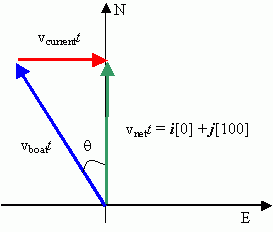
The next displacement is thus
Δrtotal = Δrboat + Δrcurrent = vboatt + vcurrentt = i[-4sin(θ)t + 2 t] + j[4cos(θ)t].
Comparing this expression for the given displacement the x components give us the equation -4sin(θ)t + 2t = 0. Solving for sin(θ) we find sin(θ) = ½ or θ = 30°. Using the y component information we find 4cos(θ)t = 100 or t = 100/(4cos(30°)) = 28.9 seconds.
Since the velocities are constant we are asking that the net displacement be Δrtotal = i[350] + j[0]. Since the velocities are constant, the displacement of the plane due to the wind current is Δrwind = vwindt = j[50t]. The displacement of the plane by its own motion is Δrplane = vplanet where we don't know how long t it takes to get to the town. A moment's consideration would lead up to expect that the plane must head south of east to counteract the wind. The diagram below shows the situation where the unknown angle is labelled θ.
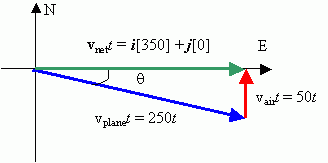
The next displacement is thus
Δrtotal = Δrplane + Δrair = vplanet + vairt = i[250cos(θ)t] + j[-250sin(θ)t + 50t].
Comparing this expression with the given displacement, the y components give us the equation -250sin(θ)t + 50t = 0. Solving for sin(θ) we find sin(θ) = 1/5 or q = 11.5°. Using the x component information we find 250cos(θ)t = 350 or t = 350/(250cos(30°)) = 1.43 hours.
Since the velocities are constant the displacements are ΔrA = vAt and ΔrB = vBt. A sketch of the situation, assuming that there is a collision, is shown below.
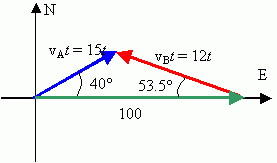
Careful examination leads us to expect a collision only if the y components of each are the same. Checking ΔrAy = 15sin(40°)t = 9.64t and ΔrBy = 12sin(53.5°)t = 9.65t which is close enough to suggest they will collide.
To find the time we know that x distance travelled is 100 km, or
15cos(40°)t + 12cos(53.5°)t = 100.
Solving for t yields, t = 5.37 hours.
The destroyer must be due east of the submarine when the torpedoes arrive or they will miss. Now the time that the travelling to that point, tD, is not the same as the time tT that the torpedo takes to get to the point of impact. Since the velocities are constant, the displacements are ΔrD = vDtD and ΔrT = vTtT. A sketch of the situation, assuming that there is a collision, is shown below.
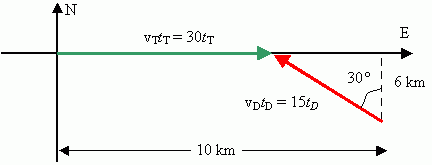
So first find out how long it takes the destroyer to travel 6 km north. From the sketch, 15tDcos(30°) = 6. So it will take tD = 0.4619 h for the destroyer to get to the right location. In the meantime it will have moved 15sin(30°) * 0.4619 h = 3.4642 km closer to the sub (i.e. they would be 6.5356 km apart). It takes a torpedo tT = 6.5356/30 = 0.2179 h to cross that distance. So it must fire the torpedoes 0.4619 - 0.21790 = 0.244 h = 14.6 minutes after spotting the destroyer.
A 2D kinematics problem is solved by considering it to be two 1D kinematics problems. To do this we consider the x and y components separately.
| x | y | ||
| v0x | = 30 cos(30°)
= 25.98 m/s |
v0y | = 30 sin(30°)
= 15.00 m/s |
| ax | =10 cos(45°)
= 7.071 m/s2 |
ay | =10 sin(45°)
= 7.071 m/s2 |
| t | = 5.00s | t | = 5.00s |
| Δx | = ? | Δy | = ? |
| vfx | = ? | vfy | = ? |
Considering the x information, we see that we can use the equation Δ x = v0t + ½at2 to find the displacement. Using the given data,
Δ x = (25.98)(5)+½(7.071)(5)2 = 218 m .
We can use the equation vf = v0 + at, to find the final x component of velocity,
vf =25.98 + (7.071)(5.00) = 61.34 m/s .
We do the exact same thing with the y information,
Δ y = (15)(5)+½(7.071)(5)2 = 163 m , and
vf =15.00 + (7.071)(5.00) = 50.36 m/s .
So the displacement is D = ( 218 m, 163 m). Converting back to polar form, we use the Pythagorean Theorem to get D = [(218)2+(163)2]½ = 274 m. The angle it makes is given by θ = arctan(163/218) = 36.8° . So in polar form, D = (274 m, 36.8° ).
Similarly, the final velocity vf = ( 61.34 m/s, 50.36 m/s). Converting back to polar form using the Pythagorean Theorem, gives vf = [(61.34)2+(50.36)2]½ = 79.4 m/s. The angle it makes is given by θ = arctan(50.36/61.34) = 39.4° . So in polar form, vf = (79.4 m/s, 39.4° ).
A 2D kinematics problem is solved by considering it to be two 1D kinematics problems. To do this we consider the x and y components separately.
| x | y | ||
| v0x | = 15 cos(22°)
= 13.908 m/s |
v0y | = 15 sin(22°)
= 5.619 m/s |
| vfx | = 25 cos(42°)
= 18.579 m/s |
vfy | = 25 sin(42°)
= 16.728 m/s |
| t | = 15 s | t | = 15 s |
| Δx | = ? | Δy | = ? |
| ax | = ? | ay | = ? |
Considering the x information, we see that we can use the equation Δ x = ½(v0 + vf)t to find the displacement. Using the given data,
Δ x = ½(13.908 + 18.579)(15) = 243.7 m .
We can use the equation vf = v0 + at, to find the x component of the acceleration,
ax = (vf – v0)/t = (18.579 – 13.908)/15 = 0.3114 m/s2 .
We do the exact same thing with the y information,
Δ y = ½(16.728 + 5.619)(15) = 167.6 m , and
ay = (16.728 – 5.619)/15 = 0.7406 m/s2 .
So the displacement is D = ( 243.7 m, 167.6 m). Converting back to polar form, we use the Pythagorean Theorem to get D = [(243.7)2+(167.6)2]½ = 296 m. The angle it makes is given by θ = arctan(167.6/243.7) = 34.5° . So in polar form, D = (296 m, 34.5° ).
Similarly, the acceleration is a = ( 0.3114 m/s2, 0.7406 m/s2). Converting back to polar form using the Pythagorean Theorem, gives a = [(0.3114)2+(0.7406)2]½ = 0.803 m/s2. The angle it makes is given by θ = arctan(0.7406/0.3114) = 67.2° . So in polar form, a = (0.803 m/s2, 67.2° ).
We will start with a sketch of the problem.
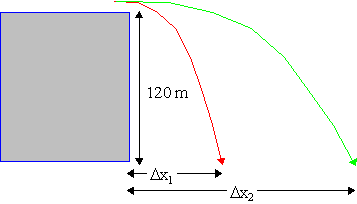
A 2D kinematics problem is solved by considering it to be two 1D kinematics problems. To do this we consider the x and y components for each boy separately. The fact that the boys throw the rocks horizontally tell us that the initial y component of velocity is zero. We are told that Δ x2 = 4Δ x1 = 60 m. As well since we are given the height of the cliff Δ y1 = Δ y2 = –120 m. For projectiles, ax = 0 and a = 0 and ay = –g.
| puny boy | muscular boy | |||||||
| x | y | x | y | |||||
| vP0x | = ? | vP0y | = 0 | vM0x | = v2 | v0y | = 0 | |
| vPfx | = ? | vPfy | = ? | vMx | = ? | vfy | = ? | |
| ax | = 0 | ay | = –g | ax | = 0 | ay | = –g | |
| Δx1 | = 15 m | Δy | = –120 m | Δx2 | = 60 m | Δ y | = –120 m | |
| t1 | t2 | |||||||
Examining the y columns, we see that we have enough information to use the equation Δ y = v0yt – ½gt2. Notice that the y information is the same for both boys, so the time in the are will be identical. Since v0y = 0, we get
t = [2Δ y/g]½ = [2(–120)/(–9.91)]½ = <± 4.95 s.
We want the forward in time or positive solution, so both rocks are in the air for 4.95 s.
Now that we have the time, we have enough information to find v0x for each boy using Δ x = v0xt+ ½axt2. Since ax = 0,
vP0x = Δ x1 / t = (15 m)/(4.95 s) = 3.03 m/s,
vM0x = Δ x2 / t = (60 m)/(4.95 s) = 12.12 m/s.
So the muscular boy throws the rock four times as fast as the puny boy.
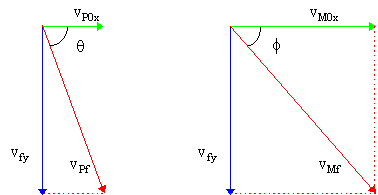
To find vf we need to find the components of the final velocity, vfx and vfy, first. Since ax = 0, vPfx = vP0x = 3.03 m/s and vMfx = vM0x = 12.12 m/s. We can use vfy = v0y + ayt to determine the y components. Since v0y = 0 and ay = –g in both cases,
vMfy = vPfy = –(9.81)(4.95) = –48.52 m/s .
We can use the Pythagorean Theorem and trigonometry to find vf in each case.
| puny boy | muscular boy | ||
| vPf | = [(3.03)2+(–48.52)2]½
= 48.6 m/s |
vPf |
= [(12.12)2+(–48.52)2]½
= 50.0 m/s |
| θ | = arctan(48.52/3.03)
= 86.4° |
φ | = arctan(48.52/12.12)
= 75.9° |
So the final velocity of the puny boy’s rock is 48.6 m/s at 86.4° below the horizontal, while the muscular boys rock has a final velocity of 50.0 m/s at 75.9° below horizontal.
First we sketch the situation and possible outcomes.
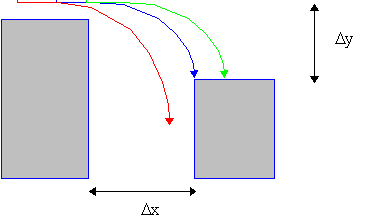
While you are jumping, you are a projectile. We solve projectile motion problems by considering the x and y components separately, keeping in mind that the time in air is common. We write out the i and j information in separate columns including the information that we can infer or that we are supposed to know like the fact that running horizontally implies that voy = 0..
| i | j | ||
| Δxsafe = 6.50 m | Δysafe = –3.00 m | minus indicates down | |
| ax = 0 | No x component for projectiles | ay = –g = –9.81 m/s2 | gravity acts down |
| v0x = 8.10 m/s | v0y = 0 m/s | horizontal takeoff means no vertical component | |
| tair = ? | common | tair = ? | |
Looking at the x information, we see that we have enough data to find tair. The kinematics equation that has all four quantities is Δx = v0xt + ½axt2. Since ax = 0 for a projectile, this equation becomes Δx = v0xt. Solving for t, we get
t = Δx / v0x = (6.50 m) / (8.10 m/s) = 0.8025 s .
This is the time it would take you to cross a horizontal distance of 6.50 m. You must be in the air for at least this long if you are to safely make it across to the next building.
On the other hand, looking at the y information, we see that we also have enough data to find tair. The kinematics equation that has all four quantities is Δy = v0yt + ½ayt2. We know v0y = 0 since you ran off the roof horizontally, and since ay = –g, this equation becomes Δy = –½gt2. Solving for t, we get
t = { –2Δy / g }½ = {(–2×–3.00 m) / (–9.81 m/s) }½ = 0.7821 s .
This is the time it takes you to fall a vertical distance of 3.00 m. If you do reach the other building, then this is how long you were in the air.
Since the time it takes to cross the horizontal distance is less than the time you have, you have don’t make it across.
To make it across safely you of course would need to run off the roof faster. Since ax = 0 for projectiles, this equation become Δx = v0xt where t is now the 0.7821 s. Solving for v0x, we get ,
v0x = Δx / t = (6.50 m) / (0.7821 s) = 8.31 m/s .
If you were able to run at 8.31 m/s you would safely make it to the other building.
A good sketch helps us to understand the problem.
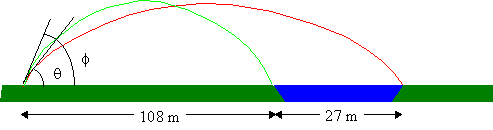
We see that if the angle is between θ and φ , the golfball lands in the pond.
We will consider this problem as two separate level–to–level projectile problems.
| short | long | ||
| x | y | x | y |
| v0x = v0cosθ | v0y = v0sinθ | v0x = v0cosφ | v0y = v0sinφ |
| Δx = 108 m | Δy = 0 | Δx = 108+27 m = 135 m | Δy = 0 |
| ax = 0 | ay = –g | ax = 0 | ay = –g |
| t = ? | t = ? | ||
Considering the golfball that lands just short of the pool, we see we have two unknowns θ and t. We will need to write an equation for each column and solve the two equations together;
Δx = (v0cosθ )t , (1)
0 = (v0sinθ )t – ½gt2. (2)
In equation (2), we can divide by t, so the equation simplifies to
t = (2v0sinθ )/g .
This can be substituted into equation (1) and we get
Δx = 2(v0)2cosθ sinθ /g. (3)
This is difficult to solve unless we recall the identity
2 cosθ sinθ = sin(2θ ) .
Using the identity, equation (3) becomes
sin(2θ ) = gΔx/(v0)2. (4)
So inverting the (4) yields
θ = ½arcsin[gΔx/(v0)2].
For Δx = 108 m, this yields θ = ½(41.47° ) = 20.7° but this is not the only answer since the arcsine functions give multiple solutions. There are is another positive solutions θ = ½[180° – 41.47° ] = 69.3° . Note that the first and second solution add to 90° . So the golfer can hit the ball at either 20.7° or 69.3° and just avoid the pool.
For the long shot, our calculations are identical. For Δx = 135 m, φ = 27.9° or 62.1° . So the golfer can hit the ball at either 27.9° or 62.1° and have it land just beyond the pool.
So avoid the watertrap, the angles to avoid are 20.7° < α < 27.9° and 62.1° < β < 69.3° .
First we sketch the situation and possible outcomes.
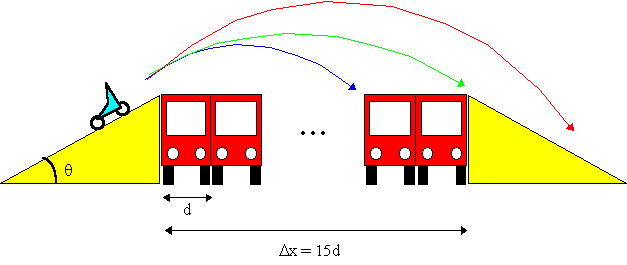
While the motorcyclist is jumping, she is a projectile. We solve projectile motion problems by considering the x and y components separately, keeping in mind that the time in air is common. We write out the i and j information in separate columns including the information that we can infer or that we are supposed to know. We see from the sketch that if the motorcyclist is successful, then this is an example of level–to–level flight and Δ y = 0. Note that the initial velocity is broken into components.
| i | j | ||
| Δxsafe = 15×2.50 m
= 37.5 m |
Δysafe = 0 | level to level flight | |
| ax = 0 | No x component for projectiles | ay = –g = –9.81 m/s2 | gravity acts down |
| v0x = v0 cosθ | v0 is unknown | v0y = v0sinθ | |
| tair = ? | common | tair = ? | common |
Looking at the x and y information, we see that we have two unknowns, v0 and t, for both. While we cannot solve any equation for x or y since there are two unknowns, both can be solved together. The appropriate kinematics equation that has all four quantities for x and for y is:
Δx = v0xt + ½axt2, and Δy = v0yt + ½ayt2.
We substitute in known quantities to get
Δx = v0 cosθ t (1),
and
0 = v0 sinθ t – ½gt2 (2).
We can divide equation (2) by t and we get
v0 sinθ = ½gt.
We rewrite the first equation (1) as t = Δx / v0 cosθ , which we substitute into the second equation to get v0 sinθ = ½g[Δx / v0 cosθ]. Getting v0 by itself, we have v0 = {gΔx/(2sinθ cosθ)}½. Plugging in the appropriate numbers, we get v0 = 20.61 m/s = 74.2 km/h. This is the speed that the motorcyclist must have on liftoff to successfully reach the other ramp.
We can substitute this value into t = Δx / v0 cosθ to find the time in air to be 2.10 s.
A 2D kinematics problem is solved by considering it to be two 1D kinematics problems. To do this we consider the x and y components separately.
| x | y | ||
| v0x | = v0 | v0y | = 0 (horizontal flight) |
| ax | = 0 | ay | = –g = –9.81 m/s2 |
| t | = ? | t | = ? |
| Δx | = +1.30 m | Δy | = –0.95 m (note sign!) |
| vfx | = ? | vfy | = ? |
Considering the y information, we see that we can use the equation Δy = v0t + ½at2 to find the time in air. Using the given data,
–0.95 m = (0) + ½(–9.81 m/s2)(t)2 .
From this we find that t = 0.4401 s.
We can use the equation Δx = v0xt + ½axt2, to find the initial x component of velocity,
+1.3 m = v0xt + ½(0)(t)2 .
thus
v0x = 1.3 m / 0.4401 s = 2.95 m/s .
the can leaves the countertop at 2.95 m/s.
|
|
|
|
|
Questions? mike.coombes@kpu.ca
![[Return to Kwantlen Homepage]](http://www.kpu.ca/images/return_button.gif)