![[Return to Physics Homepage]](../physics.gif)
![[Return to Mike Coombes' Homepage]](../coombes.gif)
![[Return to List of Handouts]](../handouts.gif)
![[Return to Sample Tests]](../tests.gif)
|
Physics 1100
|
Test #4
|
March 2002
|
Use methods shown in class. Show all work.
- A physics instructor drops a 75-g ball from a height of 1.50 m. It collides with the floor and bounces back
to a height of 1.25 m.
(a)What is the velocity of the ball just before it hits the floor?
(b)What is the velocity of the ball just after it leaves the floor on its way up to 1.25 m?
(c)If the impact with the floor lasted 0.015 seconds, what was the average force
acting on the ball?
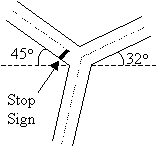
- A 1200-kg car travelling at 60 km/h misses a stop
sign and enters the intersection in the diagram below. In the
intersection, a 2200-kg SUV
travelling at 75 km/h smashes into and, becomes entangled with, the
car. Find the magnitude and direction velocity of
the two vehicles just after the collision. Why isn’t this exactly
a free collision? How much energy is lost in the collision? Where did
the majority of the energy go?
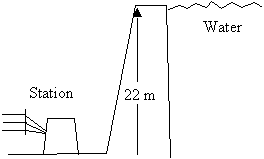
- A 22-m tall dam is built to supply a 5.00 MW power
station as shown in the diagram below.
(a) What is the minimum amount of water that passes through the power station each second if
the station is generating 5.00 MW?
(b) How much water is that every day?
(c) The power station’s generators are not 100% efficient in extracting energy from the
falling water. Only about 30% of the energy is converted to electrical energy.
How much water is needed to generate 5.00 MW in this case?
Some Useful Formulas
 |
 |
 |
 |
 |
 |
 |
 |
sin(2θ) = 2sin(θ)cos(θ) |
 |
 |
 |
 |
 |
 |
 |
 |
 |
G = 6.672 × 10⁻¹¹ N-m2/kg2 |
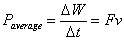
| W=FLcos(θ) |
K=½mv2 |
U = mgh |
| Wnc = Ef – Ei |
E = K + U |
 |
 |
|
 |
 |
|
 |
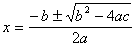
Quadratic Equation
Given the formula
 ,
the solutions are
,
the solutions are
Questions?
mike.coombes@kpu.ca
![[Return to Kwantlen Homepage]](http://www.kpu.ca/images/return_button.gif)