![[Return to Physics Homepage]](../physics.gif)
![[Return to Mike Coombes' Homepage]](../coombes.gif)
![[Return to List of Handouts]](../handouts.gif)
![[Return to Sample Tests]](../tests.gif)
|
Physics 1100
|
Test #3
|
March 2002
|
Use methods shown in class. Show all work.
- The U.S.S. Voyager is in circular orbit around a Class M
planet. Ensign Kim reports to Captain
Janeway that the planet has a radius of 5840 km, that the Voyager is 3000 km
from the surface of the planet, and that it takes Voyager 3 hours and 16
minutes to make one orbit of the planet.
He further reports that the planet has one moon whose centre is 3.50 ×
105 km from the centre of the planet. The orbit of the moon is circular.
(a) What is the mass of the planet?
(b) What is the acceleration due to gravity on the surface of the planet?
(c) How long does it take the moon to complete one orbit?
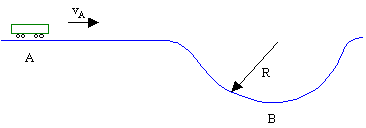
- A rollercoaster filled with people is moving with speed vA at point A
on a flat part of the track. Ahead is a
circular depression in the track of radius R = 15.0 m. How fast does vA have to be so
that the people feels four times as heavy as normal at point B at the very
bottom of the depression? Ignore
friction and air resistance.
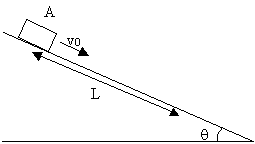
- A block is sliding down a long incline incline.
At point A it has a velocity of v0 = 5 m/s. How much further, L, will it slide down the
incline until it comes to a complete stop?
The coefficients of friction between the block and the incline are μS
= 0.65 and μK = 0.40. The incline makes an angle of
18.0° to the horizontal. Hint the distance the block slides down the incline is related to
the height it drops.
Some Useful Formulas
 |
 |
 |
 |
 |
 |
 |
 |
sin(2θ) = 2sin(θ)cos(θ) |
 |
 |
 |
 |
 |
 |
 |
 |
 |
G = 6.672 × 10⁻¹¹ N-m2/kg2 |
| W=FLcos(θ) |
K=½mv2 |
U = mgh |
| Wnc = Ef – Ei |
E = K + U |
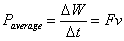 |
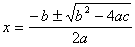
Quadratic Equation
Given the formula
 ,
the solutions are
,
the solutions are
Questions?
mike.coombes@kpu.ca
![[Return to Kwantlen Homepage]](http://www.kpu.ca/images/return_button.gif)