![[Return to Physics Homepage]](../physics.gif)
![[Return to Mike Coombes' Homepage]](../coombes.gif)
![[Return to List of Handouts]](../handouts.gif)
![[Return to Sample Tests]](../tests.gif)
Final Examination
PHYSICS 1100
23 April 2002
One 8½ × 11 sheet containing formulas is allowed.
Formula sheet and examination paper must be submitted with examination.
Time to do the test is three hours maximum.
If you have any questions, raise your hand and remain seated.
Please start each question on a new page in your booklet.
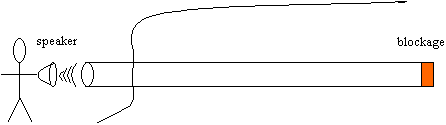
- When sewer pipes are blocked, city
engineers often use the following trick to find where the blockage has
occurred. They go to an unblocked end
as shown below and play a pure single frequency tone into the open end.
They change the frequency until they find
the lowest frequency that causes a resonance or standing wave.
In this particular case they find that f =
4.95 Hz. The speed of sound in air is
340 m/s.
(a) What is the distance to the blockage?
(b) Sketch the standing wave.
(c) What is the next highest frequency that produces a standing wave?
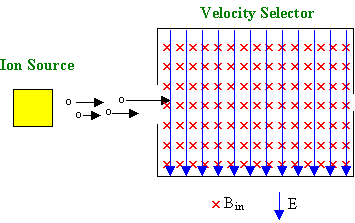
- The diagram below shows a Velocity
Selector used to allow only charged particles with a desired velocity to
pass though. The velocity selector consists of a magnetic field B and an
electric field E at right angles to one another.
At one end is a hole that allows charged particles with various
speeds to enter. At the other end is a
small hole to let out particles that have not changed velocity.
The charged particles have very little mass.
(a) Sketch the path that a negative charge
would take if its speed is too large.
(b) Sketch the path that a negative charge
would take if its speed is too small.
(c) Sketch the path that a positive charge
would take if its speed is too large.
(d) Sketch the path that a positive charge
would take if its speed is too small.
(e) If B = 0.200 T and E = 1200 N/C, what is
the velocity that a negative charge must have to pass through both holes?
(f) If B = 0.200 T and E = 1200 N/C, what
is the velocity that a positive charge must have to pass through both holes?
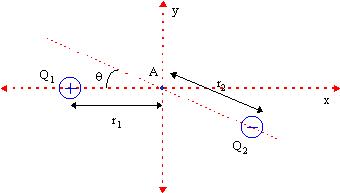
- (a) Find the x and y components of the net electric field at point A.
We know that Q1 = 5.0 μC, Q2 = –3.0 μC, r1
= 0.20 m, r2 = 0.15 m, and θ = 30.0°.
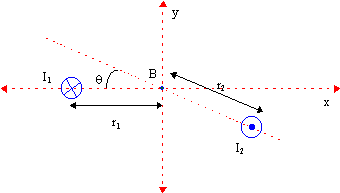
(b) Find the x and y components of the net magnetic field at point B.
We know that I1 = 5.0 A into the
paper, I2 = 3.0 A out of the paper, r1 = 0.20 m, r2
= 0.15 m, and θ = 30.0°.
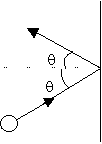
- During a hockey
game, a puck is shot across the ice and deflects off the boards as shown in the
diagram below. The angle of incidence is the same as the angle of reflection
and equals θ = 27º. The speed of the puck just before and after the collision is 80
km/h. The puck is in contact with the boards for 0.0015 s. The puck has a mass
of 0.330 kg. Find the magnitude and
direction of the average force acting on the puck during the collision.
- A person places an object 40 cm from a
converging lens that has a focal length of 30 cm.
Where will the image form? Characterize the final image.
The person moves the lens around (not
the object) and discovers that he can find another position for the lens that
produces an image which is the same distance from the object as before
although the image is a different size.
How far is the object from the lens in this case?
Characterize the final image.
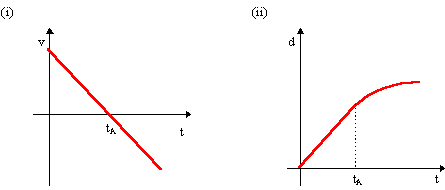
- (a) Diagram (i) below presents the velocity versus time graph of a particle.
Sketch the corresponding position versus
time graph. Indicate tA on
your sketch.
(b) Diagram (ii) below presents the position versus time graph of a
particle. Sketch the corresponding
velocity versus time graph. Indicate tA
on your sketch.
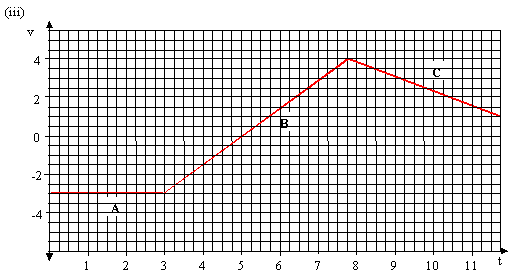
(c) Diagram (iii) below presents the velocity versus time graph of a
particle. When does the particle turn around? Explain.
(d) In Diagram (iii), what is the average velocity in Segment B?
(e) In Diagram (iii), what is the displacement between t = 2.0 s and t =
6.0 s?
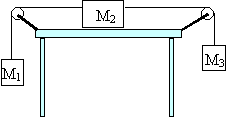
- Three blocks are connected by strings as shown in the diagram below. The
blocks have mass μ1 = 0.200 kg, μ2 = 1.000 kg,
and μ3
= 0.400 kg. The coefficients of friction between the middle block and the table
are μs = 0.25 and μk = 0.15. Find the acceleration of the blocks.
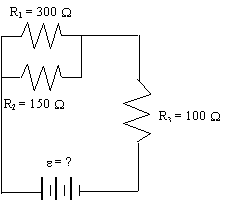
- A student is
working with the circuit shown in the diagram below.
She uses an ammeter and finds that the current through the branch
with the 300-Ω resistor to be I = 0.050 A.
(a) What is the voltage drop across the 300-Ω resistor?
(b) What is the voltage drop across the 150-Ω resistor?
(c) What is the current through the 150-Ω resistor?
(d) What is the current through the 100-Ω resistor?
(e) What is the voltage drop across the 100-Ω resistor?
(f) What is the emf of the battery?
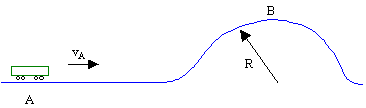
- A rollercoaster filled with people is
moving with speed vA at point A on a flat part of the track.
Ahead is a circular hill on the track of
radius R = 25.0 m. At point B, at the very top of the hill, the people feel
one-third as heavy as normal. How fast does vA have to be for that
to have happened? Ignore friction and
air resistance.
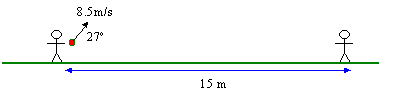
- Two boys are playing catch. Initially
the boys are 15.0 m apart. The first boy makes a weak pitch at a velocity of v
= 8.50 m/s at an angle of 27º. The other boy starts running at constant speed
as soon as the other boy throws the ball. How fast must the second boy run in
order to catch the ball? Assume he catches the ball at the same height it left
the first boy.
Useful Formulas
 |
 |
 |
 |
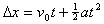 |
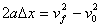 |
 |
 |
sin(2θ) = 2sin(θ)cos(θ) |
 |
 |
 |
 |
 |
 |
 |
 |
 |
G = 6.672 × 10⁻¹¹ N-m2/kg2 |
| W=FLcos(θ) |
K=½mv2 |
U = mgh |
| Wnc = Ef – Ei |
E = K + U |
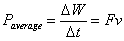 |
 |
|
 |
 |
|
 |
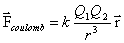 |
|
 |
 |
|
k = 8.99 × 10⁹ N-m2/C2 |
| V=IR |
|
P= IV |
 |
|
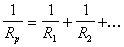 |
| F = qvBsin(φ) |
r = mv/qB |
½mv2 = qΔV |
| F = ILBsin(φ) |
 |
μ0 =
4π × 10 -7 T-m/A |
 |
 |
 |
If string is fixed at both ends, or air column is open at both ends,
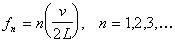 |
If string or air column has one open end and one fixed end,
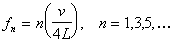 |
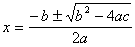
Quadratic Equation
Given the formula
 ,
the solutions are
,
the solutions are
Questions?
mike.coombes@kwantlen.ca
![[Return to Kwantlen Homepage]](http://www.kpu.ca/images/return_button.gif)