![[Return to Physics Homepage]](../physics.gif)
![[Return to Mike Coombes' Homepage]](../coombes.gif)
![[Return to List of Handouts]](../handouts.gif)
![[Return to Sample Tests]](../tests.gif)
Test #1
PHYSICS 1100
3 October 1997
- [1 Mark] You are given a position versus time
graph. What physical quantity is given by the slope of a line
tangent to the curve at time t?
- [1 Mark] You are given a velocity versus time
graph. What physical quantity is given by the slope of a line
tangent to the curve at time t?
- [2 Marks] When would v = 0 for a object in one
dimension? Give examples.
- [2 Marks] If an object, moving in a straight line,
has a negative velocity and its speed is decreasing, what is the
sign of its acceleration? Explain.
- [2 Marks] A rifle fires a bullet horizontally
over level ground. At the same instant that the bullet leaves
the gun, a second bullet is dropped from the same height as the
muzzle of the gun. Which is correct: (i) the bullet from the
gun will hit the ground first, or (ii) the dropped bullet will
hit the ground first, or (iii) both bullets hit the ground at
the same time? Explain.
- [2 Marks] A person springs off a trampoline and
bounce 2.0 m up into the air. At the top of the jump, he has
zero velocity. Is he accelerating at that point? Explain.
- [2 Marks] A ball is thrown into the air. On
its way up and on its way down it passes point H. How does the
velocity of the ball compare in these two cases? Explain.

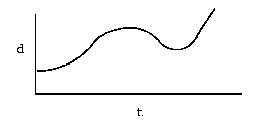
- [2 Marks] In the d versus t graph below, is the
velocity ever negative? Explain.
- [2 Marks] Is it possible for an object to have
zero velocity but nonzero acceleration? Explain with examples
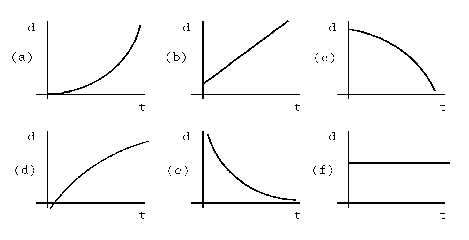
- [6 Marks] For the following position versus time
graphs, state whether a > 0, a < 0, or a = 0.
- [10 Marks] A plane can fly with a speed of 150
km/h relative to the air. On a windy day, with a wind of 35 km/h
due east, the pilot wants to fly to an airfield which is due North
of his present location.
(a) In what direction should the pilot point the
plane to fly directly to his destination?
(b) What will be the plane's speed over the ground?
(c) If the airfield is 250 km away, how long will
it take the pilot to get there?
- [10 Marks] A person leans over a balcony railing
and throws a ball straight upwards at a speed of 7.00 m/s. The
ball eventually hits the ground 5.00 m below the height at which
it was thrown.
(a) Find the height of the ball 0.90 s after its
leaves the person's hand.
(b) Find the time the ball is in the air until
it hits the ground.
(c) Find the velocity of the ball just before it
hits the ground.
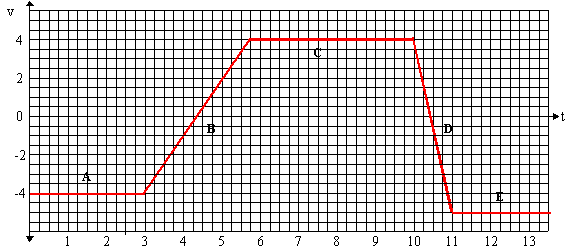
- The diagram below represents the velocity (v
in m/s) as a function of time (t in seconds) of a ball moving
in a straight line.
(a) For each of the segments, find the average velocity
in that segment.
(b) For each of the segments, find the acceleration
in that segment.
(c) For each of the segments, find displacement
in each segment.
(c) Does the ball ever turn around? If so when?
Formulas
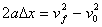
Kinematics
 |
 |
vaverage = ½(vf+v0) |
| Δx = vaveraget |
Δx = v0t + ½at2 |
v = v0 + at |
 |
 |
g = 9.81 m/s2 |
Newton's Laws
| ΣFx = max |
ΣFy = may |
fmax static = μsN |
fkinetic = μkN |
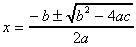
Quadratic Formula
if ax2+bx+c = 0, then
Questions?
mike.coombes@kpu.ca
![[Return to Kwantlen Homepage]](http://www.kpu.ca/images/return_button.gif)