![[Return to Physics Homepage]](../physics.gif)
![[Return to Mike Coombes' Homepage]](../coombes.gif)
![[Return to List of Handouts]](../handouts.gif)
![[Return to Sample Tests]](../tests.gif)
Final Examination
PHYSICS 1100
16 December 1997
- An object is placed 48.0 cm from a converging lens which has
a focal length of 30.0 cm.
(a) Characterize the image formed. Include where the image is,
whether it is real or virtual, erect or inverted, and its magnification.
(b) Neatly and accurately, provide a sketch of the image using
the Principle Ray Technique.
(c) Draw an eye on your drawing to indicate where an observer
would have to be to see the image.
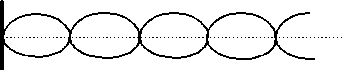
- (a) A string of mass 32.0 g, length 3.15 m, and under a tension
of 12.0 N, has the standing wave pattern shown in the diagram
below.
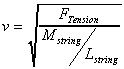
(i) What is the speed of a wave on this string?
(ii) What is the frequency of vibration that produced this wave?
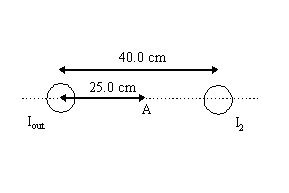
(b) The diagram below shows an end-on view of two wires which
are 40.0 cm apart. The wire on the left carries a current Iout
= 2.15 Amps out of the page. What would have to be the direction
and magnitude of I2 for the net magnetic field at point
A to be zero. Point A is 15.0 cm from the wire on the left.
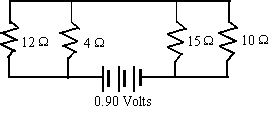
- Find the equivalent resistance of the circuit below. Find
the current, potential drop, and power through each resistor.
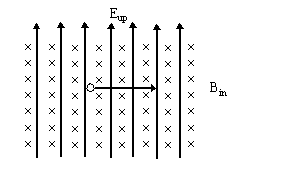
- A particle of mass m = 75.0 g and charge q = 60.0 μC is moving
through a box at a speed of v = 2400 m/s. In the box is an electric
field Eup = 5000 N/C and an unknown magnetic field
Bin. If the acceleration of the charge is zero, what
is Bin?
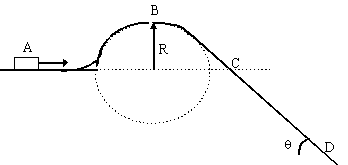
- At point A, in the diagram below, a block has a velocity of
5.00 m/s. Between points A and C, the surface is frictionless
but from point C to D the coefficient of friction is
μk
= 0.71. The last part of the hill is straight and makes an angle
θ = 15.0° with the horizontal.
(a) It is known at point B that the apparent weight of the block
is only 7/8th of its true weight. What is the radius
of curvature, R, of the hill? Hint - consider the energies of
points A and B.
(b) The block comes to a complete stop at point D. How long is
the path from C to D? Hint - consider the energies of points A
and D.
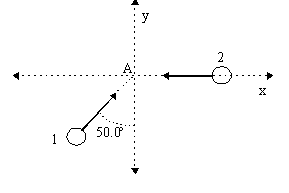
- Two blocks undergo a totally inelastic collision at point A
on a frictionless surface. Block 1 has a mass of 22.0 kg and
a speed of 12.2 m/s directed as shown. Block 2 has a mass of
17.0 kg and a speed of 13.7 m/s.
(a) What is the velocity of the blocks after the collision?
(b) How much kinetic energy is lost in the collision?
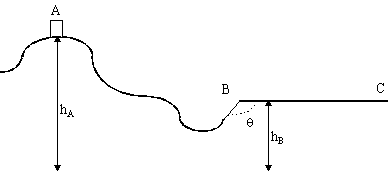
- A block slides from rest at point A over a frictionless surface
to point B where it is launched into the air. It later lands
at point C. The heights in the diagram are hA = 2.75
m and hB = 1.15 m. The given angle is
θ = 125.0°.
(a) How fast is the block moving at point B?
(b) How far is point C from point B?
(c) How long is the block in air?
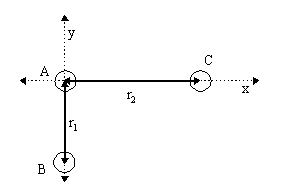
- The small asteroids are arranged in outer space as shown in
the diagram below. The masses of the asteroids are mA
= 1.25 × 10¹⁰ kg, mB
= 1.78 × 10¹⁰ kg, and mC
= 3.56 × 10¹⁰ kg. The separation
of the asteroids is given by r1 = 2500 m and r2
= 4250 m. The asteroids also have charge QA = 0.300
C, QB = 0.700 C, and QC = 1.400 C . Find
the magnitude and direction of the acceleration of asteroid A
at the instant shown below.
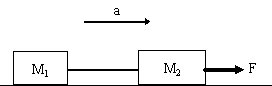
- Two blocks of mass M1 = 5.00 kg and M2
= 7.50 kg and on a surface where the coefficient of kinetic friction
is μ = 0.30 .
The second block is being pulled by a force F =
75 N. Both blocks have the same acceleration.
(a) Find the magnitude of the acceleration.
(b) Find the tension in the string connecting the blocks.
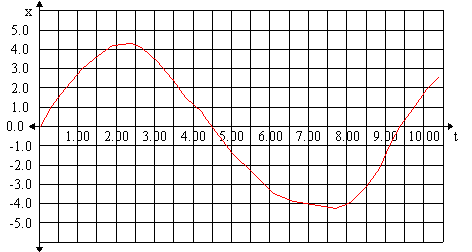
- (a) The graph below shows the position versus time curve for
a moving block.
(i) At what time(s) is the velocity of the block zero?
(ii) What is the instantaneous velocity of the block at t = 3.50
s?
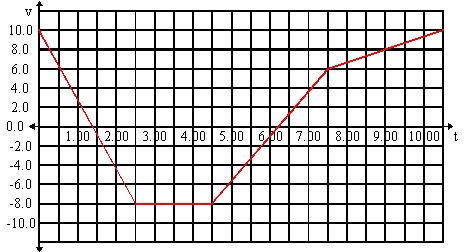
(b) The graph below shows the velocity versus time curve for a
moving block.
(i) At what time(s) is the block turning around?
(ii) What is the displacement of the block between t = 3.00 s and
t = 9.00 s?
(iii) What is the average velocity between t = 4.50 s and t = 7.50
s?
Formulas
Kinematics
 |
 |
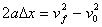
vaverage = ½(vf+v0) |
| Δx = vaveraget |
Δx = v0t + ½at2 |
v = v0 + at |
 |
 |
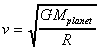
g = 9.81 m/s2 |
Newton's Laws
| ΣFx = max |
ΣFy = may |
fmax static = μsN |
fkinetic = μkN |
 |
 |
 |
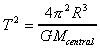 |
| G = 6.672 × 10⁻¹¹ N-m2/kg2 |
Work and Energy
| W = FΔxcos
θ
= FxΔx |
Wnc = ΔK
+ ΔP |
K = ½mv2 |
P = mgh |
Collisions
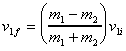
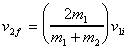
| m1v1f
+ m2v2f =
m1v1i
+ m2v2i |
I = mvf - mvi
= FaverageΔt |
 |
 |
| p = mv |
Coulomb's Law and Electric Fields
 |
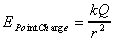 |
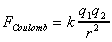
| F = qE |
k = 8.99 × 10⁹ N-m2/C2 |
Electric Circuits
| V = IR |
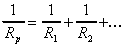
Rseries = R1 + R2 + ... |
 |
| P = IR2 = IV = V/R2 |
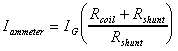 |
Vvoltmeter = IG(Rcoil
+Rmultiplier) |
Magnetic Fields
| F = qvBsinφ |
 |
 |
| F = ILBsinφ |
 |
μ0
= 4π × 102
T-m/A |
Standing Waves
Reflection, Refraction, Mirrors and Lenses
| θincident =
θreflected |
n1sinθ1
= n2sinθ2 |
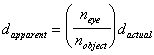 |
f = ½R |
 |
f = + concave mirrors, converging lens
f = - convex mirrors, divergin lens
o = + object on incident side
i = + image on incident side of mirror, on transmission side of lens
i = - image behind mirror, on incident side of lens |
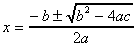
Quadratic Formula
if ax2+bx+c = 0, then
Questions?
mike.coombes@kpu.ca
![[Return to Kwantlen Homepage]](http://www.kpu.ca/images/return_button.gif)